
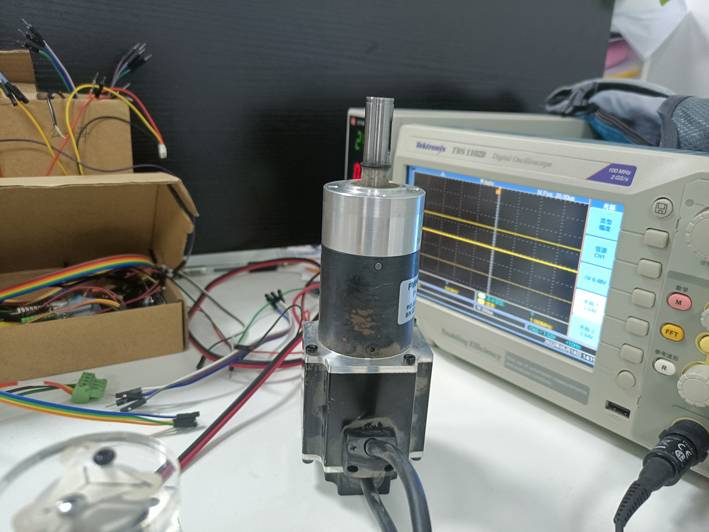
Brushless DC motors (BLDC) integrate Hall sensors and are closed-loop operation based on FOC. In industrial fields involving high current and high power, is there a relatively good motor control solution? It is understood that many industrial-grade motors currently use brushless DC motors, and there are also many methods to control BLDC motors. For convenience and efficiency, does Trinamic also have a fast and efficient solution?
In previous approaches, a certain control card would be used, with self-written or customized algorithms, and then connected to a control chip for use. To control the motor rotation direction and motor rotation position, the BLDC motor uses Hall sensors to record position and then sends the signal to the control chip. In addition to poor accuracy, with support provided by software algorithms, it basically meets all motor control requirements. This solution also has many disadvantages, such as requiring a lot of time in the early stage to study the algorithm, while the control card is large in size and high in cost.
As a global leader in embedded motion control, Trinamic's control solution introduced for BLDC motors adoptsTMC4671+TMC6100, where TMC4671 is an FOC algorithm chip featuring torque control (FOC), speed control, and position control; TMC6100 is a three-phase BLDC pre-driver chip. This solution supports high-power motor motion control and provides a more precise, accurate, and efficient approach. This solution has not been vigorously promoted in China, resulting in only a minority of domestic enterprises currently using it.

With the chip shortage wave arriving, this solution has been recognized by more and more industrial customers, and they are independently designing new boards and developing new software control programs to meet higher-requirement, higher-precision motion control.
If Trinamic's solution is used, how can efficient positioning be achieved? What control approaches will it bring to BLDC motors?
How is the speed of a brushless DC motor with Hall sensors controlled?
Speed is adjusted by adjusting the pulse/direction frequency. We need to set the chip frequency; the normal driver chip frequency is 25 kHz. This precision is clearly sufficient—after all, Hall sensors are not inherently precise, so setting a higher frequency serves no useful purpose.

When speed is adjusted by frequency, the motor can run faster or slower according to the configured pulse/direction setting as the pulse frequency rises or falls.
Precision setting for brushless DC motors
A register must be adjusted. The register defaults to 0, which means pulse/direction is not used. When it is set to 1, one input pulse moves the motor one position; when it is set to 2, two input pulses move it one position.
How are the distance and position of a brushless DC motor controlled during motion?
Hall sensors have essentially no precision to speak of—there are only 6 positions per revolution, so the inherent precision is very low. With an encoder, position values can be sent directly via SPI. The motor's speed, stopping, and position can all be changed by sending values over SPI.
Limitations
Using the TMC4671+TMC6100 solution, absolute encoders are not supported; an MCU is required as an intermediary to output absolute values.
The TMC4671 implements a hardware-based FOC algorithm and can be configured via SPI registers. Although it solves the hardware drive scheme, support from software engineers is still required. In particular, when a project already has an algorithm, that algorithm must be abandoned and a new algorithm developed to meet the requirements of this driver, which imposes a certain workload on software engineers.
Solutions from Trinamic
High precision for improved performance
Small size saves space
Built-in algorithms greatly reduce the workload when designing new projects
Cost control and stable supply of Trinamic chips

Trinamic's control solution for brushless DC motors is bound to become a trend in the future. At present, the TMC4671+TMC6100 solution is widely used in design projects such as electric RC cars, medical equipment, laboratory automation, robots, robotic arms, factory automation, pumps, and blowers. We also hope engineers in this field will give us valuable feedback; we have carefully evaluated and improved the integrated chips. You can use the above evaluation board to carry out improvement and upgrade testing for your project.