
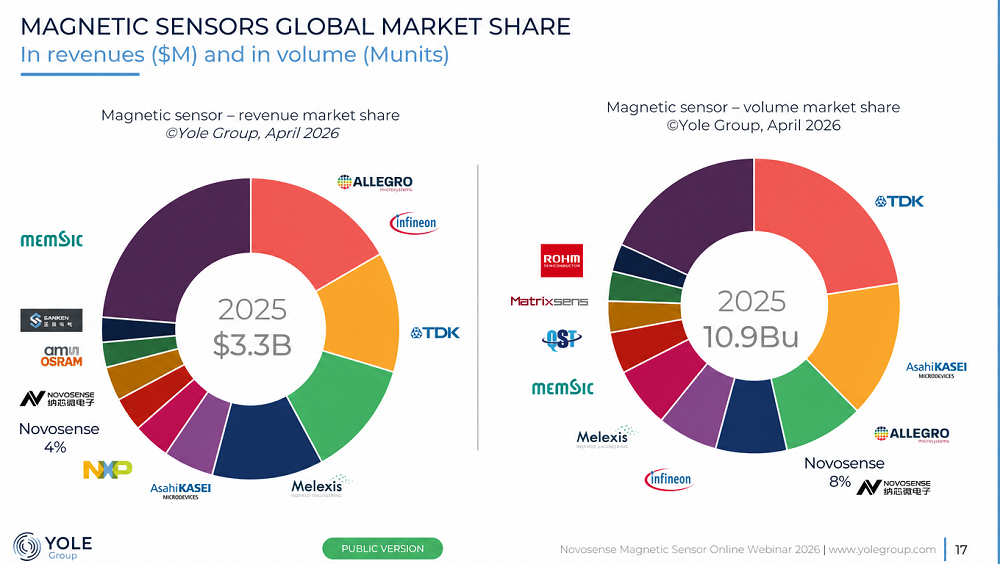
Yole Group presents two rankings in its 'Status of the Magnetic Sensor Industry – 2026 Edition.' By shipments, NOVOSENSE ranks fourth globally, with more than 1 billion units shipped in 2025 alone and over 2 billion cumulative. By revenue, it ranks seventh. In the same market, the same company differs by three places.
This gap is usually interpreted as a familiar weakness of domestic vendors: selling more but not commanding a premium. That interpretation is not wrong, but the same report contains two numbers more worth examining—from 2025 to 2031, global magnetic sensor market revenue CAGR is projected at 4.5%, while shipment CAGR is 4.1%.
Revenue growth is outpacing shipments. The market is not just getting bigger; it is getting more expensive.
Where the money is flowing
The 0.4 percentage point difference between 4.5% and 4.1% is explained by Yole analyst Pierre-Marie Visse as average selling price differences across market segments. In plain terms, the extra money in the coming years will mainly be earned from higher value per unit; the contribution from simply selling more sensors is limited.
The structural reasons are not hard to find. Automotive remains the largest application market for magnetic sensors, and electrification has made current sensors a necessity—traction inverters, OBCs, DC-DC and other power electronics units all need current measurement. Industrial is the second-largest market, with revenue CAGR of about 6%, above the overall market. The emerging demand from humanoid robots should not be underestimated: every joint degree of freedom requires an angle sensor, and power management also requires current sensors. Consumer electronics has large shipments but the lowest unit prices.
So the incremental growth distribution in this market over the next few years is clear: whoever stays at the low-unit-price end will only capture the volume-growth portion, while the value increment lies at the high-unit-price end.
Read in this context, domestic manufacturers are collectively stuck in the same position.
A collective position
Visse's assessment of Chinese manufacturers is fairly direct: they stand out in shipment volume, but their average selling price is relatively low, with a high share of low-priced products such as consumer-grade ones, and there is still considerable room for breakthroughs in higher-ASP, high-value markets such as automotive and industrial.
This is not a problem for one company; it is domestic manufacturers collectively stuck in the same position. The reason is simple: the first categories captured by domestic substitution were those with low certification barriers, price sensitivity, and short decision chains. Moving volume is the easiest capability to prove, so the area that scales up first is naturally this one.
The cost is written on the rankings: high on the shipment-volume list, low on the revenue list. NOVOSENSE's three-place gap between fourth and seventh is a specimen of this structure.
But from another angle—from the perspective of those who use these parts—the shipment-volume table has another reading. A scale of 1 billion units a year means capacity, supply stability, and batch-to-batch consistency have already been validated at large scale: you will not be forced to redesign the board because one part cannot be supplied, nor will you have to repeatedly debug on the production line because of parameter drift between batches. This kind of certainty cannot be obtained from small-batch suppliers, and its value to mass-production projects is not necessarily lower than the unit price on paper.
The problem is that this capability does not translate into a corresponding position on the revenue ranking. What it proves is delivery capability, which is a different matter from whether you can make something others cannot.
Three Hurdles to Cross in Moving Upmarket
Xie Ben, Marketing Director for Magnetic Sensors at NOVOSENSE, breaks the difficulty of moving upmarket into three layers.
The first layer is technology. International vendors have built barriers through their patent portfolios in high-precision magnetic sensor chips and signal-processing algorithms, while domestic vendors still lag in the accumulation of core technologies such as sensing elements, signal conditioning, and temperature compensation, as reflected in metrics including accuracy, stability, consistency, and lifetime.
The second layer is the power to define systems. Leveraging years of deep cooperation with leading customers, international vendors find it easier to participate in the early definition of system architectures and use their first-mover advantage to launch future-oriented products. This layer is harder to win than parameters. If you are not at the definition table, you can only make a replacement part according to specifications written by others—and the pricing power for replacement parts is never in your own hands.
The third layer is trust. Automotive-grade certification cycles are long, customer trust is slow to build, and international giants are already deeply bound to customers. Users remain skeptical of domestic products that lack long-term operating data. Even if the parameters match, entering the supply chain is still difficult; this situation is not uncommon in the automotive-grade field.
In Xie Ben's own words, Chinese vendors' breakthrough in the high-end magnetic sensor market will be a protracted war. Looking at the three layers above, this judgment is well-grounded.
The Multiple-Choice Question of Technology Routes
The magnetic sensor industry has another characteristic: no single technology route can dominate all applications.
Hall is the most mature and offers the best cost-effectiveness, covering large-scale scenarios with mid-to-low precision and cost sensitivity. AMR has relatively low cost and good SNR, but a single-resistor scheme cannot cover 0–360° omnidirectional angle detection, and thermal stability also has certain limitations. GMR is mainly used for automotive wheel-speed detection. TMR has the highest sensitivity; its small chip area helps achieve low power consumption and can also eliminate an additional signal amplification stage. It has already seen large-scale application in consumer electronics and some industrial scenarios. However, its immunity to stray magnetic fields is relatively limited, while automotive-grade applications have extremely stringent requirements for stray-field immunity and need more validation data to support them—this is also why some OEMs are still watching.
These technology routes are not simply substitutes for one another; rather, they complement one another according to accuracy, cost, power consumption, mounting structure, and environmental adaptability. For companies, betting on the wrong route is costly: once they miss a growth window, competitors may pull ahead.
Visse observed that China’s ecosystem is developing fastest along the two routes of TMR and Hall. The fact that some OEMs are taking a wait-and-see approach to TMR may not be a bad thing for domestic manufacturers: waiting means the landscape has not yet solidified, and everyone is still being evaluated from the same starting line.
The Cards in Novosense's Hand
With the above structure clear, looking at Novosense's moves over the past two years makes the logic clear.
The wholly owned acquisition of Maige'en at the end of 2024 was a fast move. During the industry consolidation period, the company needed to fill out the xMR (AMR and TMR) magnetic encoder line; building it from scratch would take three to five years, whereas acquiring it allowed consolidation in the same year. By 2025, Novosense's cumulative magnetic sensor shipments exceeded 2 billion units, with single-year shipments exceeding 1 billion units.
At the platform level, it covers several principles—Hall, xMR (AMR and TMR), inductive, and fluxgate—and is also supported by signal-conditioning ASICs, packaging and integration, and calibration and testing capabilities. This breadth is necessary; as mentioned earlier, a single route cannot cover all scenario requirements.
The several new products released in July this year all fall at the higher unit-price end, and their approach shares one common point: solving problems through structure and algorithms rather than by piling on components.
NSM2025Integrates a U-shaped flux concentrator into the package, converting a vertical magnetic field into a horizontal magnetic field that the chip can detect. It can be used by mounting directly on the main control board, eliminating the need for an external magnetic core. Full-temperature accuracy is about 1.5%, bandwidth is 270 kHz, and typical response is 2 μs. This device’s approach is to drive down cost through integration, taking capabilities honed in the high-volume segment and applying them to mid-to-high-end requirements.
NSM2051Achieves 15 mm creepage distance and clearance, a basic insulation working voltage of 2800 VDC, and isolation ratings of 7500 V withstand isolation voltage, 12 kV maximum surge isolation withstand voltage, and 13 kA maximum surge current. It targets replacing bulky Hall current modules with a compact PCB-mount solution—the latter are through-hole mounted, cannot be SMT-mounted, and are nearly 20 mm tall. As for the volume ramp timing in the targeted 2000 V photovoltaic energy-storage scenario, it depends on how far voltage-platform standardization in the PV and energy-storage industries progresses; it is too early to draw conclusions now. However, the packaging capability to achieve 15 mm creepage distance is transferable, and it corresponds to the very direction of “replacing plug-in modules with surface-mount solutions.”
NSM350xIt is China’s first off-axis single-turn absolute magnetic encoder based on a Hall dual-code-track vernier algorithm. Absolute angular resolution is up to 22 bit, streamlined self-calibration gives typical accuracy of ±0.3°, and constant-speed self-calibration can reach ±0.1°. The motor shaft can pass through the center of the magnetic ring without occupying central-axis space, making it suitable for hollow wiring in robot joints. The market size for humanoid robots is still hard to estimate, but it is certain that every joint needs an angle sensor.
NSM903xAlthough it is a three-axis linear position sensor aimed at consumer electronics and its specifications are not complex, its pedigree is what tells the story—design, calibration, compensation, test, and reliability capabilities all reuse the automotive-grade and industrial platform stack, with cost, power consumption, and size then optimized for the consumer market. The same technology assets are monetized once in the high-end market and again in the consumer market, amortizing R&D costs. This is also the benefit of shipment scale—being able to sustain a platform and then reuse it everywhere.
The hard part lies beyond the parameters.
To judge how far NOVOSENSE has progressed in moving upmarket, wheel-speed sensors are a good window.
Requirements at this tier are among the highest in automotive-grade. Installed in ABS, ESP, and EPS, with one to two per wheel, they must continuously output wheel-speed signals under high temperatures, severe cold, humidity, and electromagnetic interference. If something goes wrong at this position, the consequences are borne by the entire vehicle; historically, this position was long controlled by international vendors.
NOVOSENSE'sNSM41xxThis series is China's first ABS wheel-speed sensor built on AMR technology and compliant with functional-safety requirements. It was developed to ISO 26262 ASIL B(D), supports system integration up to ASIL D, meets AEC-Q100 Grade 0, and has passed more than 30 EMC tests required by leading customers. In terms of performance, compared with a Hall solution using the same magnetic wheel, air-gap capability is 50% higher and jitter performance under large air gaps is 3x better. Together with TÜV Rheinland's ASIL D process certification, the specification hurdle has been cleared.
The harder part comes next: what lies beyond the specifications. Building the product is one thing; whether it can keep entering the mass-production lists of more vehicle models depends on long-term operating data and accumulated customer trust—both can only be earned with time.
Conclusion
4.5% and 4.1%—the market is moving toward the higher-priced end, and that is certain; Yole's data says so.
Novosense has a good card in hand: annual shipments of 1 billion units mean it has a low-cost manufacturing foundation solid enough to support long-cycle investments such as moving upmarket. Having the card is one thing, but cashing it in cannot rely on continuing to chase volume—going from making drop-in alternatives according to datasheets to sitting at the system-definition table requires patent accumulation, customer relationships, and ten years of operating data.
So let's return to the question in the title. In one sentence: Novosense is still on the volume side today, but its moves—from the NSM2025 integration roadmap to the NSM350x's positioning in robot joints—already point toward the higher-price end. Every step forward from seventh place on the revenue ranking depends not just on shipment volume, but on how quickly the share of these high-value categories in the revenue mix can rise. At present, the NSM350x comes with a demo board, programming tools, application videos, programming documentation, and application notes, so customers can complete debugging and self-calibration themselves; the supply-side actions are in place. As for the results, Xie Ben's remark may be the most honest assessment: this is a protracted battle.
For inquiries about Novosense magnetic sensors, please contact: sales@chiplinkstech.com; Mr. Chen, +86 139 2467 5549.

Attachment: Sample Request

WeChat Official Account