
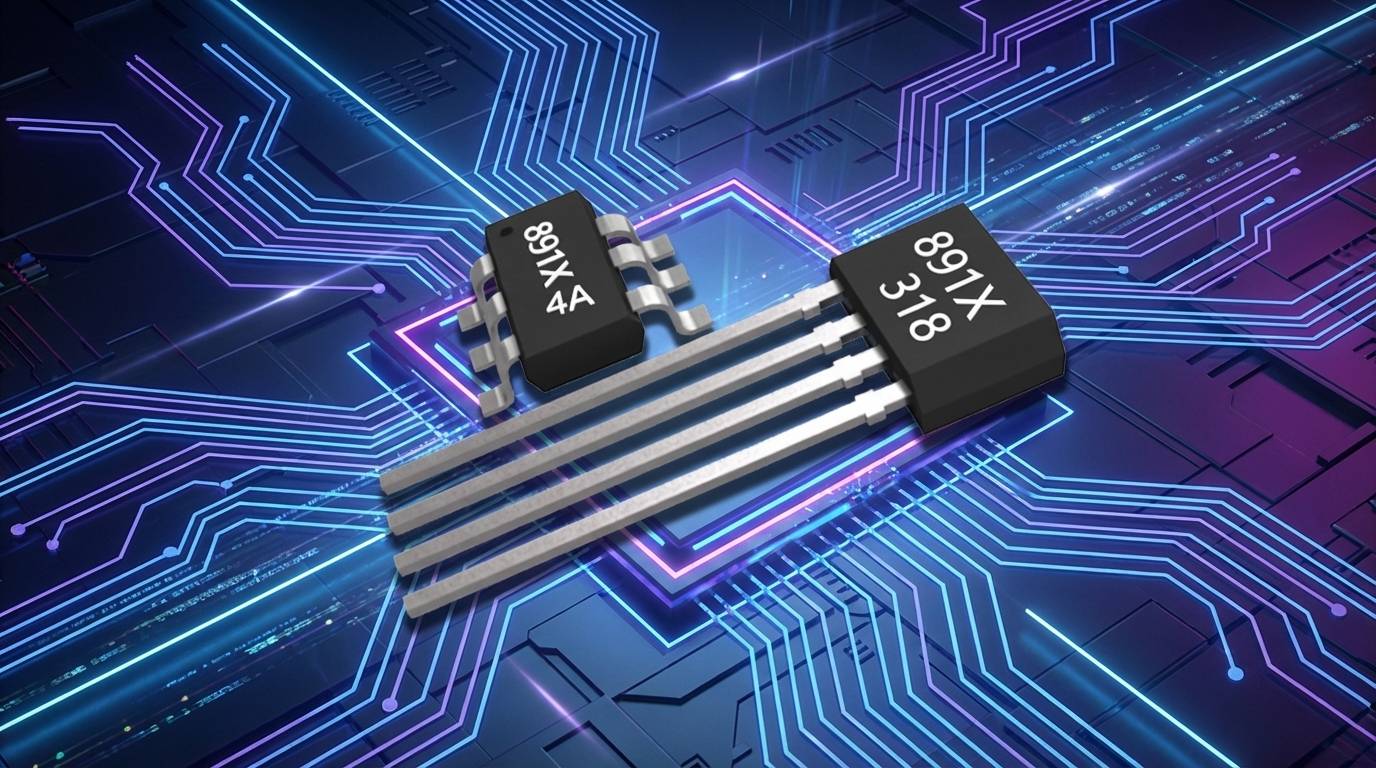
In modern precision control, the demand for motion-state sensing is becoming increasingly complex and layered—window anti-pinch systems must accurately identify motion direction and sudden speed changes, electronic shifters rely on unambiguous position signals, and industrial robotic arms need to correct rotational trajectories in real time. Traditional single-channel sensors struggle to meet the dual requirements of “safety redundancy” and “intelligent control.” The MT8901 dual-output automotive-grade Hall-effect latch launched by Magntek (now part of Novosense), with its SS (dual-speed redundancy) and SD (speed + direction) designs, fills the gap left by traditional solutions and empowers precision motion control systems.

1. Sensing Evolution: From State to Strategy
The intelligence of motion control begins with an upgrade in sensing dimensions. Early Hall-effect switches could only provide on/off signals, while Hall-effect latches added a “latching” feature. However, in complex rotary and linear reciprocating motion, they still lacked “speed continuity” and “direction certainty,” making it difficult to support safety interlocks and trajectory optimization.
This leads to two core requirements: first, the “safety requirement” of never compromising on reliability—for example, in brake-position detection, the signal must be absolutely continuous and failure-proof; second, the “intelligent requirement” of continuously expanding control dimensions—for example, in robot joints, the rotation direction must be known in real time for trajectory correction.
The MT8901 precisely captures this distinction. Through two functional modes, SS (speed + speed) and SD (speed + direction), it turns a single product into a solution platform that can match different design philosophies.

Functional Block Diagram
II. Technical Core: Smart Implementation of Dual Hall Plates
The MT8901 integrates two Hall sensing elements whose spacing is precisely fixed at 1.45 mm, which is the key to its ability to derive two functional modes. The dual Hall plates act like a miniature speed-measurement baseline for a moving object. When a magnet sweeps past, the two plates are triggered in sequence, producing two raw signals with a fixed time difference.
- MT8901-SS (Speed and Speed):The two Hall plates output independent speed signals (SP1 and SP2), with no direction signal. They carry the same speed information and serve as redundant backups for each other. This design is intended to build a safety loop: if one signal fails unexpectedly, the other can ensure that the system still obtains critical speed information, continues safe operation, or enters a preset safe state, making it suitable for high-reliability scenarios.
- MT8901-SD (Speed and Direction):SP1 outputs the speed signal, and DIR outputs the direction signal (synthesized from the two Hall plate signals). Internally, the chip analyzes the phase order of SP1 and SP2 and directly outputs clockwise (CW) or counterclockwise (CCW) direction, so the controller can read it without complex calculations. Speed can be obtained directly from the SP1/SP2 signal frequency, making it suitable for precise trajectory control.
This design, based on the same hardware and achieving functional differentiation through different internal logic, demonstrates extremely high engineering wisdom.
III. Performance Analysis: Automotive-Grade Product
The MT8901 series uses a BCD process—Bipolar + CMOS + DMOS—providing high performance and high reliability: a wide operating temperature range from -40°C to 150°C, together with a wide operating voltage range from 2.7V to 24V, covering all automotive, industrial, and consumer electronics application scenarios; a sampling frequency of up to 100kHz, paired with a 1.2 μs response delay, ensures accurate real-time performance in high-speed motion scenarios; the dual Hall differential design + dynamic offset cancellation system provides a magnetic matching error of ≤±10Gs and a temperature coefficient of -1000ppm/°C, ensuring stable magnetic characteristics across the full temperature range.
The MT890X series features full-chain protection: -30V reverse power supply protection, 30mA output overcurrent protection, and ESD protection (HBM Class H3, CDM Class C3), guarding against electrical interference and installation errors. It also provides customers with flexible package options—surface-mount SOT-23-6L and through-hole flat TO-94—and all packages comply with RoHS.
Key Parameter Table
| Sampling Frequency | 100KHz |
| Operating Voltage | 2.7V~24V |
| Power Consumption | 4.5mA |
| Operating Temperature | -40℃~150℃ |
| Operating Point (BOP) | 25Gs |
| Release point (BRP) | -25Gs |
| Response delay | 1.2us |
| Output format | Speed + Speed (SS) / Direction (SD) |
| Automotive-grade certification | AEC-Q100 |
| Package | SOT-23-6L;Flat TO-94 |

Package view
IV. Additional Details: Self-Diagnostic Function
The MT8901 has a built-in self-diagnostic function. At power-up, it can detect signal path integrity and wiring correctness, preventing system misjudgments caused by device faults or soldering issues, and is a core safeguard for automotive-grade reliability.
Activation conditions:
① When the chip is powered off, the host MCU's I/O pin pulls the SP1 output low;
② The chip is powered up (VDD rise rate > 5 V/μs, ensuring the POR circuit triggers correctly);
③ After power-up, the host releases the SP1 pin, and the timing interval requirements for “power-up complete (tsup)” and “release (trls)” must be satisfied.
Diagnostic process:
① The chip generates a “virtual BOP signal” → SP1 is pulled low (tedge1), simulating magnetic field triggering;
② A “virtual BRP signal” is generated → SP1 is pulled high (tedge2), simulating magnetic field release;
③ The host captures tedge1 and tedge2. If they occur within the specified time window, the diagnosis is successful, and the real data is then output (tedge3).
Scope: SD models detect only SP1, while SS models detect both SP1 and SP2 (the SP2 waveform is synchronized with SP1).
V. Scenario Enablement: From Automotive to Smart Home Appliances
1. Automotive Electronics
- Electronic Gear Shifter: The SD model can accurately output the direction and travel of gear shifts and unambiguously identify shift commands; automotive-grade quality resists in-vehicle voltage fluctuations and high temperatures;
- Power Window Anti-Pinch System: The SD model can monitor speed and direction in real time. If a sudden change in rotational speed caused by an obstruction is detected, it immediately triggers reverse motion, meeting ASIL-B functional safety requirements;
- Brake Position Detection: The SS model features a dual-speed redundant design; if one channel fails, the other channel ensures signal continuity, preventing brake control failure;
- Linear Actuator/Slider: The SD model detects linear motion direction and speed, suitable for linear control scenarios such as seat adjustment and trunk opening.
2. Industrial Automation
- Robot arm joints: The SD type provides direction pulses, laying the foundation for closed-loop trajectory control; its 1.2 μs low latency ensures precise correction of joint motion;
- Conveyor rollers: The SS type provides dual speed monitoring and triggers a shutdown when speed is abnormal, ensuring production line safety;
- High-speed encoders: A 100 kHz sampling frequency supports high speeds of 20,000 rpm, with a lower failure rate than optical encoders.
3. Smart Home Appliances
- Oven knobs: The SD type accurately senses rotation direction and number of steps, enabling fine switching of temperature/mode and providing clear “click” tactile feedback;
- Smart blinds: The SD type can identify the direction of blade rotation and precisely control the amount of light entering;
- Washing machine drums: The SD type can detect drum rotation direction and adapt to different wash modes (such as gentle wash and intensive wash).
VI. Conclusion
Through dual-variant synergy, the MT8901 turns diverse requirements into reliable engineering reality—the SS variant safeguards operational safety in critical scenarios, while the SD variant expands the intelligent boundaries of precision control. From the stringent requirements of automotive electronics to the efficient operation of industrial equipment and the comfortable experience of smart home appliances, the MT8901 dual-output Hall-effect latch—with automotive-grade reliability and dual-mode flexibility—becomes the "core sensing cornerstone" of precision motion control.
For more information about the MT8901 or to request samples, please contact the official authorized distributor: sales@chiplinkstech.com (email); official website: https://www.chiplinkstech.com/. Product selection services and technical support are available.

Attached: Sample Request

WeChat Official Account