

In the world of real-time control MCUs (microcontrollers), Texas Instruments’ (TI) C2000 series is an unavoidable name. For over thirty years, it has been like a master with profound skills, defining standards in high-performance motor control, digital power, and other fields. For countless engineers on the front lines, C2000 is not just a chip; it is a kind of technical inertia, a vast and mature ecosystem, and a set of development methodologies tempered through countless trials. From the classic F2812 to today’s F2837x and F28004x series, the C2000 family genealogy is almost a miniature history of modern power electronics control technology.
This strong market position stems from its outstanding real-time performance, an architecture born for control, and a deep software “moat”—C2000Ware, motorWare, InstaSPIN™ and a series of software libraries and development tools that provide engineers with powerful firepower support. The stickiness of this ecosystem is so strong that during the global “chip shortage” of the past few years, even when C2000 lead times were painfully long, the market’s willingness to seek alternatives was not as strong as expected. Behind this lies engineers’ reverence for system stability and their cautious consideration of the huge R&D investment and unknown risks brought by changing the main control platform.
However, beneath the calm surface of the arena, undercurrents are always moving. Deep reliance on a single supplier, like putting all eggs in one basket, has always been a thorn in system designers’ minds. The closed nature of the ecosystem brings convenience, but it also means the shackles of “vendor lock-in.” The market—especially China’s new energy and industrial automation market, which is in explosive growth—has been waiting for a true challenger. This challenger cannot merely be a “me-too” product in terms of parameters; it also needs to bring architectural innovation, performance beyond the existing, and services and support closer to the local market.
Today, this challenger seems to have arrived. The NSSine™ NS800RT series of real-time control MCUs, jointly created by NOVOSENSE, a leading domestic analog and mixed-signal chip company, and a mysterious team with deep technical heritage—ChipSine—is coming with a full set of “hard skills” to face C2000, the battle-hardened king. This is not just a product showdown, but a head-on collision of technology routes, ecosystem strategies, and even market structure.
A Strong Alliance: NOVOSENSE and ChipSine’s “Core” Covenant
To understand the confidence behind NS800RT, one must first understand the “operators” behind it. This challenge was not launched by a greenhorn just starting out, but by a carefully laid-out strategic alliance.
ChipSine Semiconductor: An 'Avengers' in the MCU Field
ChipSine Semiconductor is not a traditional startup; its core team is truly star-studded. Most members are senior experts from the world's leading semiconductor companies, including Huawei, Renesas, NXP, and even Texas Instruments (TI), which it directly benchmarks against. The founder's achievements are even more remarkable: he once led Huawei's Kirin processor project and led automotive-grade SoC/MCU mass production at a leading domestic automotive chip company. This is a team of 'veterans' with an average of 17 years of industry experience. They not only deeply understand the design essence of real-time control MCUs, but also possess extremely rare domestic practical experience in completing full-chain R&D and mass production of 'automotive-grade, high- and low-voltage, digital-analog mixed-signal core chips.' Their goal is clear: focus on embedded processors dedicated to electronic control in the 'automotive and energy' fields, and commit to providing chip-level system solutions that benchmark international advanced levels on key indicators.
NOVOSENSE's Strategic Move: From 'Analog' to 'Analog-Digital Integration'
As a recognized leading domestic company in sensors, signal chains, and power management, why is NOVOSENSE entering the digital chip MCU battlefield? The founder of NOVOSENSE explained the strategic consideration: 'To provide a complete solution for this industry (PV-storage inverters, new energy vehicle major/minor three-electric systems, industrial automation), MCU is an indispensable part. Without MCU, it is difficult to have in-depth discussions with customers about how next-generation application solutions will evolve. Because all application evolution logic revolves around the main control chip.'
This reveals a profound industry insight: in high-end application fields, the pure 'selling chips' model is no longer sufficient to build core competitiveness; providing 'system-level solutions' is the way to win. And MCU is exactly the brain and commander of this system.
However, NOVOSENSE also clearly recognizes that analog chips and MCUs are 'completely different games' in business model, team background, and ecosystem building. Rather than spending huge manpower and material resources starting from scratch, it is better to 'let professionals do professional things.' Thus, cooperation with ChipSine Semiconductor clicked immediately.
The Birth of NSSine™: 1+1>A Chemical Reaction Greater Than 2
This collaboration is not a simple OEM/private-label arrangement or business outsourcing, but a deep strategic integration. The two parties jointly launched a co-brand—NSSine™ (NOVOSENSE + ChipSine)—symbolizing the combination of two major forces.
In this alliance, the two parties have clearly divided roles and complementary strengths:
- ChipSine Semiconductor contributes its top-tier MCU design DNA, including deep digital and analog design capabilities, a comprehensive application knowledge system, and valuable mass-production experience with automotive-grade MCUs.
- NOVOSENSE provides its strong platform capabilities, including a complete and professional quality and supply chain management system, a culture committed to long-term value and solid financial support, a well-established global sales and technical support network, and secure and reliable “all-domestic” or “all-overseas” supply chain options.
More importantly, NOVOSENSE is not only ChipSine’s partner but also its investor. At the same time, ChipSine has also attracted the favor of industrial investment institutions focused on the energy storage sector, such as Fenghe Capital. This dual endorsement of “industry + capital” has injected strong confidence and momentum into the long-term development of the NSSine™ brand. This is not a speculative market attempt, but a fully prepared campaign that is determined to win.
Head-to-Head: NS800RT5049 vs. TMS320F280049 — Full Specifications Explained
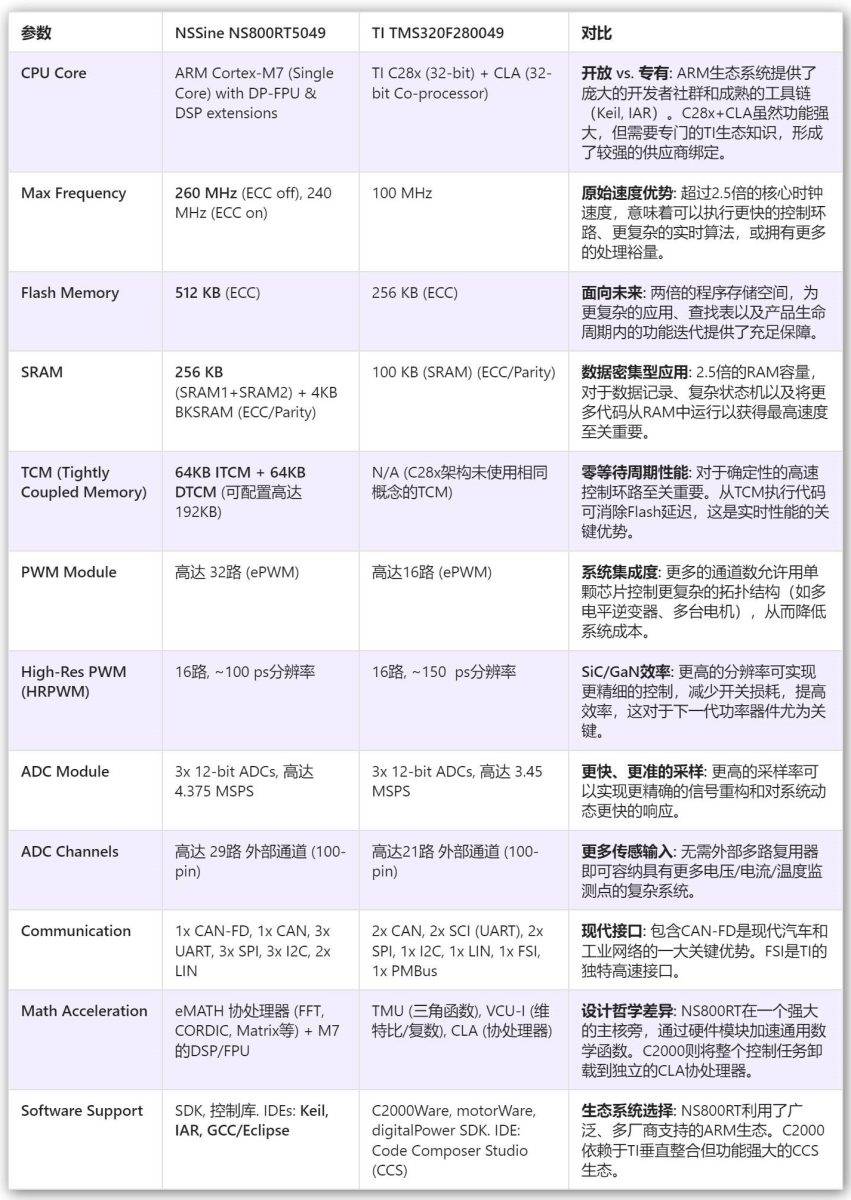
Paper specifications cannot fully define the strengths and weaknesses of an MCU, but they are the most intuitive window into its architecture, performance potential, and technology roadmap choices. Using the flagship models from both sides—NSSine™ NS800RT5049 and TI TMS320F280049—as examples, we will conduct a hardcore specification showdown based on official datasheets.
NS800RT5049 vs. TMS320F280049
Deep dive: The technical battle behind the table
Core architecture: open ARM ecosystem vs. proprietary C28x+CLA
At the heart of this showdown are two completely different design philosophies.
The NS800RT chose the industry's most mainstream and open ARM Cortex-M7 core. This itself is an extremely important strategic decision. It means developers can immediately leverage the world's largest embedded ecosystem, including mature IDE toolchains such as Keil and IAR, a vast array of third-party libraries and middleware, and a huge ARM developer community. Its design philosophy is "
Brute force over finesse": a powerful main core clocked at up to 260 MHz is enough to use its raw performance to directly handle the vast majority of complex control tasks, without relying on coprocessors as often as MCUs with lower clock speeds do. This simplifies the development process and debugging complexity to a certain extent. Its integrated eMATH math accelerator is more like a "turbocharger" for this powerful heart, specifically designed to accelerate common DSP-intensive computations such as FFT, CORDIC, and matrix operations, working in parallel with the main core to further improve computing power.
By contrast, TI's C2000 series adheres to its proprietary C28x core and supplements it with a series of powerful coprocessors, especially the Control Law Accelerator (CLA). The CLA itself is an independent 32-bit floating-point processor that can fully take over a high-speed control loop (such as a current loop) and run in parallel with the main CPU. The advantage of this architecture lies in extreme parallel processing and task offloading, but it also objectively creates a closed technical system. Developers need to learn and adapt to TI's unique development model and toolchain (Code Composer Studio), thereby creating extremely high user stickiness.
For engineers, this presents an important choice: embrace the openness, flexibility, and high-performance main core of the ARM ecosystem, or continue to develop deep expertise within TI's highly optimized proprietary ecosystem? The arrival of NS800RT provides, for the first time, such a compelling option in the high-end real-time control field.
Precision Race: Significance of Picosecond-Level PWM for Next-Generation Power Devices
In motor control and digital power, PWM precision directly determines system efficiency and performance. The HRPWM offered by NS800RT, with up to 100-picosecond (ps) resolution, compared with 150 ps on the TMS320F280049, is a seemingly small difference, but in high-frequency applications using wide-bandgap semiconductor devices such as silicon carbide (SiC) and gallium nitride (GaN), it can deliver a qualitative leap.
Higher resolution enables finer pulse-width adjustment and shorter dead time. This directly brings several key benefits:
- Lower switching losses: More precise control can minimize energy loss during switching, thereby improving the overall efficiency of the inverter or converter.
- Lower output ripple: A smoother voltage output means lower harmonic distortion, which is crucial for improving motor operation smoothness and power quality.
- Increase switching frequency: Under the premise of ensuring control accuracy, the system can operate at a higher switching frequency, thereby using smaller inductors, capacitors, and other passive components, ultimately achieving higher power density and lower system cost.
It can be said that the NS800RT's 100ps HRPWM is precisely the finely crafted saddle prepared for taming 'wild horses' such as SiC/GaN, enabling them to fully unleash their high-frequency and high-efficiency potential.
Memory Architecture: The Decisive Factor for Real-Time Determinism
For real-time control systems, performance is not only about speed but also about 'determinism.' NS800RT has made considerable efforts in this regard, and its memory architecture is a highlight that cannot be ignored. Up to 128KB of tightly coupled memory (64KB ITCM for instructions, 64KB DTCM for data) enables zero-wait-cycle CPU access.
This means engineers can place the most critical, time-sensitive code (such as interrupt service routines (ISRs) and core control algorithms) into TCM for execution. No matter how busy Flash or other bus peripherals are, the execution time of these critical tasks will be fixed and predictable, completely eliminating uncertainty caused by cache misses or bus arbitration. This is crucial for demanding control applications that require microsecond or even nanosecond response. In contrast, traditional Flash- and cache-based execution, although fast on average, cannot guarantee worst-case execution time (WCET). The TCM design of the NS800RT provides a solid hardware foundation for implementing hard real-time systems.
Industrial Sector: Unleashing Performance in Motor Control
Industrial motor control is the 'main battlefield' for real-time MCUs and the touchstone for testing their 'quality.' Modern industrial applications, such as servo drives, robots, and CNC machine tools, place increasingly stringent requirements on controllers.
The performance specifications of the NS800RT are perfectly utilized here:
- Faster control loops: A 260 MHz main frequency and zero-wait-state TCM enable the current loop, speed loop, and position loop in field-oriented control (FOC) algorithms to execute at higher frequencies. Higher loop bandwidth directly translates into faster system response, stronger disturbance rejection, and lower torque ripple, thereby achieving higher-precision motion control.
- More complex control algorithms: The combination of the powerful M7 core DSP instruction set and the eMATH math accelerator provides the compute power to support more advanced control algorithms. For example, in sensorless FOC applications, complex sliding mode observers (SMO) or extended Kalman filters (EKF) must be run to estimate rotor position and speed, and these algorithms are computationally intensive. The compute headroom of the NS800RT allows algorithms that previously might have required a dedicated DSP to now run efficiently on a single MCU, thereby reducing system cost and complexity.
- More comprehensive system integration: Industrial automation systems often need to handle multiple signals and interfaces. The NS800RT provides rich control peripherals, such as up to 2 eQEP modules for connecting quadrature encoders to achieve high-precision position feedback, 8 SDFM channels for connecting sigma-delta modulators to achieve high-precision isolated current sensing, and a CAN-FD interface for high-speed communication with higher-level industrial networks. These highly integrated peripherals enable it to easily address the design challenges of complex robots and multi-axis servo drive systems.
Other tracks: Progress in domestic substitution for photovoltaics, energy storage, and automotive electronics
In addition to industrial control, the powerful performance of the NS800RT also gives it strong competitiveness in two emerging tracks: “pan-energy” and automotive electronics. Demand for high-performance, high-reliability MCUs in these fields is growing at an unprecedented rate, also providing excellent entry opportunities for domestic MCUs.
- PV Inverters and Energy Storage Systems (ESS): The core of these applications is high-efficiency power conversion. The NS800RT has up to 32 PWM outputs, which can flexibly drive complex multilevel inverter topologies to reduce harmonics and improve efficiency. Its high-speed ADC and powerful math capabilities can support more advanced maximum power point tracking (MPPT) algorithms, thereby maximizing photovoltaic power generation. In its datasheet application list, solar and energy-storage inverters are explicitly listed as core application areas.
- Automotive Electronics:
- On-Board Chargers (OBC) and DC/DC Converters: These are essentially high-power digital power supplies. The NS800RT’s high-resolution PWM, fast ADC, and powerful computing capability are key to implementing advanced topologies such as totem-pole PFC, thereby improving charging efficiency and power density.
- Powertrain: In applications with extremely high safety and reliability requirements, such as main traction inverters, the NS800RT is also ready. From the outset of design, this product series fully considered functional safety requirements, targets ISO 26262 ASIL B certification, and offers automotive-grade models compliant with AEC-Q100 Grade 1. This is the “entry ticket” to the core automotive control field.
Currently, the industrial-grade MCUs in the NSSine™ series have officially entered mass production, while certification of the automotive-grade version is also underway and is expected to be introduced to the market soon. NOVOSENSE itself has deep experience in the automotive field, and its various chips have already been mass-produced by mainstream automakers. This provides strong trust endorsement and channel advantages for its MCU products to enter the automotive supply chain.
Conclusion: Not just a replacement, but the beginning of surpassing
Returning to the original question: Can the NSSine™ NS800RT shake TI C2000's dominant position?
From the perspective of pure technology and product strength, the NS800RT series is already more than a "replacement." It demonstrates the ability to match or even exceed C2000 products at the same level across multiple dimensions such as core performance, memory architecture, and peripheral precision. It represents a more modern and more open design philosophy, choosing to embrace ARM, the world's largest embedded ecosystem, and providing developers with another high-performance option beyond TI's proprietary system.
Behind this strong alliance is the grand narrative of the development of China's semiconductor industry. As Wang Shengyang, CEO of NOVOSENSE, said: "Today, China has become the R&D and innovation source for many applications. As a local chip company, we are closer to this source." In fields such as new energy and industrial automation, the Chinese market itself is the source of innovation, and local chip companies have the opportunity to collaborate more closely with downstream customers to jointly define and develop products that lead the future.
The launch of the NSSine™ NS800RT is powerful proof of this trend. It presents Chinese engineers striving in the field of real-time control with a new, highly capable "weapon." Its emergence signals that the dominance of a single player in the high-end real-time control MCU market will be broken, and a new era of more diversified and more vibrant competition is beginning. This may not be a simple battle of replacement, but the beginning of surpassing.