
Introduction
On August 26, NOVOSENSE officially launched the NSUC1800 — an ultrasonic radar probe chip (Slave) compatible with the standard DSI3 protocol, providing more accurate and reliable sensing capabilities for intelligent driving scenarios such as UPA, APA, and AVP. The chip has passed functional safety and automotive-grade certifications, helping domestic ultrasonic radar systems accelerate mass production deployment.

With the rapid development of intelligent assisted driving technology, vehicles' demand for environmental perception is increasing. Especially in low-speed parking scenarios, drivers face multiple challenges such as numerous blind spots, high precision requirements, and complex environments; parking remains a “pain point” for many drivers. Among various sensing solutions, ultrasonic radar, with its cost advantages, high technological maturity, and strong environmental adaptability, has become an indispensable technical solution for short-range sensing.
Moreover, the domestic ultrasonic radar market is currently in a stage of rapid development. According to market research data, the installation volume of ultrasonic radars in Chinese passenger cars reached 121.955 million units in 2023, a year-on-year increase of 13.7%. It is projected to exceed 140 million units in 2025 and is expected to exceed 220 million units by 2028. Facing this huge market demand, NOVOSENSE has made a precise layout and launched the ultrasonic radar probe chip NSUC1800. With its fully domestic design concept and excellent performance, it is becoming a key force in breaking foreign technological monopolies and improving supply chain security.
I. Core Product Highlights
Fully Domestic Supply Chain and Protocol Compatibility:
NSUC1800 achieves full-chain localization from chip design, wafer manufacturing, testing, and packaging, fundamentally ensuring stable production capacity and controllable costs. Compared with imported products, a fully domestic supply chain can bring shorter delivery cycles and more stable supply assurance, providing automakers with a more cost-effective option. It helps customers balance delivery efficiency and cost control when selecting Slave and Master devices, building a more resilient domestic supply chain. In terms of protocol compatibility, NSUC1800 is fully compatible with the DSI3 bus, helping to realize system solutions for cross-brand interoperability between master and slave devices. This compatibility ensures that the chip can seamlessly interface with mainstream master controllers, greatly reducing system integration difficulty and development costs, shortening verification cycles, and accelerating project introduction.
High-performance encoding and detection capabilities:
NSUC1800's arbitrarily configurable frequency-point encoding method can support multiple Chirp and FSK+Chirp schemes, significantly enhancing scanning speed and anti-interference capability, and can complete a bumper scan within two cycles. In terms of ranging performance, hardware gain settings combined with an optimized NFD algorithm accurately identify near-distance events, compressing the near-field blind zone to within 10 cm; the chip's receive path features 18-bit resolution and low noise, supporting long-range detection extended to 6–7 m and providing reliable data support for low-speed AEB.

NSUC1800 encoding scheme
Automotive-grade reliability and integration:
NSUC1800 has passed AEC-Q100 automotive-grade certification and ISO 26262 ASIL B functional safety certification, fully meeting the stringent requirements of automotive scenarios. The chip's operating temperature range covers -40°C to 150°C, enabling it to adapt to various extreme automotive environments such as high temperature, low temperature, and humidity changes. It also features multiple voltage, overcurrent, and overtemperature diagnostic functions, further ensuring safe and reliable system operation.
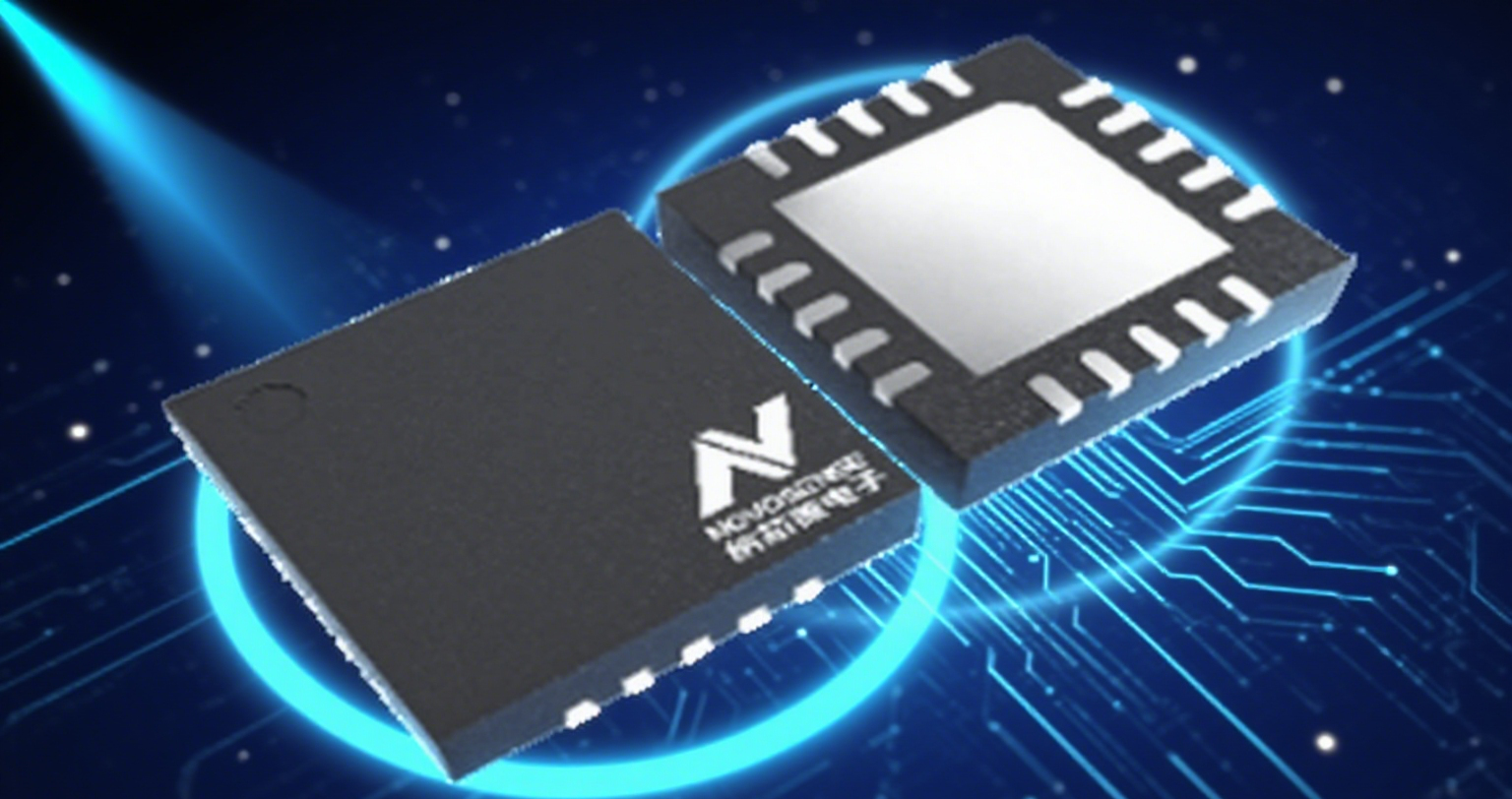
In terms of packaging and integrated design, it uses a small QFN20 (4mm×4mm) package, integrating an MCU Cortex-M3 core and multiple types of memory within a limited space. The MCU runs at up to 44MHz and provides up to 32kB NVM and 10kB on-chip SRAM, offering ample scalability for algorithms such as data compression. This highly integrated design can effectively reduce PCB area and the number of peripheral components, further lowering system BOM cost and significantly improving system reliability and production efficiency.

QFN20(4mm×4mm)
II. Application Scenarios and Market Prospects
Application scenarios:
The NSUC1800 is suitable for all three ultrasonic radar application scenarios.
- UPAIn (assisted parking) systems: The chip's small blind-zone feature ensures accurate short-range detection, helping the driver avoid low obstacles.
- APAIn (automatic parking) systems:Multi-chip collaboration enables precise parking space recognition and path planning, improving the success rate of automatic parking.
- AVPIn (valet parking) systems:The 6–7 m long-range detection capability supports low-speed AEB, ensuring safety during unmanned parking.
Currently, mainstream vehicle models' ultrasonic radar configurations have increased from 8 units to 12 units, with some high-end models reaching even 16 units. Taking mid-size SUVs as an example, the 12-sensor solution has become standard. Mass production of the NSUC1800 will provide automakers with a reliable domestic solution that meets the configuration requirements of different vehicle classes.

All 12 ultrasonic sensors in the vehicle can be equipped with the NSUC1800.
Market Outlook:
As L2+ advanced driver assistance systems (ADAS) accelerate adoption in mid- to high-end and mass-market vehicles, the penetration rate of ultrasonic radar in low-speed scenarios such as parking is rising rapidly. In 2023, the installation rate of ultrasonic radar in new vehicles in China reached 85%, and it is expected to exceed 90% by 2025.
Notably, new energy vehicles, with their higher level of intelligence, have stronger demand for ultrasonic radar—the average installed quantity is 2–3 units more than that of traditional fuel vehicles. Combined with the wave of automotive intelligence and growth in new energy vehicle sales, market demand for ultrasonic radar will continue to expand, and the NSUC1800 has broad market application prospects.
III. Domestic Substitution and Supply Chain Value
Backed by NOVOSENSE's technical strength, ensuring both product and supply chain reliability:
NOVOSENSE Microelectronics has always focused on the R&D of high-performance analog and mixed-signal chips and has accumulated deep technical expertise in three major areas: sensors, signal chain, and power management. In the field of ultrasonic radar chips, NOVOSENSE has fully leveraged its technical advantages in sensors and signal processing, migrating years of accumulated Hall sensor technology and isolation chip technology into its ultrasonic products, achieving cross-domain technological innovation and coordinated development.
At the same time, NOVOSENSE has established a comprehensive automotive-grade quality system: its product development process complies with ISO 26262, its production process is IATF 16949 certified, and it has AEC-Q100 certification testing capabilities, ensuring product reliability and consistency throughout the entire process from R&D to production. This technical strength and quality control capability not only give the NSUC1800 excellent performance but also provide stable supply chain assurance, laying the foundation for the large-scale application of domestically produced ultrasonic radar chips.
Advancing domestic substitution and strengthening an autonomous, controllable industrial chain:
The launch of the NSUC1800 is a concrete manifestation of the advancement of China's chip technology—domestic chip manufacturers have moved from technological catch-up to leading in some performance aspects, breaking the technological monopoly of foreign manufacturers in this field. As such domestic chips enter mass production and application, China's intelligent driving industrial chain will further reduce its dependence on imported chips, enhance the autonomy and controllability of its supply chain, drive the wave of domestic substitution forward, and inject 'domestic chip momentum' into the high-quality development of the industry.
IV. Summary and Outlook
The successful development and mass production of NOVOSENSE's NSUC1800 ultrasonic radar chip represent another important breakthrough in China's automotive chip field. Today, domestic chips can provide strong 'chip' support for intelligent driving systems through excellent performance, reliable quality, and cost advantages.
Looking ahead, with the rapid development of electronic technology and intelligent driving technology, demand in the automotive chip market will continue to grow. Domestic chip manufacturers will also continue to deepen their work in core technologies, continuously iterate product performance, and launch more innovative solutions—not only in the ultrasonic radar field but also in multiple segments such as sensors, processors, and power management—achieving breakthroughs and innovations, injecting more domestic 'chip' strength into fields such as intelligent vehicles, industrial automation, and consumer electronics, and driving China's semiconductor industry to a higher level.
For more technical details and application cases regarding domestic-substitution chips, please contact: Shenzhen Zhilian Microelectronics Co., Ltd.sales@chiplinkstech.comWe are an officially authorized chip distributor of NOVOSENSE and look forward to working with you.