
In variable frequency drives, inverters, and power management systems, current sensing is an unavoidable core function. Motors need to know the present current to achieve precise torque control; power supplies need to monitor current to implement overcurrent protection; and energy storage systems need to measure current to calculate battery state of charge.
Among traditional current-sensing solutions, the shunt resistor plus isolated amplifier approach offers high accuracy but faces challenges from common-mode interference and signal delay; current transformers are simple and reliable but cannot measure DC components and have limited bandwidth; discrete Hall-effect solutions rely on additional magnetic cores and complex assembly, making it difficult to balance system consistency and integration.
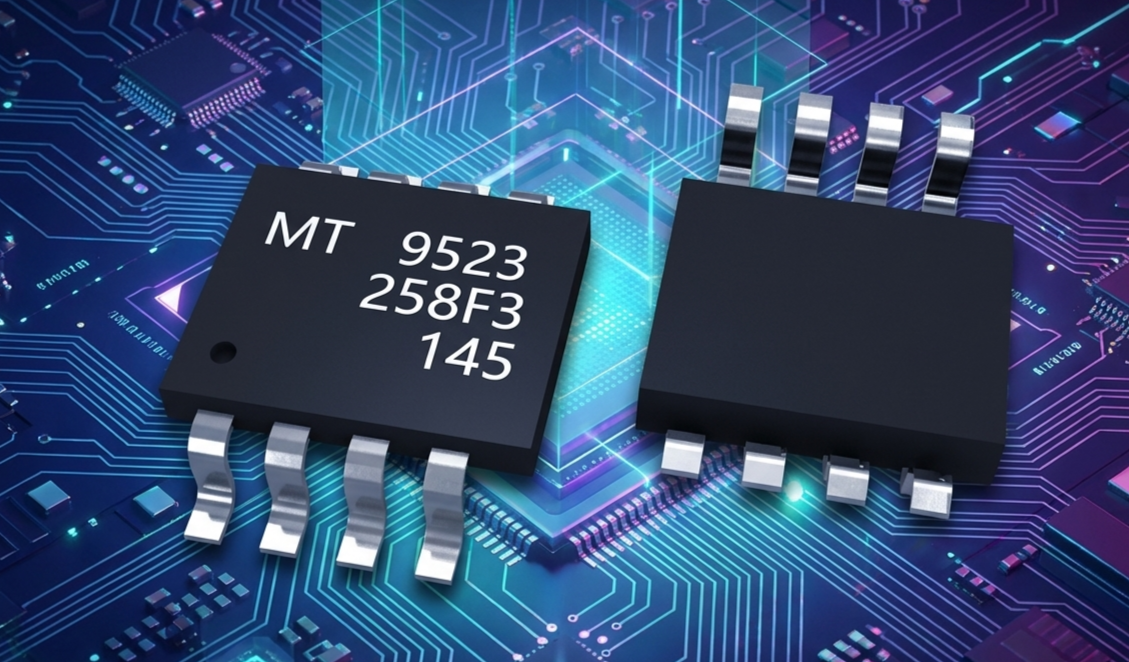
The MT9523 series products (hereinafter referred to as MT9523), as the new-generation fully integrated isolated linear Hall-effect current sensor IC launched by MagnTek (now part of NOVOSENSE) after the MT9223 series, integrate the entire current-sensing chain. With an ultra-simple architecture, they achieve high-precision, high-immunity, and highly reliable AC/DC current sensing, meeting the power electronics system design requirements in industrial, communications, and new energy fields.

1. Simplifying the Complex
In the MT9523 datasheet, a distinctive internal block diagram can be seen: from pins 1 and 2 to pins 3 and 4, there is a low-resistance current path running directly through the chip.

Functional Block Diagram
The internal core of the MT9523 consists of a low-offset chopper-stabilized linear Hall circuit built with a CMOS Hall chip, a current conductor path with low insertion resistance, and signal conditioning and temperature compensation units. Based on the Hall effect principle, it linearly converts the magnetic field generated by the current flowing through the chip into a voltage output signal proportional to the input current.
In conventional solutions, engineers need to design the layout of the current-sense resistor, consider routing for Kelvin connections, and handle power and signal isolation for the isolation amplifier. In the MT9523 solution, the current under test flows directly through the chip, and the Hall sensing element is integrated directly above this current path. This integrated design brings multiple benefits:
First, parasitic parameters are minimized: because the current path and sensing circuit have already been optimized inside the chip, there is no need to worry about extra inductance and resistance introduced by PCB routing, significantly improving system stability and consistency.
Second, space occupation is reduced: a single SOP-8 package can perform all functions of isolated current sensing. Compared with discrete solutions, the PCB area can be greatly reduced.
At the same time, the design cycle is shortened: matching and debugging between the sensing circuit and isolation amplifier are eliminated, and design implementation can be completed simply by referring to the recommended circuit.
II. Low-Impedance Philosophy
In power electronic systems, there is an often-overlooked specification in current sensing: insertion loss. Every component connected in series in the power path generates power dissipation, which is ultimately converted into heat and reduces system efficiency.
The internal conductor resistance of the MT9523 is typically 1.0 mΩ, enabling low power consumption. At a rated current of 50 A, the power dissipation generated by the chip itself is only 2.5 W. With a conventional shunt resistor solution, even if a high-cost precision alloy resistor is selected, it is difficult to achieve a resistance below 1 mΩ while maintaining sufficient power capacity and temperature drift characteristics.
At the same time, the heat generated by the low resistance of the MT9523 is evenly distributed inside the chip and conducted to the PCB through multiple pins of the SOP-8 package, resulting in a short thermal path and low thermal resistance. In contrast, high-power shunt resistors often require additional heat sinks or forced air cooling, further increasing system complexity and cost.
III. Differential Dual Hall
Power electronic systems themselves are huge sources of electromagnetic interference. The high-frequency switching of IGBTs produces steep dv/dt and electromagnetic fields radiated by power loops, while current sensors must operate accurately in precisely this harsh environment.
MT9523 addresses this challenge by adopting differential current sensing technology. The chip integrates two Hall elements that respond in opposite directions to the magnetic field generated by the current under measurement, but in the same direction to common-mode interfering magnetic fields in the environment. Through differential summing, the chip can effectively cancel stray magnetic field interference and accurately extract the valid current signal. The typical common-mode magnetic field rejection ratio (CMFRR) reaches 40 dB, optimizing the magnetic signal-to-noise ratio.
This design is of great significance in practical applications. In motor drive systems, stray magnetic fields generated by adjacent power lines can reach tens of gauss, enough to cause significant errors in ordinary Hall sensors. The MT9523 can maintain ±0.3% linearity amid these interferences.
IV. High-Speed Response and Full-Temperature Stability
The core of modern power electronic control systems lies in “real time.” Whether it is the current loop in motor control or the fast response of digital power supplies, the current sensing stage is required to have sufficient bandwidth and response speed.
The MT9523 has a typical response time of 2.2 μs and a signal bandwidth of 250 kHz. In a motor drive with a 20 kHz switching frequency, one switching period is 50 μs. A 2.2 μs response time means that the current sensing stage occupies only 4.4% of the switching period, leaving the controller ample time for sampling, calculation, and PWM updates. At the same time, faster response also allows a higher control bandwidth, thereby improving the dynamic performance of the system.
Different electronic devices face different operating environments. The MT9523's operating temperature range covers -40°C to 150°C. Its chopper-stabilization technology eliminates the zero-point offset caused by temperature drift of the Hall element, and each chip undergoes multi-temperature-point calibration and optimization with a built-in temperature compensation circuit, keeping the temperature drift of the chip's midpoint voltage and sensitivity within a very small error range. Its typical linearity over the full temperature range remains within ±0.3%, which is crucial for applications requiring accuracy over a wide temperature range, such as electric vehicle drive systems or outdoor photovoltaic inverters.
V. Flexible Outputs, Multiple Ranges
Different application scenarios have different preferences for the output form of the current-sensing signal. Some systems use traditional ratiometric output, relating the sensed signal to the supply voltage; others prefer fixed output to simplify the ADC reference design. The MT9523 offers a rich set of product configurations. While supporting 3.3 V/5 V supply, it provides two different output modes—ratiometric output and fixed output—with the supply and output types freely combinable.
Different power levels require different current-sensing ranges. For example, a 5 A servo drive and a 50 A inverter have completely different range requirements for current sensors. The MT9523's flexible output, together with its built-in current path, can easily implement 0 A to ±50 A current-sensing applications. Engineers can choose the most suitable model based on actual power requirements:
- Bidirectional: ±5 A, ±10 A, ±15 A, ±20 A, ±25 A, ±30 A, ±40 A, ±50 A;
- Unidirectional: +10 A, +20 A, +30 A.
The sensitivity of the MT9523 versions with different ranges is inversely proportional to the range. For example, the MT9523CT-05BR5 (±5 A) has a sensitivity of 400 mV/A, while the MT9523CT-50BR5 (±50 A) has a sensitivity of 40 mV/A. This design makes the output voltage range at full scale basically consistent across versions with different ranges, simplifying the design of downstream circuits.
VI. Safety Design
In industrial applications, current sensors often serve as the isolation barrier between high and low voltage. A sensor's isolation capability is directly related to the safety of the low-voltage control side.
The MT9523 is UL-ready for relevant safety certifications and provides 2.5 kVrms/1 min isolation withstand voltage, with a maximum working isolation voltage of up to 450 Vrms/636 VDC. Its conductive-path terminals (pins 1 to 4) are electrically isolated from the signal lines (pins 5 to 8), allowing direct use for high-side current sensing without additional isolation techniques. In addition, its 4.2 mm electrical clearance and creepage distance meet reinforced insulation requirements, withstand 6 kV lightning surge impulses, and provide sufficient protection for the low-voltage side under fault conditions.
In addition, the MT9523 integrates undervoltage lockout (UVLO) and power-on reset (POR) functions, which keep the output state controllable when the supply voltage is abnormal and prevent system faults caused by false detection. These parameters and functions not only ensure safe operation under normal conditions but also provide sufficient protection under fault conditions.
VII. Application Landscape
The MT9523's application areas cover the main arenas of modern power electronics:
Low- and medium-power inverters are one of its core applications, with motor phase current sensing and bus current monitoring as typical use cases. The MT9523's 250 kHz bandwidth and 2.2 µs response time fully meet this requirement, while its ±0.3% linearity ensures precise torque control.
PV inverters and energy storage systems are another important arena. With the growing adoption of renewable energy, distributed energy resources impose new requirements on current sensing: high isolation voltage, low power consumption, and high reliability. The MT9523's UL-ready design and low insertion loss precisely meet these needs.
The charger and power converter field is likewise applicable. Whether for on-board chargers or telecom power supplies, accurate current sensing is a prerequisite for efficient power conversion and reliable protection.
Overcurrent protection for DC power supplies is a relatively simple but equally important application. The fast response of the MT9523 enables it to trigger protection action within microseconds after a fault occurs, effectively limiting fault energy and protecting downstream circuits.
VIII. Conclusion
In traditional current sensing solutions, engineers need to pay attention to too many details: the temperature coefficient of the shunt resistor, the common-mode rejection ratio of the isolation amplifier, parasitic parameters of the PCB layout, noise coupling in the signal chain... Each detail can become a "roadblock" to system accuracy.
The MT9523 encapsulates these complexities inside the chip. Engineers only need to focus on a few core questions: What range should be selected? Is 3.3 V or 5 V power required? Ratio output or fixed output? The remaining work is to connect the power and output pins according to the recommended circuit in the datasheet.
This "simplified thinking" allows engineers to devote more energy to system design innovation rather than repeatedly solving basic problems that already have mature solutions. For more information about the MT9523 series products or to request samples, please contact the official authorized distributor: sales@chiplinkstech.com (email), WeChat Official Account: Zhilianwei - Motor Control Chips, providing product selection services and technical support.

Appendix: Sample Request

WeChat Official Account