
I. Introduction to Brushless DC Motors
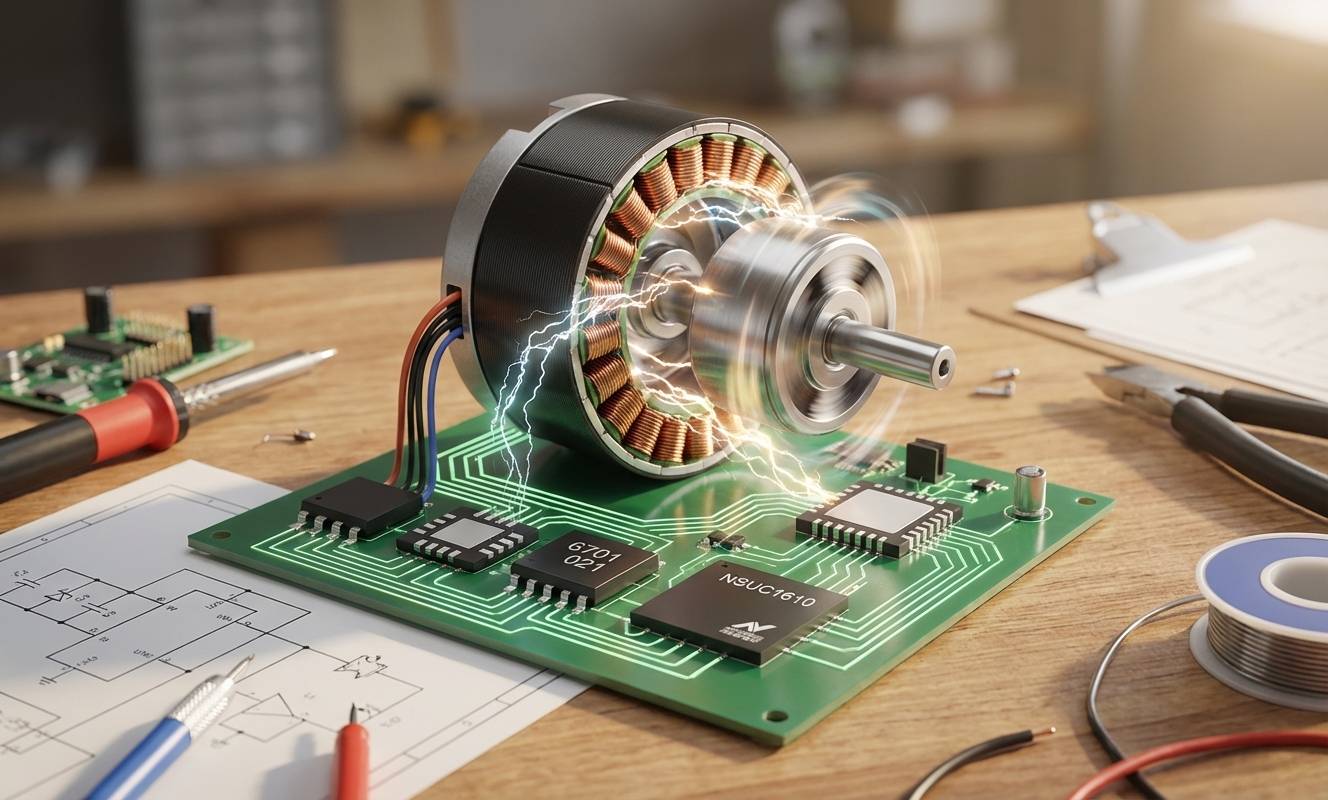
A brushless DC motor (BLDC) is a widely used electric motor with stable performance and an important drive component in many fields. It combines the excellent speed-regulation performance of conventional DC motors with the high structural reliability of AC motors. It eliminates the conventional carbon-brush and slip-ring structure and uses electronic circuits for contactless commutation. It can operate at low speed and high power and offers advantages such as small size, light weight, high stability, high efficiency, long life, low noise, and excellent speed-torque characteristics. It is widely used in automotive, industrial automation, home appliances, and many other industries.

(AI-generated image, for reference only)
II. Solution Introduction
(1) Core Hardware Composition and Key Parameters
1Single-Controller Solution: NOVOSENSE NSUC1610

The NSUC1610 is a dedicated motor control chip with four integrated half-bridge drivers. It can directly drive a BLDC motor without an additional driver, effectively reducing cost. Its key configuration and performance parameters are as follows:
- Control modes: The NSUC1610 supports both sensored (e.g., Hall sensor) and sensorless BLDC control, providing strong adaptability and flexibility.
- Core and memory: It features an ARM Cortex-M3 32-bit core and is equipped with 64 KB Flash, 4 KB SRAM, and 512 B EEPROM, meeting the program storage and data processing requirements of motor control.
- Clocking and voltage: It supports a 32 MHz high-precision oscillator (ensuring control accuracy) and a 35 kHz low-power low-speed clock (suitable for low-power scenarios); operating voltage ranges include BVDD—5 V to 18 V (main power supply), DVDD—1.62 V to 1.98 V (digital power supply; cannot be supplied externally), and AVDD—4.5 V to 5.5 V (analog power supply; output current <25 mA), adapting to various power supply scenarios.
- Peripherals and communications: Includes one 12-bit high-precision ADC and three fast back-EMF (BEMF) comparators; integrates a LIN PHY module and supports 2 communication protocols; provides four half-bridge outputs with typical high-side/low-side on-resistance of 0.5 Ω, continuous output current of 1 A (RMS), and peak current of 1.8 A, meeting motor drive requirements.
2Paired sensor solution: NOVOSENSE MT6701 Hall sensor

With NOVOSENSE's MT6701 Hall sensor, the NSUC1610 can achieve higher-precision motor control. Its key features are as follows:
- Sensing technology: Based on the differential horizontal Hall magnetic sensing principle, it supports full-range 0° to 360° angle detection with angle accuracy of <±1°, enabling precise identification of the motor rotor position.
- Output Interfaces: Rich interface configuration, including I²C, SSI, ABZ, UVW, analog/PWM, and Z-axis button functions, allowing flexible adaptation to different data transmission requirements.
- Performance Specifications: Supports speeds up to 55,000 RPM; output propagation delay is only 5 μs for fast response; typical operating current is 14 mA, VHBM=±6kV、VCDM= ±1 kV, with strong anti-interference capability.
(II) Solution Control Characteristics and Performance
1Control Advantages
- The back-EMF comparator (BEMFC) has good symmetry at different speeds, improving motor operating efficiency and reducing heat losses; combined with the MT6701's 5 μs low-latency angle output, it enables real-time closed-loop control.
- Supports closed-loop control over a wide speed range and can also achieve position control based on Hall signals or the output signals of the integrated BEMFC module, with outstanding control accuracy and stability.
- The NSUC1610's 12-bit high-precision ADC (1 μs conversion time) can quickly acquire phase voltage and phase current signals; together with the chip's built-in overvoltage, undervoltage, and thermal shutdown protection, it further improves solution reliability.
2No-load waveform characteristics
Under no-load conditions, the phase voltage and phase current waveforms of the motor remain stable and symmetrical across different speed ranges (5000 RPM, 10000 RPM, 15000 RPM, and 20000 RPM). The phase voltage scale is 5 V/div, the phase current scale is 500 mA/div, and the time base is adapted according to speed (5 ms/div or 2 ms/div), demonstrating excellent operational consistency and electrical stability.

(III) Motor Back-to-Back Test Results
1Test Conditions
The control board drive duty cycle is set to 100%, and motor torque is gradually increased to measure the correlation curves of torque versus phase voltage, current, efficiency, power, and speed.

2Key Test Conclusions
- Speed-torque relationship: As torque increases, motor speed shows a downward trend (e.g., 9 mN·m corresponds to 22000 RPM, 1.7 mN·m corresponds to 8800 RPM, etc.), and the torque-speed curve has good linearity.
- Efficiency comparison: The domestic Novosns solution has a peak efficiency of 75%, and the Maxon solution has a peak efficiency of 76%; the two have similar efficiency performance and are at the same high-efficiency level.
- Electrical parameter characteristics: During the experiment, the phase voltage and phase current showed a steady upward trend as torque increased, with no obvious fluctuations, verifying the electrical stability of the solution under different loads.
III. Core Product Introduction
(I) NSUC1610 Controller
The NSUC1610 is a highly integrated dedicated motor control processor chip from NOVOSENSE. It is particularly suitable for low-power motor drive and can drive brushed DC motors, brushless DC motors, stepper motors, and other motor types, and is widely used in the automotive field. Core features are supplemented as follows:
- Compliant with the AEC-Q100 automotive electronics standard, with a maximum junction temperature of up to 175°C and an operating temperature range of -40°C to 150°C, adapting to extreme operating conditions.
- Integrated overvoltage protection (wide voltage tolerance on the LIN port and BVDD pin), undervoltage detection (BVDD undervoltage threshold programmable in 4 levels), and thermal shutdown protection (TSD); I/O ports support 5 V tolerance, ensuring high reliability.
- The core is a Cortex-M3 based on the ARM instruction set, using a Harvard architecture with independent data and address buses, improving the efficiency of transmitting address and data signals.
- Physical characteristics: QFN32 (5×5 mm) package; the exposed pad must be soldered to the PCB to ensure heat dissipation; 32 pins, I/O output current ±4 mA, MOUT pin continuous current 1 A and peak 8 A, meeting low-power motor drive requirements.
(2) MT6701 Hall Sensor
The MT6701 is a new-generation angular position sensor IC launched by MagnTek (now part of Novosense), based on the differential horizontal Hall magnetic sensing principle. The chip integrates two pairs of differential Hall Wheatstone bridges placed at 90° to each other, senses the Z-axis magnetic field component of a magnet rotating in the chip's X-Y plane, and outputs two sinusoidal voltage signals as the magnetic field angle α changes. After amplification, compensation, and calculation by subsequent dedicated circuits, the angle value α is obtained. It has excellent immunity to stray magnetic field interference.
- Provides an incremental ABZ output interface to replace traditional optical encoders; the maximum incremental output resolution is 1024 pulses per revolution (4096 steps per revolution), programmable.
- Provides incremental UVW signals to replace Hall switches for commutation; 1 to 16 pole pairs programmable.
- Equipped with a standard I²C or SSI interface, supports reading 14-bit absolute angle data; I²C timing is compatible with the standard protocol, and SSI supports CRC checking.
- Single-wire PWM or analog output, providing absolute angle data with 12-bit resolution.
- The PUSH pin supports contactless press detection; sensitivity and response time can be configured through registers, expanding human-machine interaction scenarios.
- Internally integrates EEPROM, with a programming voltage of 5 V to 5.5 V, and supports repeated erasing and writing of parameters multiple times.
MT6701 Parameter Table
| Magnetic Sensing Principle | Differential Hall |
| Operating Voltage (V) | 3.3 to 5 (typical) |
| Operating Temperature (°C) | -40~125 |
| Absolute Angle Resolution | 14-bit |
| PWM Output | 12-bit |
| Digital Interface | I²C,SSI |
| ABZ Output | 1–1024 pulses/revolution; 1–4096 steps/revolution |
| UVW Output | 1–16 pole pairs, programmable |
| Angle Accuracy | <±1° |
| Package | SOP-8;QFN3x3-16L |
For more information about domestic motor solutions or to request samples, contact the official authorized distributor: sales@chiplinkstech.com (email); WeChat Official Account: Zhilian Micro - Motor Control Chips, which provides product selection services and technical support.

Sample Request Attached

WeChat Official Account