
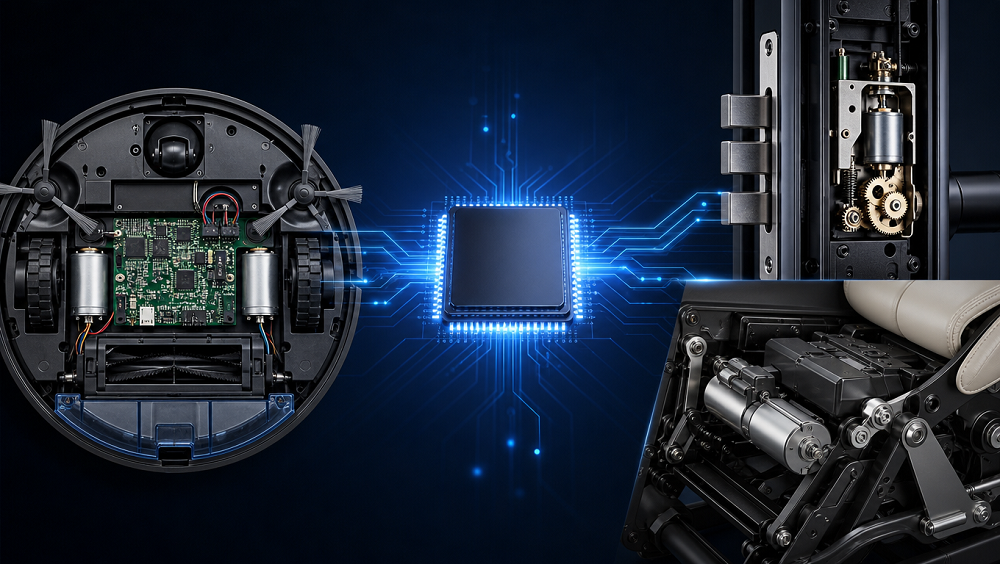
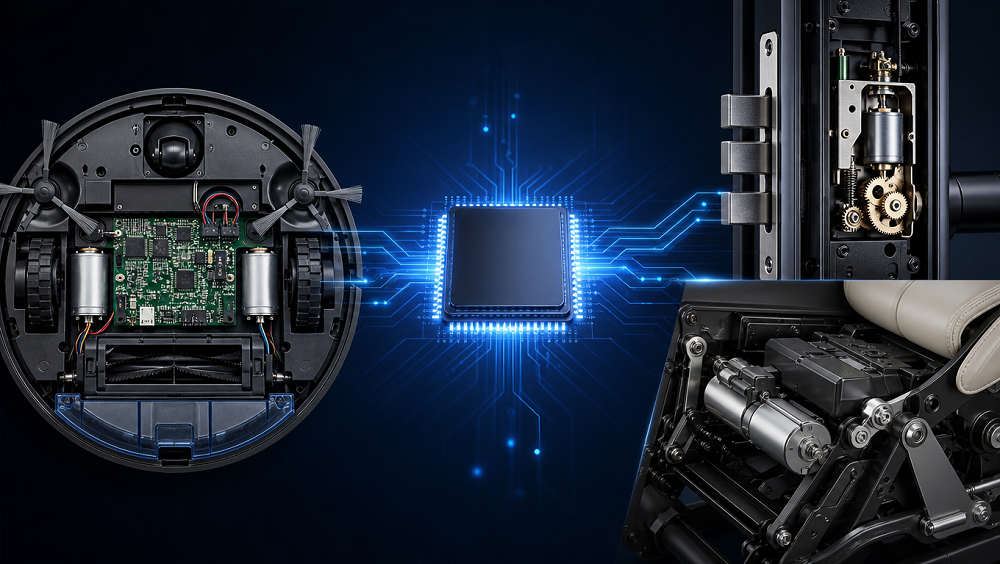
Indoors, after a robot vacuum finishes cleaning the last room, it turns around, slows down, and aligns itself with the charging dock; outside the door, the instant a thumb presses on the fingerprint sensor, the latch bolt retracts into the lock body with a click; on the sofa, the massage chair's mechanism travels along the guide rail from the shoulders and neck all the way to the lower back, and the kneading heads begin to apply force.
These three things seem completely unrelated, but at their core they are all about “motion”—drive wheels turning, latch bolts extending and retracting, the mechanism traveling, and the kneading heads operating. Beneath all mechanical motion lies the same combination: a motor plus a chip that drives it. The motor converts electrical energy into power, while the chip precisely manages start/stop timing, speed, output force, and the response strategy when resistance is encountered. These chips hide in inconspicuous corners of the machines: under the robot vacuum's chassis, deep inside the lock body, and within the massage chair's backrest.
Robot Vacuums: Multi-Motor Coordination in a Tight Chassis
Open the chassis of a robot vacuum and you can see four or five motors “crowded” together: one for each of the left and right drive wheels, one for the central main brush, and one or two side-brush motors attached at the sides; in mid-to-high-end models, the LiDAR rotating platform, the dust-collection dock fan, and the mop-lifting mechanism each also take one motor. They are powered by the same lithium battery, and the main controller must coordinate the start/stop, speed, and direction of all motors at the same time.
This scenario imposes four stringent tests on driver chips:
The first is low-voltage droop tolerance.Mainstream robot vacuums fall into two voltage platforms: entry-level models mostly use 7.4 V (2S) lithium batteries, about 8.4 V fully charged, and down to 5.5–6 V at the end of deep discharge; mid-to-high-end high-suction models mostly use 14.4 V (4S) lithium batteries, about 16.8 V fully charged, and about 11–12 V at the end of discharge. The chip's minimum operating voltage determines whether the device can fully use the remaining battery capacity.
Second is extremely low standby power consumption.After cleaning is complete and the vacuum automatically returns to its dock, the whole unit may sit idle for several days. The driver chip's sleep current must be reduced to the microamp or even nanoamp level—for every additional 1 mA of sleep current, the unit's standby time will be visibly shortened.
Third is the current surge during startup and stall.At the instant the robot vacuum's wheels go from standstill to rotation, the current is several times the rated value; when the wheels are tangled in a charging cable or caught on the edge of a carpet, the motor stalls but the current keeps rising. Without hardware current-limiting protection, both the motor and the driver transistors will burn out.
Fourth is space constraints.The interior of the chassis is packed with the battery, air duct, and sensors, and the space left for the driver circuit is usually only the size of a fingernail.
What can satisfy all these requirements at the same time is a low-voltage, small-package, single-channel or dual-channel H-bridge driver with complete hardware protection. Different voltage platforms and different load levels correspond to different solutions.
- 7.4 V low-voltage platform:For light-load side brush motors, the following can be selected: SS8833T Dual-channel H-bridge driver: operating voltage 2.7 V to 15 V, perfectly covering the full discharge range of low-voltage batteries; a single chip integrates two independent H-bridges, with a maximum load current of 1.0 A per channel, exactly matching the light-load conditions of the left and right side brushes; one chip drives two motors, saving PCB area and wiring; optional QFN 3×3 ultra-small package, built-in undervoltage lockout, overcurrent protection, and overtemperature protection, sleep current 1 μA, suitable for long standby requirements. For discrete single motors (LiDAR, mop lift), the SS8837T single-channel driver can be used: 0–12 V voltage range, 1.8 A peak output; DFN 2×2 ultra-small package, 120 nA ultra-low sleep current consumption.
- 14.4 V battery operating platform:For medium-power core drives such as drive wheels and main brushes, the following can be selected: SS8870T Single-channel H-bridge driver, supporting 8.5 V to 40 V input; the 40 V voltage rating can handle back-EMF spikes from motor stall and commutation. Its peak current is 3.6 A, it uses an ESOP8 package, on-resistance is 520 mΩ, and it has a low-power sleep mode; built-in undervoltage lockout, overcurrent protection, and overtemperature protection, with automatic recovery after fault removal; it also supports PWM speed regulation and current regulation, adapting to different cleaning modes. For high-power load requirements such as high-suction fans and high-torque main brushes, the following can be selected: SS6548D Single-channel H-bridge driver: operating voltage 6.5 V to 40 V; continuous current 7 A, peak 16 A, capable of supporting high-power loads; typical on-resistance only 45 mΩ, low heat generation at high current, and no thermal throttling during long periods of continuous cleaning; DFN 5×5 small package, built-in full suite of overcurrent, overtemperature, and undervoltage protections, supports automatic fault recovery.
Fingerprint lock: instantaneous current surge within one second
Fingerprint recognition only completes identity verification; the actual door-opening action is performed by the clutch motor inside the lock body. Within the few hundred milliseconds after fingerprint verification passes, the motor must quickly push the clutch into engagement and drive the latch bolt to retract. The entire action is extremely short, and the core requirement is instantaneous high torque.
The challenges in this scenario are mostly concentrated on reliability under extreme operating conditions:
First is the startup current surge.At the instant the motor goes from standstill to rotation, the current can reach several times the rated value. The current rating of the driver transistor must have sufficient margin for the peak value.
Second is the risk of locked-rotor failure.Door frame deformation, lock body jamming, or the handle being held against something—the motor cannot turn, but the current will not stop. Without reliable current-limiting protection, both the motor and the driving MOSFETs will burn out. This is also one of the most common causes of repair returns for fingerprint lock products.
Third is the ultra-long standby requirement.Smart door locks are battery-powered and remain in standby for more than 99% of the day, operating only briefly at the moment of opening. The driver chip's sleep current must be kept extremely low, and after wake-up it must immediately enter the operating state.
A single-channel H-bridge is the standard answer for this position. The previously mentioned SS8837T is one typical example: it provides single-channel output with 1.8 A drive capability, matching the current magnitude of clutch and latch motors with margin; sleep current is in the microamp range, so standby is not a burden; overcurrent, overtemperature, and undervoltage protection are all implemented inside the chip, so when the lock body jams, hardware responds before software and prevents burnout.
If the lock type has top and bottom hooks and is a fully automatic heavy-duty structure, the peak current at the moment of unlocking must go up another level, so you can switch to SS6285M (7 A peak)or SS6286L (15 A peak)。
The core requirement for fingerprint-lock driver chips is not functional redundancy but ultimate reliability.
Massage Chair: A Half-Hour Continuous Full-Load Endurance Race
A massage chair has more motors than the previous two combined: mechanism travel motor, kneading motor, tapping motor, plus calf lift, backrest actuator, and air pump. Among them, the kneading and tapping motors mostly use 24V DC brushed motors, with power of tens of watts; a single massage program runs for at least thirty minutes.
This is exactly the opposite of a fingerprint lock: the lock has to handle a momentary impact,A massage chair is tested for continuous stability under high current over long periods, and the core issue is temperature rise. Every increase in on-resistance adds to chip heating, and the whole machine must pay the cost in heat sinks and airflow channels. Therefore, in this scenario, on-resistance and thermal resistance parameters deserve more attention than peak current.
In addition, there are three key points:
First, “voltage withstand safety margin.”In the 24V systems commonly used by massage chairs (some high-end models use 36V), during motor commutation and stall transients, voltage spikes generated by inductive freewheeling or energy regeneration can significantly raise the bus voltage. If the chip’s voltage rating is insufficient, it will break down directly; a withstand voltage of at least 40V or more is required to leave a safety margin.
Second, still “all-scenario stall protection.”The movement mechanism may get stuck on foreign objects while traveling along the guide rail, and the backrest can jam when pushed to its limit position, so overcurrent protection is essential.
Third is “noise control.”The user is less than one meter from the motor, and sudden changes in drive current can turn into audible “clicking” sounds; the smoothness of current control directly affects the user experience.
Different motors in a massage chair place different requirements on the driver chip, so they also need to be considered separately:
- Kneading motors and tapping motors:These two types of motors are the “main force” of the massage chair, driving the massage balls to perform kneading and tapping actions, with power typically ranging from tens of watts to over a hundred watts. Their requirements are high current, high voltage withstand, and low on-resistance. Take the high-current driver chip mentioned earlier SS6548D as an example: its operating voltage is 6.5 V to 40 V, continuous current is 8 A with a peak of 16 A, and typical on-resistance is only 45 mΩ. It generates less heat at high currents, which significantly helps with temperature-rise control during half an hour of continuous operation; the chip has built-in overcurrent protection, overtemperature protection, and undervoltage lockout, and can self-recover after a fault.
- Travel motor:The travel motor drives the movement core up and down along the guide rail and needs to position at specific locations such as the shoulder/neck and waist. Most solutions use a stepper motor with a lead screw for precise positioning and require dual-channel H-bridge drive with microstepping control for smooth operation. Take SS6841P as an example: operating voltage is 8.2 V–47 V, maximum withstand voltage 52 V; each H-bridge can deliver a maximum peak current of 3.2 A and an RMS current of 2.1 A (at 24 V and 25°C with adequate heat dissipation); it supports bipolar stepper motors in full-step, 2-microstep, and 4-microstep operation, optimizing the drive waveform and reducing operating noise. If the travel mechanism uses a DC motor plus encoder solution, a single-channel H-bridge chip is sufficient.
Domestic Alternatives Hidden in the Long Tail
Robot vacuums, fingerprint locks, and massage chairs are consumer products with low unit prices and low chip content per unit. But zoom out: China is the world's largest producer of robot vacuums, smart door locks, and massage chairs; together, these 'long tail' markets add up to demand for hundreds of millions of chips.
At the system level, IDC data shows that in the first three quarters of 2025, global smart robot vacuum shipments totaled 17.424 million units, up 18.7% year on year. Roborock, Ecovacs, Dreame, Xiaomi, and Narwal took the top five global shipment positions, together accounting for more than 70% share. For smart door locks, AVC aggregate data shows that in 2025 China's smart door lock retail sales across all channels reached 19.51 million sets, with retail value of RMB 21.2 billion; despite a slight decline in volume, mid- and high-end products drove a 'volume down, value up' result. Massage chairs present a different growth picture: China is the world's largest massage chair production base, but household penetration in China is far lower than in Japan and South Korea, leaving substantial room for growth.
At the chip level, motor drive and control chips have long been dominated by international vendors such as Texas Instruments, STMicroelectronics, Infineon, and Microchip. Domestic vendors are entering through low-voltage, small-package, cost-sensitive home appliance and consumer scenarios, accelerating penetration and gradually replacing incumbents. The growth of domestic motion control chips is emerging bit by bit from such niche gaps, but higher-integration BLDC brushless motor driver chips remain an important direction for future breakthroughs by domestic vendors.
The localization of complete machines has been repeatedly confirmed by the market and data, while those chips hidden under the chassis, inside the lock body, and in the backrest are still on their way to becoming 'mainstream.' They are concealed in the machines, quietly finishing the job in the 0.3 seconds after you press your fingerprint or the moment the movement core reaches your lower back. The next time a robot vacuum cleans, a fingerprint lock releases its clutch, or a massage chair's movement core slowly descends, one of the domestic chips may be quietly working within the smart service you enjoy.
For more domestic motor control chip solutions, please contact: sales@chiplinkstech.com; Mr. Chen, 13924675549.

Attach Sample Request

WeChat Official Account