
Here’s what happened. A couple of days ago, a customer doing servo drives came to ask us, saying that the lead time for the UCC21520 on their BOM had been extended again, from 8 weeks to 40 weeks. Coincidentally, NOVOSENSE launched its automotive-grade reinforced isolated half-bridge gate driver chip, the NSI6602Ux series, not long ago.
Perhaps many engineers working on power supplies, motor drives, and PV inverters still perceive domestic isolated gate drivers as merely “usable or not.” But in fact, for the NSI6602Ux, many parameters are already stronger than those of TI’s products at the same tier. Based on official data from both companies, let’s get straight to the key points.
1. Replacement Cross-Reference Table
If you are currently using the following TI parts in your BOM, you can directly check the corresponding NSI6602Ux part.
The NSI6602Ux is a dual-channel isolated gate driver product family. It has multiple sub-models depending on package and function, covering TI’s mainstream part numbers at this tier.
| TI Part Number | Alternative Models | Package Compatibility | Remarks |
| UCC21520/UCC21520-Q1 | NSI6602Ux | DWK-14 compatible | Preferred replacement in the same segment |
| UCC21550/UCC21550-Q1 | NSI6602Ux | DWK-14 compatible | Upgraded model benchmark |
| UCC21530/UCC21530-Q1 | NSI6602Ux | DWK-14 compatible | Functional Safety Benchmarking |
Compare the NSI6602Ux with three core TI competitors.
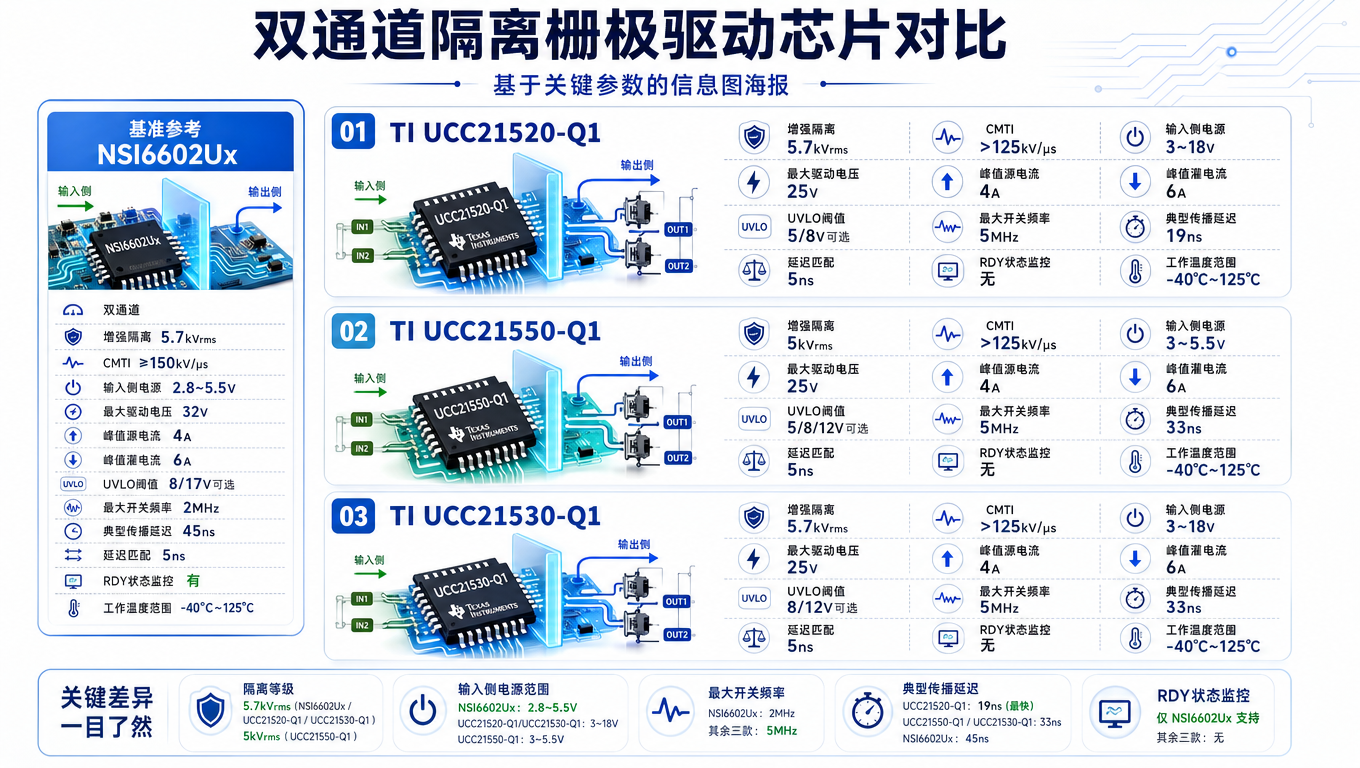
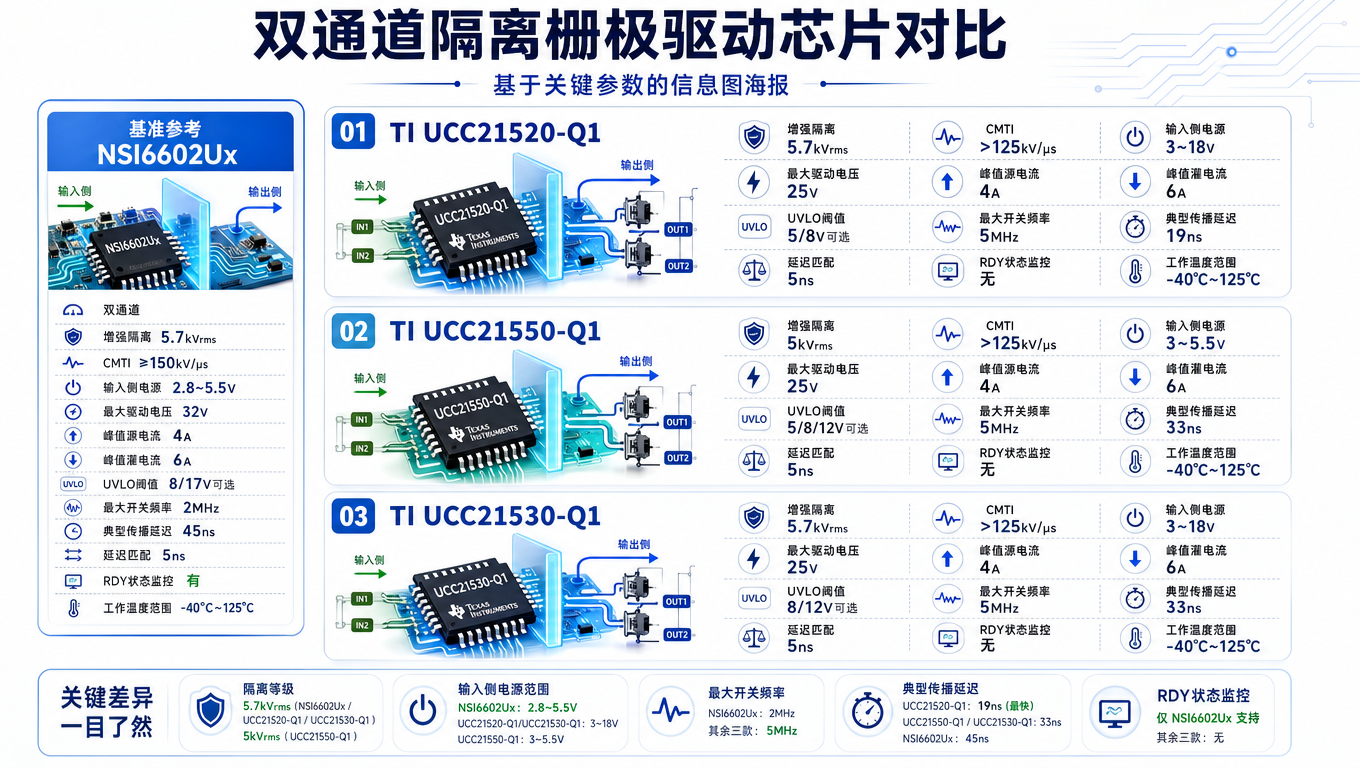
| Parameter | NSI6602Ux | TI UCC21520-Q1 | TI UCC21550-Q1 | TI UCC21530-Q1 |
| Number of Channels | Dual-Channel | Dual-Channel | Dual-Channel | Dual-Channel |
| Isolation Rating | Reinforced, 5.7 kVrms | Reinforced, 5.7 kVrms | Reinforced, 5 kVrms | Reinforced, 5.7 kVrms |
| CMTI | ≥150kV/μs | >125kV/μs | >125kV/μs | >125kV/μs |
| Input-Side Supply | 2.8~5.5V | 3~18V | 3~5.5V | 3~18V |
| Maximum Drive Voltage | 32V | 25V | 25V | 25V |
| Peak Source Current | 4A | 4A | 4A | 4A |
| Peak sink current | 6A | 6A | 6A | 6A |
| UVLOThreshold | 8/17VOptional | 5/8VOptional | 5/8/12VOptional | 8/12VOptional |
| Maximum switching frequency | 2Mz | 5Mz | 5Mz | 5Mz |
| Typical propagation delay | 45ns | 19ns | 33ns | 33ns |
| Delay Matching | 5ns | 5ns | 5ns | 5ns |
| RDYStatus Monitoring | Yes | No | No | No |
| Operating Temperature Range | -40°C~125°C | -40°C~125°C | -40°C~125°C | -40°C~125°C |
After reading this table, I believe most engineers already have a clear idea.
II. Let's break down a few key advantages
1CMTI 150 vs 125: this is not a numbers game
CMTI, or common-mode transient immunity, is basically an isolated gate driver's ability to avoid being disrupted by noise during high-speed switching and severe voltage swings. The higher the number, the more robust it is.
The NSI6602Ux guarantees a minimum CMTI of 150 kV/μs (typically up to 200 kV/μs). Compared with 125 kV/μs for TI products, a 20% advantage means greater noise margin in engineering terms.
In SiC and GaN applications, this margin is especially critical. These third-generation semiconductors are inherently suited to high-speed switching, and dv/dt often goes above 100 kV/μs. If an isolated driver's CMTI is too close to the system dv/dt, unit-to-unit variation in mass production may cause problems in certain batches. The extra 25 kV/μs is extra peace of mind.
2Drive voltage up to 32 V provides design margin
The UCC21530 maxes out at 25 V, while the NSI6602Ux goes all the way to 32 V. What practical benefit does the extra 7 V bring? For IGBT gate drive, you can choose a more relaxed operating point within the standard 12 V to 18 V range. Especially in high-power motor drives and PV inverters, once the IGBT Miller capacitance comes into play, the drive voltage must hold up. The 32 V upper limit gives power supply design a wider degree of freedom.
3RDY status monitoring: a small feature that helps a lot
This feature is completely absent on many TI products. The RDY pin can tell you whether the driver chip is operating normally. It sounds like a minor feature, but during mass-production troubleshooting, this pin can narrow down problem localization from "suspect everything" to "this particular part just didn't come up." Engineers who have been through mass production should understand the value of this feature.
It is worth mentioning that, apart from RDY status monitoring, the other integrated functions of the NSI6602Ux are almost exactly the same as those of TI products in the same class—programmable dead time (DT pin), enable logic (DIS/EN), and IN+/IN- input interlock to prevent shoot-through—everything you would expect is there. In other words, RDY is an extra, not something obtained in exchange for something else; switching over will not cost you any function you are already used to.
4Cost, without beating around the bush
Cost has always been an advantage of domestic products. Compared with TI products, the NSI6602Ux reduces BOM cost by roughly 30% to 40%. In products like photovoltaic inverters, where a single BOM contains dozens of gate drivers, this amounts to saving hundreds of thousands per month.
III. Shortcomings must be made clear; part selection requires attention
1. Propagation delay is a clear weakness
As can be seen from the parameter comparison, the NSI6602Ux does fall short of TI on one metric—its typical propagation delay is 45 ns, which is 26 ns higher than the 19 ns of the UCC21520-Q1 and 12 ns higher than the 33 ns of the UCC21550-Q1 and UCC21530-Q1.
Propagation delay directly limits the upper bound of switching frequency. The NSI6602Ux supports a maximum switching frequency of 2 MHz, while TI products can be pushed to 5 MHz—a fairly large gap.
What does this mean? If you are designing a hard-switching power supply at the hundreds-of-kHz level, such as servo drives (10 kHz), photovoltaic inverters (20 kHz), or charging pile modules (50–200 kHz), 19 ns versus 45 ns is basically imperceptible, and 2 MHz headroom is more than sufficient. But if you are designing a MHz-level high-frequency GaN LLC or phase-shifted full bridge, where dead-time control is at the nanosecond level, then this difference needs to be carefully evaluated—TI's 5 MHz is indeed an advantage in this scenario.
As for the NSI6602Ux itself, in the vast majority of medium- and high-frequency IGBT and SiC applications, the 45 ns and 2 MHz will not become a bottleneck.
2. The input-side voltage range is relatively narrow
The input side of the NSI6602Ux only supports the standard 2.8 V–5.5 V logic level and is compatible with 3.3 V/5 V controllers; some TI products support a wide 3 V–18 V input (UCC21550/-Q1: 3 V–5.5 V) and can directly interface with 12 V controller levels. If your design uses a 12 V input, you need to add an extra level-shifting circuit.
4. One-Sentence Selection Summary
1. Short version:
In the vast majority of conventional scenarios—servo, inverter, OBC, charging pile, UPS—the NSI6602Ux can be used as a direct replacement; most parameters are better, the price is 30%–40% lower, lead times are stable, and it is worth spending time to build an evaluation board for verification. In a few extreme scenarios—MHz-level high-frequency GaN, special voltage logic—there is nothing wrong with sticking with TI. The key is to figure out exactly which TI features your project actually uses. If the NSI6602Ux has all those features, then don't overthink it.
2. Detailed version:
1. Scenarios where NSI6602Ux is the preferred replacement:
- Lead-time and cost optimization for mass-production projects that currently use UCC21520/UCC21530/UCC21550.
- Automotive OBC, DC-DC, thermal management, industrial servo, PV inverters, EV charging stations, and other medium/high-frequency scenarios using SiC/IGBT. NSI6602Ux has passed AEC-Q100 automotive qualification and can be used in automotive applications.
- Projects with higher requirements for safety margins, noise immunity, and mass-production troubleshooting efficiency. The combination of 5.7 kVrms reinforced isolation, ≥150 kV/μs CMTI, and RDY status monitoring is unique among products in the same class.
- High-volume mass-production projects that are sensitive to supply chain stability and cost. The delivery certainty of the domestic supply chain plus a 30%–40% price advantage directly translates into financial-statement cost savings in scenarios such as PV inverters and OBCs, where a single BOM uses dozens of units.
2. Scenarios not recommended for replacement:
- Ultra-high-frequency GaN power supplies with switching frequencies above 1 MHz and topologies with extreme propagation-delay requirements. NSI6602Ux supports up to 2 MHz, but TI can go up to 5 MHz and has lower delay (19 ns/33 ns vs. 45 ns). In scenarios such as GaN high-frequency LLC and phase-shifted full bridge that require nanosecond-level dead-time control, TI has a clear hard advantage.
- Special designs requiring 12 V input logic levels and 5 V/12 V UVLO thresholds. TI's wide-input models and more UVLO options still have advantages in these special designs.
- Operating conditions involving long-term operation in extreme environments above 125°C. The operating temperature ranges of the NSI6602Ux and TI’s products in the same class are both -40°C to 125°C. The TI UCC21550 has a junction temperature of up to 150°C, which provides some thermal margin, but the upper ambient operating temperature limit is the same. If a system operates long-term above 125°C ambient temperature, neither is suitable, and higher temperature grade products should be considered.
5. Conclusion
Honestly, the pace of progress of domestic chips in recent years has already changed many people's stereotypes. Products like NOVOSENSE's NSI6602Ux are no longer positioned as mere replacements; they have surpassed in the dimensions where they excel (CMTI, driving voltage, integrated functions, and cost).
Domestic substitution doesn't need impassioned slogans. The specs are here, the price is here, and the lead time is here. Engineers will vote with their multimeters and oscilloscopes. If you find this article useful, you can follow our account; we will continue to update more domestic chip selection guides and measured data.
Appendix: NSI6602Ux Series Selection Table

For more product information or to request samples, please contact the official authorized distributor: sales@chiplinkstech.com; 13924675549 Engineer Chen;WeChat Official Account: Zhilianwei - Motor Control Chips.

Attach Sample Request

WeChat Official Account