
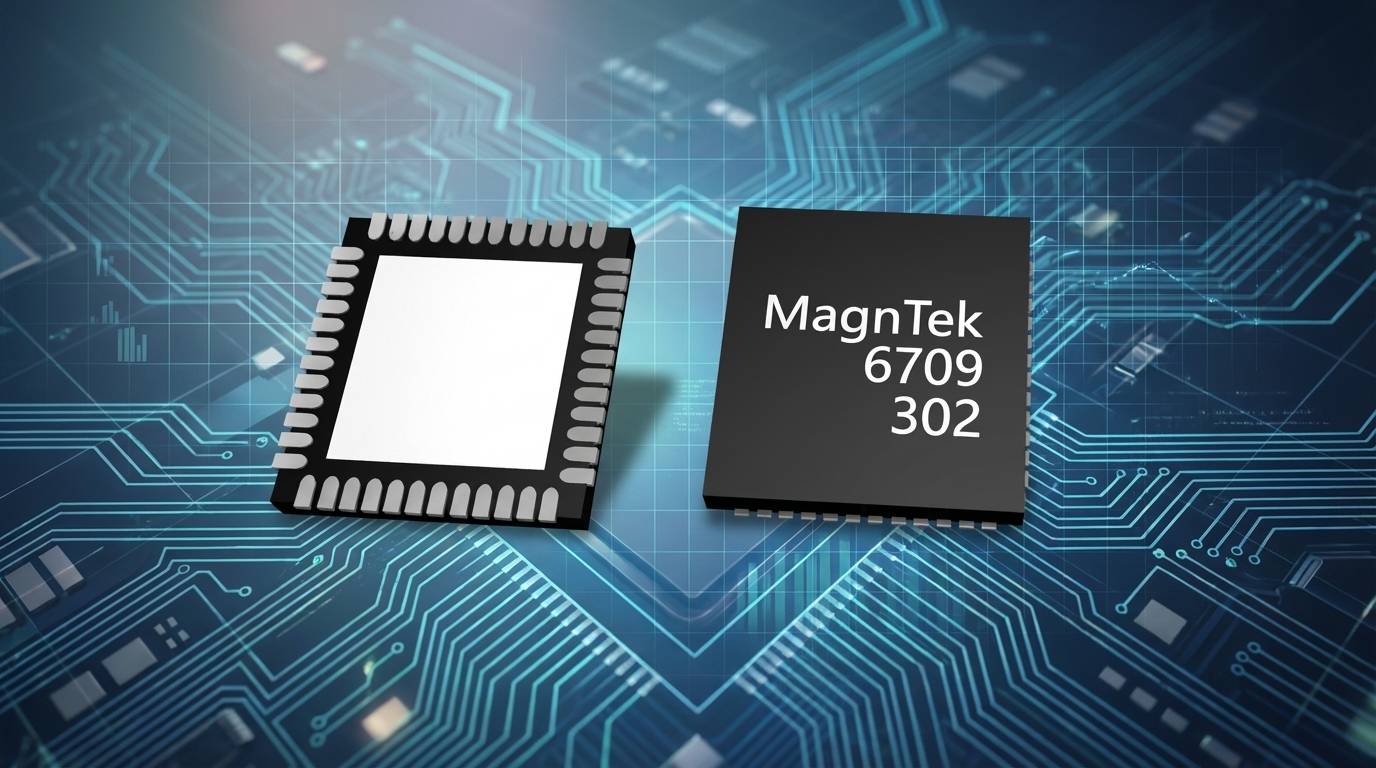
Traditional sensor solutions cling to the obsession with “physically perfect alignment,” requiring the magnet and sensor chip to be coaxially attached in an attempt to become a perfect mirror of the physical world; any mirroring deviation is regarded as a defect. This not only raises the bar for mechanical design and assembly but also makes precise detection under many complex operating conditions difficult. MT6709, by contrast, is like an “understanding” partner—it accepts the imperfections of the real world and, by performing angle decoding calculations on external analog signals and compensating for deviations, achieves precise off-axis (Off-Axis) 0–360° absolute angle detection, adapting to deviations and complexity in real-world scenarios.

1. Technical Decoding: Reconstructing the Signal Chain
As a decoder chip that calculates angles from sine and cosine analog signals input by external linear Hall sensors, MT6709 is a powerful “signal translation and correction hub,” and its workflow is clear and efficient:
1. Signal Acquisition: When the rotating shaft drives a simple single-pole-pair magnetic ring (one N pole and one S pole) to rotate, four linear Hall chips arranged symmetrically at 90° to one another around it sense and output raw differential sine and cosine analog signals, which are received by MT6709.
2. Signal Preprocessing: The received analog signals are amplified and filtered by MT6709’s built-in instrumentation amplifier and then sent to the ADC.
3. Analog-to-Digital Conversion and Calculation: After being digitally quantized by a high-performance ADC, the signals are sent to the DSP unit, where calibration parameters compensate for offset, amplitude, and phase errors to decode 17-bit absolute angle data.
4. Multiple output formats: Angle data can be read directly via 3-wire SPI, or encoded as incremental ABZ, motor commutation UVW, or simplified PWM signals to adapt to different host control systems.
In addition, the MT6709 chip adopts a highly integrated design. In addition to the low-dropout regulator (LDO) and clock oscillator (OSC), the functional system also includes:
- EEPROM: 3.0–5.5 V user-programmable electrically erasable programmable memory module, with data retention of up to 10 years (at 150°C) and endurance of ≥100 erase/write cycles;
- Analog front end: instrumentation amplifier + anti-aliasing filter to ensure analog signal integrity;
- Diagnostic module: monitors signal amplitude, supply voltage, and EEPROM data in real time, and outputs status via the STATUS/FAULT pin;
- Configuration registers: support programming of parameters such as calibration mode, output resolution, and zero position via SPI.

Schematic

Functional Block Diagram
II. Automatic Calibration: Precision Compensation Upgrade
The core advantage of the MT6709 is that it provides a simple user-side self-calibration mode—no data interaction with the MT6709 chip and no reference source are required; only several motion cycles are needed to compensate for errors such as offset, amplitude, and phase of the external input sine and cosine signals. After calibration, the INL can reach ±0.2°. This mode requires the magnetic ring to rotate continuously, but the rotation does not have to be at a constant speed. The specific steps are:
1. Install and fix the relative positions of the chip and the magnetic ring;
2. Ensure that the input signal can be maintained for 16 cycles within the speed range of 40 cycles/min to 3000 cycles/min;
3. Pull the CAL-ENB pin low (or write 1 to the 'SOFT-AUTOCAL' register) to make the chip enter the self-calibration state; then determine the chip's self-calibration status through the PWM waveform output by the STATUS pin or the value of the 'CAL-STATE' register. If self-calibration succeeds, the chip automatically saves the calibration parameters. After completion, wait 500 ms, then pull the CAL-ENB pin high or write 0 to the 'SOFT-AUTOCAL' register to exit self-calibration mode;
4. If calibration fails and recalibration is required, power-cycle the MT6709.
At the same time, the MT6709 also provides a user-side constant-speed self-calibration mode, which can further compensate the INL to ±0.1°. In this mode, after fixing the magnetic ring and chip, configure the 'AUTO_CAL_MODE' register value (0×4) to put the chip into constant-speed self-calibration mode (the factory default configuration is simple self-calibration mode), ensuring constant-speed operation in the direction in which the angle output increases; after the magnetic ring starts rotating at a constant speed, configure the 'AUTO_CAL_FREQ' register to select an appropriate speed range. The subsequent steps are the same as those for simple self-calibration mode.
III. Performance Dimensions: Comprehensive Interfaces and Outstanding Reliability
A real challenge in industrial applications is protocol fragmentation, and the appeal of the MT6709 lies in its comprehensive and flexible data output ecosystem, which can seamlessly interface with various host control systems:
- Core data: Provides 17-bit high-resolution absolute angle data that can be read directly via a 3-wire SPI interface. It supports angle latching and a configurable data refresh flag, meeting the stringent requirements of applications for absolute position information.
- Incremental encoding: Can generate ABZ incremental signals of up to 2500 pulses/period or 10000 steps/period, with any integer resolution user-programmable, perfectly compatible with most servo drives and controllers on the market.
- Motor drive: Provides programmable UVW commutation signal output, with resolution support from 1 to 63 pole pairs/period, and can be used directly for commutation control of brushless DC (BLDC) motors.
- Simplified communication: It also provides single-wire PWM output, which can transmit angle information at 12-bit resolution, offering a simple option for resource-constrained microcontroller systems.
In terms of reliability, the MT6709 follows industrial and automotive electronics-grade standards. Its operating voltage range covers 3.0 V to 5.5 V; its operating temperature spans the harsh environment of -40°C to 125°C; its electrostatic discharge (ESD) protection capability exceeds 4000 V; and it uses a compact QFN 7×7 package, enabling stable operation in harsh electrical and physical environments. Meanwhile, the MT6709 offers low latency and high stability: under constant-speed conditions, the system delay<2 µs; transient noise 0.01° rms; hysteresis window 0.022° (programmable in multiple levels). It also features real-time diagnostics: real-time output of chip operating status and diagnostic information via STATUS and FAULT interrupt pins, improving system reliability.
Product Specifications Table
| Operating voltage | 3.0~5.5V |
| Power consumption | 20mA |
| Operating temperature | -40℃~125℃ |
| Resolution | 17-bit |
| PWM output | 12-bit/cycle |
| ABZ incremental output | 1–2500 pulses per magnetic pole pair (programmable) |
| UVW incremental output | 1–63 pole pairs/magnetic pole pairs (programmable) |
| System delay (at constant speed) | <2us |
| ESD protection | VHBM:±6.0kV;VCDM:±1.0kV |
| Package | QFN7×7 |

Package outline drawing
IV. Application Scenarios
Industrial automation: collaborative robot joint angle feedback (off-axis mounting reduces mechanical design difficulty), conveyor belt position control, and rotating platform positioning; it is recommended to connect a ≥0.1 μF decoupling capacitor in parallel at the power supply and add a TVS diode to improve EMC performance.
Motor control: rotor position detection for brushless DC motors and permanent magnet synchronous motors, helping achieve precise field-oriented control.
Automotive electronics: electric power steering systems, accelerator pedal position detection, suspension height measurement, and other automotive applications; wide temperature range and high ESD protection, suitable for harsh in-vehicle environments.
Consumer electronics: knob controls, gaming devices, fitness equipment, and other consumer products requiring angle measurement; compact packaging and low power consumption current make it suitable for consumer electronics.
Off-axis applications: In special mechanical structures where on-axis mounting is not possible, MT6709, with appropriate magnetic circuit design, can achieve precise off-axis angle detection.

Typical application reference circuit
V. Conclusion: A Preferred Domestic Choice
The emergence of off-axis solutions such as MT6709 is not only an upgrade in sensor chip technology but also embodies a new development philosophy—no longer pursuing “absolutely ideal physical adaptation,” but instead adapting to the diversity and complexity of real-world scenarios through intelligent algorithms and integrated design. From joint motion in industrial robots to steering systems in automobiles, from consumer electronic knobs to positioning in special machinery, MT6709, with its comprehensive advantages of “wide voltage, high protection, multiple outputs, and easy calibration,” has become one of the preferred domestic angle detection chip solutions.
MT6709 not only lowers the barriers to device design and assembly, but also, with stable performance and an independent supply chain, injects 'precise sensing' core 'chip' power into the intelligent upgrade of industries across all sectors. To learn more about MT6709 or request samples, contact the official authorized distributor: sales@chiplinkstech.com; WeChat Official Account: Zhilian Micro - Motor Control Chips, which provides product selection services and technical support. We look forward to working with you.

Sample request attached

WeChat Official Account