
At the 2026 Spring Festival Gala, humanoid robots performed synchronized, highly difficult movements, bringing brands such as Unitree and Noetix from the tech circle into public view and giving the general public an intuitive sense of the rapid development of the robotics industry. Beyond public attention, industry information released at electronica China indicates that the humanoid robot industry has moved from “stage stunts” to a new stage of “mass-production game.” Goldman Sachs' forecast of a $154 billion humanoid robot market by 2035 is accelerating from a business blueprint into industrial reality.
But behind the industry excitement, a harsh reality stands before all practitioners: it is not hard to build a prototype capable of highly difficult movements; building 10,000 mass-produced units with high consistency, strong durability, controllable cost, and smooth motion is a long and arduous journey. From signal interference at the perception layer to heat-dissipation bottlenecks at the execution layer and energy distribution in the power domain, every hardware shortcoming can become a roadblock on the path to mass production. Among the joints responsible for executing robot motion lies a key component that is easily overlooked by the public but crucial to smooth robot movement—the encoder.
I. The “Eyes” in the Joint: Encoders
Every movement of a humanoid robot, from lifting a leg and stepping to compliant grasping, requires motors to drive joint rotation. But the motor itself can only execute the mechanical command to “rotate”; it cannot perceive “where it has rotated to, at what speed, and whether the direction is accurate.” This requires an encoder—it acts like a pair of eyes, monitoring the rotor's position, speed, and direction in real time, converting physical position into electrical signals and feeding them back to the control system. The control system then adjusts motor output in real time based on encoder feedback, ultimately enabling the robot to complete preset movements. Simply put, without an encoder, the motor would be “blind”; even a simple hand-raising action could lose control and vibrate, let alone complex high-precision operations such as grasping an egg or turning a screw.
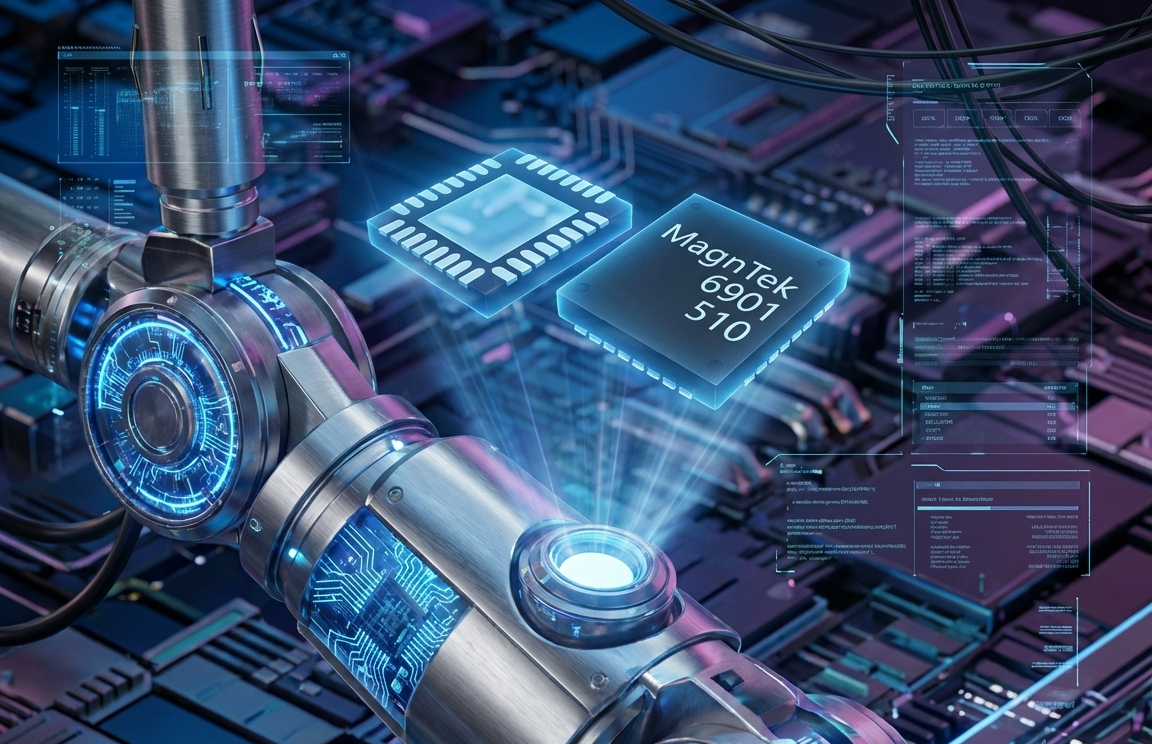
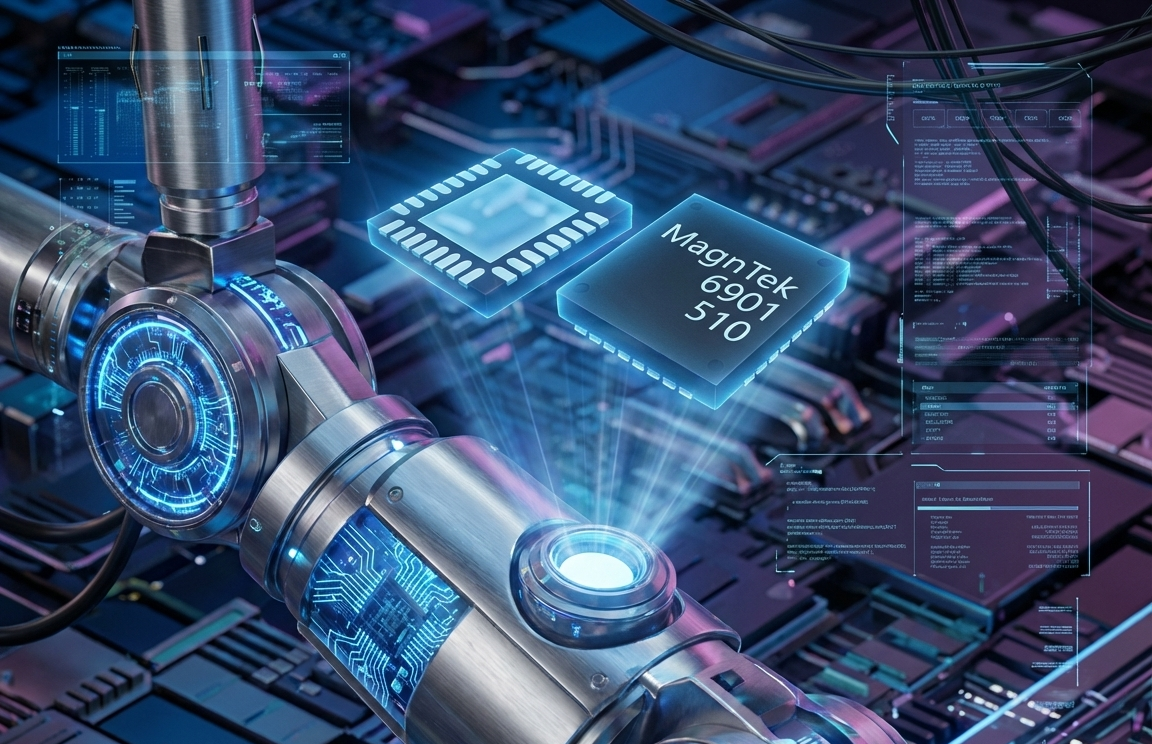
MT6901 is an inductive encoder chip designed specifically for high-precision scenarios and a key product enabling domestic encoder chips to break import monopolies and enter the core humanoid robot supply chain.
Unlike mainstream magnetic and optical encoder solutions on the market, MT6901 uses eddy-current sensing technology to achieve high-precision measurement of the rotor's absolute position by precisely detecting electromagnetic coupling changes between the coil and a metal target. This innovation at the underlying principle level sets it on a new path balancing accuracy and robustness. It inherently offers core advantages including high precision, strong magnetic immunity, low temperature drift, and good long-term stability, precisely addressing the core needs of humanoid robots, high-end servo systems, and other scenarios.

Functional Block Diagram
II. From “Trailing” to “Keeping Pace”: What Makes MT6901 Possible
For a long time, the high-end encoder chip market has been almost firmly monopolized by international giants such as Austrian Microelectronics (AMS) and Infineon. Domestic manufacturers seeking to procure high-end encoder chips not only have to bear high procurement prices, but also face delivery cycles of several months, a complex international trade situation, and technology blockades. This has become a core bottleneck restricting the cost reduction and mass production of domestically produced humanoid robots and the independent controllability of the supply chain.
The emergence of MT6901 has changed this situation.
First is accuracy.MT6901 can provide 23-bit absolute angle output through a UART interface, with resolution reaching 0.02 degrees. This means that for each motor revolution, the chip can perform precise detection at over 8 million points. At the same time, to push system accuracy to the extreme, MT6901 also builds a triple intelligent calibration system that can adapt to the accuracy requirements of different scenarios:
- Client-side simple self-calibration: no precision tooling is required. After the stator and rotor are installed, continuously rotating several turns can automatically compensate for installation eccentricity, slight tilt, and other errors. Typical linearity after calibration is ±1°;
- Client-side constant-speed self-calibration: operating at a stable speed enables deep learning and compensation of periodic errors caused by machining and assembly. Typical linearity after calibration is ±0.2°, meeting the high-precision requirements of humanoid robot joints;
- Nonlinearity (NLC) calibration: Parameter calibration is performed by running in paired operation with an ultra-high-precision reference encoder. After calibration, typical linearity is <0.1°, meeting the requirements of cutting-edge precision control scenarios.
It is exactly this extreme precision that enables humanoid robots to perform complex and delicate actions such as grasping raw eggs, turning precision screws, and compliant interaction, without problems such as force loss of control or motion deviation due to insufficient detection accuracy, perfectly meeting the core requirements of humanoid robots, high-precision servo motors, and other scenarios.
Next is interference immunity.The joint module of a humanoid robot is a typical highly integrated scenario where space is extremely precious: the motor, reducer, driver, and encoder are packed into an extremely limited space, and the strong magnetic field generated by motor operation and the electromagnetic radiation of various components intertwine, creating an extremely complex electromagnetic environment. In such an environment, traditional magnetic encoders are highly prone to signal interference and degraded detection accuracy.
The MT6901's eddy-current solution is inherently “immune” to external magnetic interference by principle. It uses an excitation coil to emit a high-frequency electromagnetic field, and eight independent receiving coils (four fine channels + four coarse channels) capture spatial magnetic-field variations modulated by rotor position. It adopts an “area” spatial sensing mode and then uses differential processing to dynamically cancel common-mode noise and external stray magnetic-field interference, achieving complete “immunity” to strong DC magnetic fields and distributed electromagnetic interference in space. At the same time, the chip uses a three-layer PCB layout and symmetric magnetic-field design, which effectively avoids EMC issues and enables stable operation in strong electromagnetic environments without additional shielding, freeing joint design engineers from the dilemma of having to achieve both high integration and interference immunity.
Next is reliability.Robot joints must withstand long-term impact, vibration, and temperature changes, and industrial robots also face contamination such as dust and oil. The long-term reliability of the encoder is a hard threshold for mass-production deployment. The MT6901 has an operating temperature range of -40°C to 125°C and has passed stringent reliability validation for impact, vibration, and high/low-temperature cycling. Its ESD protection reaches HBM ±4 kV and CDM ±1 kV. It also integrates fault diagnosis functions such as excitation-coil open-circuit and signal amplitude out-of-range detection, and includes a built-in 3.3 V to 5.0 V programmable EEPROM that supports permanent parameter retention after power-down, with endurance of 100 erase/write cycles and data retention of no less than 10 years at 150°C. Even under extreme operating conditions, it can maintain detection accuracy and operational stability over the long term.
At the same time, it inherits the advantages of magnetic encoders—tolerance to high vibration and no fear of dust, oil, or condensed-water contamination—while eliminating the need for the expensive and complex hermetic sealing design of optical encoders. Whether in a clean precision-manufacturing workshop, an industrial production line with heavy oil and dust, or a complex outdoor environment, the MT6901 can operate stably over the long term, providing solid underlying support for full-scenario humanoid robot applications.
Finally, cost.At a time when humanoid robots have not yet been widely adopted, hardware BOM cost and R&D adaptation difficulty are core factors constraining the industry's scaled development. The end-to-end domestically designed and mass-produced MT6901 not only breaks the price monopoly of imported products, but also leverages a localized supply chain to achieve better cost control, shorter lead times, and more flexible customization services.
In terms of design adaptation, the MT6901 offers an extremely rich combination of output interfaces and can connect seamlessly with various control systems: programmable ABZ incremental output is compatible with traditional servo drives and PLC systems; multiple absolute position output interfaces such as SPI, UART, and PWM can adapt to controller architectures with different computing power; it can also directly output programmable UVW motor commutation signals, greatly simplifying motor drive design and saving engineers substantial R&D and debugging time.
The cost reduction brought by scaled application is reflected not only in the procurement price of the chip itself, but also in the fact that it requires no additional shielding structure, sealing design, or large number of peripheral auxiliary components, greatly reducing the overall hardware cost and R&D cycle of joint modules and providing core cost and supply chain support for the mass production and deployment of the entire humanoid robot industry.
III. Sober Observations Beyond the Hype: What Do Robots Need?
Today's humanoid robot industry has never lacked conceptual hype and capital enthusiasm; what it lacks are core components that can truly solve mass-production pain points and achieve long-term stable operation, and domestically produced solutions that can move from the laboratory to the factory and from samples to volume production.
In the past, the vast majority of domestic humanoid robot OEMs were highly dependent on imported products for encoder solutions in joint modules. Behind this lay both the market reputation accumulated by imported products over decades and the practical dilemma that domestic encoder chips need more scenario validation in mass-production consistency and long-term reliability.
But the situation is changing. As core domestic ICs such as the MT6901 continue to be introduced, domestic chips are continuously accumulating large amounts of application data in fields such as industrial robots, servo motors, and automation equipment, and their stability, consistency, and reliability will also be fully tested by the market. More and more joint module manufacturers and complete-machine manufacturers will incorporate domestic solutions into their design blueprints—for no other reason than that performance is sufficient, prices are better, and the supply chain is more stable.
From this perspective, the breakthrough of MT6901 has never been merely the success of a single chip. It is more of a signal: in the trillion-dollar future track of humanoid robots, domestic substitution of core components has moved from “possibility” to “certainty,” and from “following and imitating” into a new stage of “running abreast and innovating.”
IV. Conclusion
On the stage of the 2026 Spring Festival Gala, the neatly synchronized dance steps of humanoid robots under the spotlight sparked nationwide amazement and imagination about the intelligent future; outside the spotlight, chips like MT6901 hidden deep in the joints are the true foundation supporting the industry’s transition from concept to reality and from prototypes to mass production.
They do not often appear at press conferences, nor are they mentioned by investors. But it is precisely these chips that, in every joint of the robot, quietly perform precise position sensing and support every step, every grasp, and every interaction with humans. One day, when intelligent humanoid robots truly enter factories and homes and become an indispensable part of our lives, MT6901 may already have been replaced by a new generation of chips. But the path it has traveled—from “following” to “running abreast,” from “import substitution” to “independent and controllable”—will ultimately become a shared memory of the domestic chip industry’s breakthrough in high-end manufacturing.For more information about MT6901 or to request samples, please contact: sales@chiplinkstech.com (email); contact: Engineer Chen, 13924675549 (WeChat: same number); WeChat Official Account: Zhilian Micro - Motor Control Chips.

Appendix: Sample Request

WeChat Official Account