
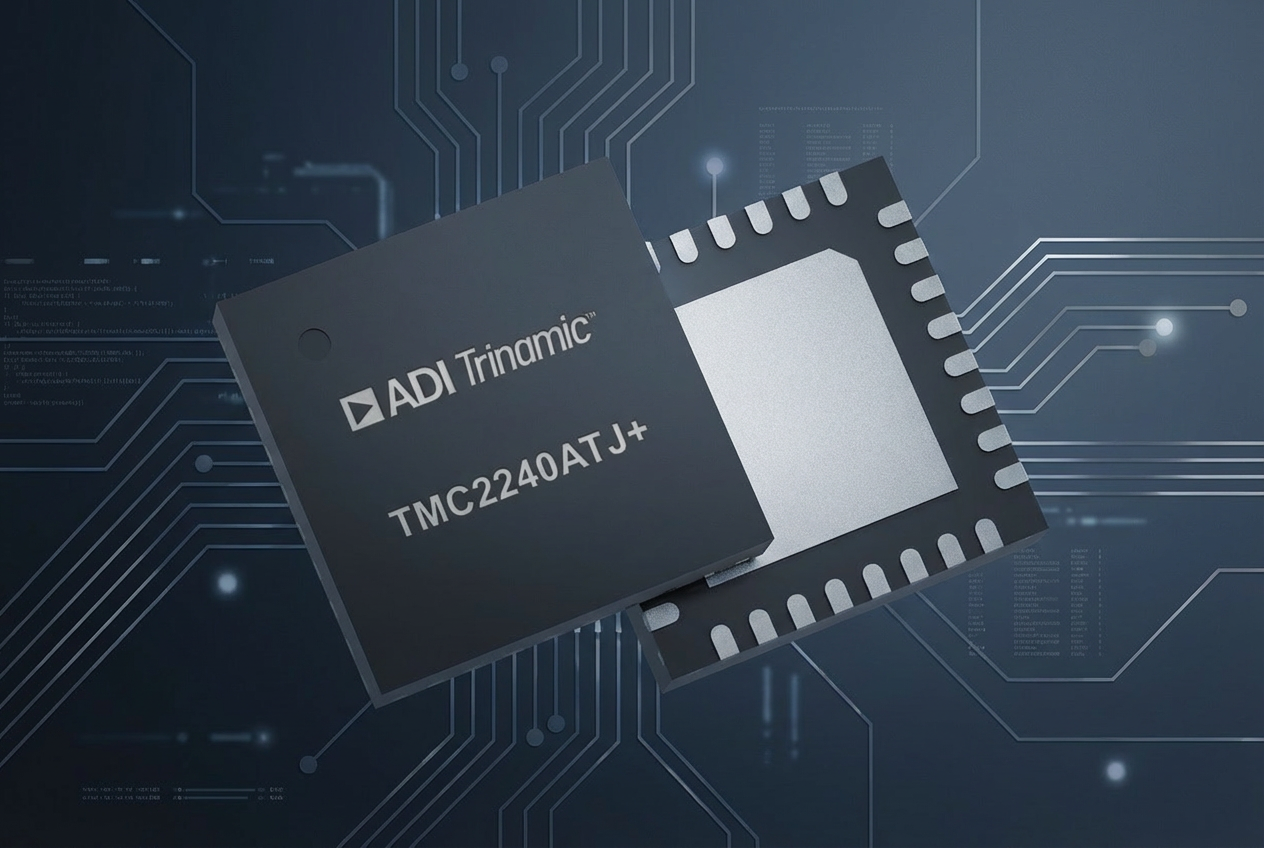
In stepper motor driver chip selection and design, engineers often need to make trade-offs among performance, cost, package, power consumption, and other dimensions. There are many choices on the market: from traditional discrete drivers to highly integrated intelligent drivers, and from low-voltage low-current to high-voltage high-current categories. This article introduces a smart, high-performance stepper motor driver IC—the TMC2240—which provides a cost-effective stepper motor drive solution with 36 V/2.1 A RMS specifications, an ultra-low on-resistance of 230 mΩ, and lossless current sensing technology.
1. Balanced Specifications, a Cost-Effective Choice
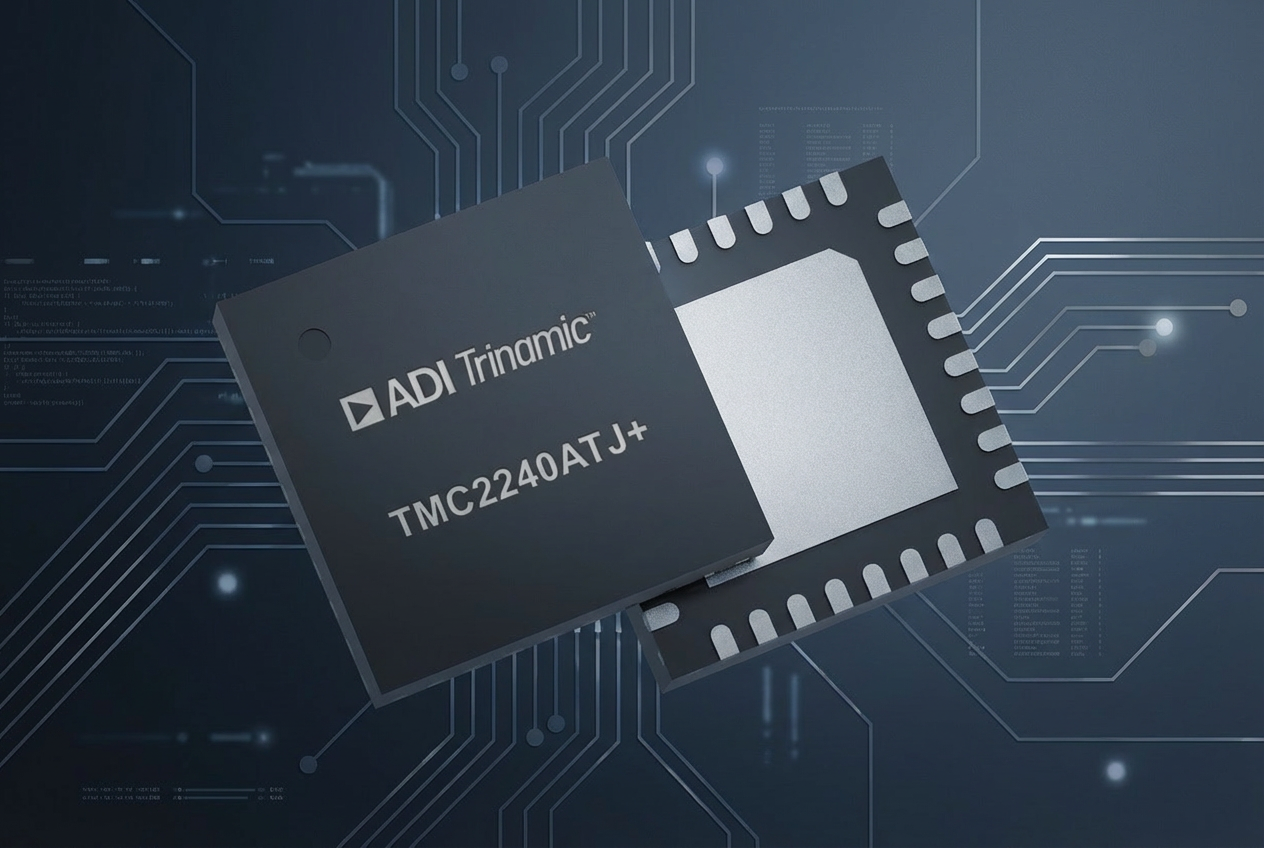
The TMC2240 is a stepper motor driver IC launched by Trinamic (now part of ADI) and positioned in the cost-effective economy driver segment. The chip supports a wide DC input of 4.5 V to 36 V, covering the power supply needs of most small and medium-sized two-phase stepper motors on the market; it integrates dual fully integrated low-resistance H-bridges with typical on-resistance as low as 230 mΩ (HS+LS), and can provide up to 5.0 A peak drive current and 2.1 A continuous RMS drive current (3 A sine peak), easily meeting the torque output requirements of most scenarios.
In terms of control precision, the chip natively supports up to 1/256 microstep subdivision and integrates an internal microstep table with 1024 sine wave entries, enabling ultra-high-precision position control without interpolation algorithms; it also features Trinamic's proprietary MicroPlyer™ microstep interpolation technology. When enabled, it can interpolate and optimize STEP pulses with low microstep inputs such as 8/16/32/64, always outputting a smooth drive effect at 256 microsteps, effectively solving torque fluctuations and jitter during low-speed motor operation and improving the device's positioning accuracy and running smoothness.
It has a complete built-in diagnostic and protection system. In addition to core protection functions such as short-circuit protection (OCP), thermal shutdown, and undervoltage lockout (UVLO), the chip also supports real-time measurement of driver IC junction temperature, supply voltage monitoring, and estimation of motor winding temperature, providing comprehensive data support for system-level diagnostics.
Compared with Trinamic's classic TMC2209, the TMC2240 has upgraded performance in driving capability, interface scalability, protection and diagnostic capabilities, while still maintaining a cost-effective product positioning, making it a suitable choice for applications such as 3D printers, office automation equipment, medical instruments, and security gimbals.
| Parameters | TMC2240 | TMC2209 |
| Supply Voltage | 4.5V~36V | 4.75V~29V |
| On-Resistance | 230 mΩ (typical, HS+LS) | 340mΩ |
| Peak Current | 5.0 A (bridge-arm peak) | 2.8A |
| RMS Current | 2.1 A (3 A sine peak) | 2A |
| Microstep Resolution | Native 1/256 step | Native up to 1/64; 1/256 microstepping requires MicroPlyer™ interpolation |
| Communication Interface | SPI, single-wire UART, STEP/DIR | Supports UART and STEP/DIR interfaces |
| Package | TQFN32(5×5mm);TSSOP38(9.7×4.4mm) | QFN28(5×5mm) |

Functional Block Diagram
II. Core Technologies: Integration and Optimization of Mature Functions
At the technical function level, the TMC2240 not only integrates multiple mature, market-proven patented technologies from Trinamic, but also adds an innovative lossless current sensing solution, achieving comprehensive improvements in drive performance, quietness, energy efficiency, and reliability:
1. Lossless Current Sensing (ICS)
Traditional stepper motor driver chips require external low-value sense resistors to measure winding current, which increases BOM cost and PCB area. At the same time, power dissipation on the sense resistors also causes additional heating.
The TMC2240 integrates non-dissipative lossless current sensing technology (ICS) internally, enabling precise closed-loop current control without external sense resistors. To ensure sensing accuracy, the ICS circuit individually measures the on-resistance RDS(ON) of each power MOSFET and compensates in real time for on-resistance fluctuations caused by changes in MOSFET junction temperature, ensuring the accuracy of current sensing and regulation across the full temperature range. It not only simplifies PCB layout and reduces BOM cost, but also eliminates the additional power dissipation and heating caused by sense resistors. It is especially suitable for space-constrained control board designs and can improve overall system energy efficiency.
2. StealthChop2 Quiet Chopping Technology
When the motor runs at low speed, traditional chopping methods tend to produce noticeable switching noise and vibration. StealthChop2, featured in the TMC2240, is a quiet chopping algorithm based on voltage-mode PWM modulation. Through precise voltage PWM modulation, it directly outputs a smooth sinusoidal drive voltage to the motor coils, causing the coil current to form an almost perfect sinusoidal waveform without abrupt changes, thereby eliminating electromagnetic noise and vibration caused by hard current switching at the source. It enables completely silent operation when the motor runs at low speed or is at standstill.
In addition, this technology has a built-in fully automatic tuning (AT) function: during the AT#1 stage, while the motor is at standstill, it automatically learns and calibrates the PWM offset parameter PWM_OFS_AUTO; during the AT#2 stage, while the motor is moving at medium speed, it automatically optimizes the PWM gradient parameter PWM_GRAD_AUTO. Users do not need to manually configure complex motor parameters; after power-up, optimal parameter adaptation can be completed with a simple homing action.
StealthChop2 also supports freewheeling and passive braking options when the motor is at standstill, reducing standstill power consumption to zero while maintaining effective motor damping.
3. SpreadCycle High-Dynamic Chopper Technology
SpreadCycle is a cycle-by-cycle current-control chopper technology optimized for high-speed and high-load scenarios, perfectly complementing StealthChop2. This technology divides each chopper cycle into four phases: on, slow decay, fast decay, and second slow decay. It can automatically integrate and optimize the decay period, ensuring smoothness during the motor current zero-crossing phase and providing excellent resonance suppression and dynamic response over a wide speed and load range.
The TMC2240 also supports automatic jitter-free switching between the two modes: set the speed switching threshold via the TPWMTHRS register, and use StallGuard technology to compensate for the phase offset caused by the motor back-EMF. This eliminates jitter and impact during mode switching: StealthChop2 is enabled at low speeds to ensure quiet operation, and the device automatically switches to SpreadCycle at high speeds to ensure torque output and dynamic performance, allowing the device to adapt to the optimal drive mode across the full speed range.
4. StallGuard2/4 Sensorless Stall Detection
The TMC2240 integrates two generations of StallGuard sensorless load detection technology. Without an external encoder, it can accurately measure the motor's real-time mechanical load by detecting the relationship between the motor back-EMF and load angle, enabling stall protection, load monitoring, and sensorless homing while reducing system hardware cost.
- StallGuard2: Compatible with SpreadCycle chopper mode, provides 10-bit load measurement resolution, supports filter mode, and allows flexible adjustment of detection sensitivity via the SGT parameter to suit different motors and mechanical characteristics; it is the optimal choice for sensorless homing;
- StallGuard4: Compatible with StealthChop2 chopper mode, provides 9-bit effective load measurement resolution, supports four independent motor phase measurements and digital filtering, and can still achieve accurate load detection and stall protection in quiet drive mode.
The TMC2240 supports setting the minimum operating speed threshold for StallGuard via the TCOOLTHRS register to ensure stable detection results. It can also configure the DIAG0/DIAG1 pins to output a hardware interrupt signal when a stall event occurs, enabling emergency stop protection for the motor.
5. CoolStep Dynamic Current Regulation
CoolStep is a load-adaptive current regulation technology based on StallGuard load detection results. It can dynamically adjust the winding drive current according to the real-time motor load: it automatically reduces the operating current under light load and quickly restores it to full current under heavy load. CoolStep can achieve up to 75% energy savings while significantly reducing heat generation in the motor and driver chip, extending equipment service life and reducing thermal design difficulty.
This technology can set the upper and lower current regulation thresholds via the SEMIN and SEMAX registers, and configure the current ramp step size and response speed via the SEUP and SEDN parameters. The motor current can be reduced to as low as 1/2 or 1/4 of the rated run current IRUN.
6. Full-Chain Diagnostics and Protection Features
The TMC2240 provides complete hardware-level protection and system diagnostic capabilities, comprehensively ensuring long-term stable operation of the equipment:
- Core protection mechanisms: include overcurrent protection (OCP) for output short circuits to GND/VS, tiered overtemperature protection (120°C overtemperature pre-warning, 165°C thermal shutdown), undervoltage lockout (UVLO) for both VM and VCC_IO supplies, and motor open-load detection. The short-circuit protection immediately turns off the H-bridge when a fault occurs; after 3 retries, it continuously latches the fault state to prevent chip damage.
- System diagnostic capabilities: a built-in 12-bit plus sign high-precision ADC can acquire the chip junction temperature, motor supply voltage, and external analog input AIN signal in real time. It can also estimate motor winding temperature changes via the PWM_SCALE register value in StealthChop2 mode, providing data support for predictive maintenance of the equipment.
3. High Compatibility and Flexible Configuration
The TMC2240 offers extremely high hardware and software compatibility:
1. Multi-mode control interfaces for full-system compatibility
The TMC2240 comes standard with the industry-standard STEP/DIR step-and-direction interface, enabling seamless compatibility with the vast majority of motion controllers, 3D printer mainboards, and CNC control systems on the market. It can upgrade the performance of existing designs without major hardware changes.
In addition, the chip supports an SPI serial interface with a clock up to 10 MHz and a single-wire UART interface, enabling online parameter configuration and real-time reading of operating status and diagnostic data to meet the customized development requirements of intelligent devices. The SPI interface natively supports multi-chip daisy-chain cascading, allowing multiple driver chips to be connected on a single bus, saving host controller I/O resources and simplifying PCB layout for multi-axis systems; the single-wire UART interface supports automatic baud rate detection and CRC data verification, ensuring anti-interference capability and stability of data transmission over long-distance communication.
2. Hardware Encoder Interface for Simple Closed-Loop Position Verification
The TMC2240 integrates a complete ABN incremental encoder hardware interface, supports A/B quadrature encoder signals and N index signal inputs, and includes a 32-bit encoder counter and programmable prescaler, adapting to encoders with different resolutions and motor parameters. This interface can compare the encoder's actual position with the theoretical position of the motor's microstep counter in real time, enabling online detection of motor step loss and position deviation verification. It improves positioning accuracy and operating reliability without requiring complex closed-loop control algorithms.
3. Dual Package Options for Multi-Scenario Adaptation
The TMC2240 is available in an ultra-small TQFN32 (5×5 mm) package, suitable for compact devices and high-density PCB designs. It is also available in a TSSOP38 (9.7×4.4 mm) package that is easy to solder by hand, lowering the barrier to prototyping and small-batch trial production while balancing R&D convenience and mass-production practicality.

Package View
IV. Application Scenarios
With a balanced performance configuration and comprehensive functional integration, the TMC2240 is suitable for the following applications:
- Desktop 3D printers: For small- and medium-sized general-purpose stepper motors, StealthChop2 technology enables ultra-quiet operation during printing; lossless current sensing simplifies mainboard wiring; CoolStep technology reduces heat generation during prolonged operation, making it an ideal upgrade over conventional drive solutions;
- Medical instruments and laboratory equipment: such as infusion pumps, liquid handling workstations, and precision syringe pumps. StealthChop technology ensures quiet and smooth operation, while StallGuard stall detection and full-chain protection mechanisms ensure safe use;
- Security PTZ dome cameras: In sealed environments with poor heat dissipation, CoolStep can reduce heat generation; microstep control makes rotation smooth and minimizes image jitter;
- Office automation equipment: such as scanners and ATM modules. StealthChop improves the user experience, while CoolStep reduces energy consumption and extends operating time.
V. Development Support and Design Considerations
The TMC2240 has a comprehensive development ecosystem and technical support, significantly lowering the development barrier: the TMC2240-EVAL evaluation board, together with TMCL-IDE software, allows rapid testing of functions and register configurations; complete datasheets, reference schematics, PCB layout guidelines, and register descriptions are provided; low-level driver examples based on mainstream MCU platforms are also provided.
During actual design and debugging, the following key considerations should be given special attention:
- In StealthChop2 mode, both stages of automatic tuning must be completed to achieve optimal quietness and drive performance. During tuning, ensure that the motor run current IRUN ≥ 8 and remains within the chip's current regulation range;
- The StallGuard stall detection function requires calibration of the SGT/SG4_THRS threshold and TCOOLTHRS speed threshold in software according to the actual motor model and mechanical load characteristics to achieve optimal detection accuracy and response speed;
- The chip's full-scale drive current is set jointly by the external resistor on the IREF pin and the CURRENT_RANGE bit in the DRV_CONF register; select appropriate parameter settings according to the motor's rated current;
- When the motor runs at high speed, it is recommended to set a speed threshold via the TPWMTHRS register to automatically switch from StealthChop2 to SpreadCycle mode, avoiding torque drop and step-loss risk at high speeds.
VI. Conclusion
The core competitiveness of the TMC2240 lies in its precise market positioning and complete functional implementation, rather than mere parameter stacking. It addresses the core pain points of traditional economy drives—high noise, incomplete protection, and low integration—while avoiding the problems of high-end industrial drives such as excessive parameters, high cost, and complex design, achieving a balanced performance of "no shortcomings in performance, cost advantage, and low design threshold."
For R&D personnel in fields such as 3D printing, medical equipment, security surveillance, and industrial automation, the TMC2240 is a stepper drive solution with great evaluation value—it enables cost reduction, efficiency improvement, and performance upgrades without compromising core performance, making it a cost-effective choice for low-to-medium power stepper drive applications.For more information about the TMC2240 or to request samples, please contact: sales@chiplinkstech.com (email); contact phone (Engineer Chen): 13924675549 (same number on WeChat); WeChat Official Account: Zhilian Micro - Motor Control Chips.

Sample Request Attached

WeChat Official Account