
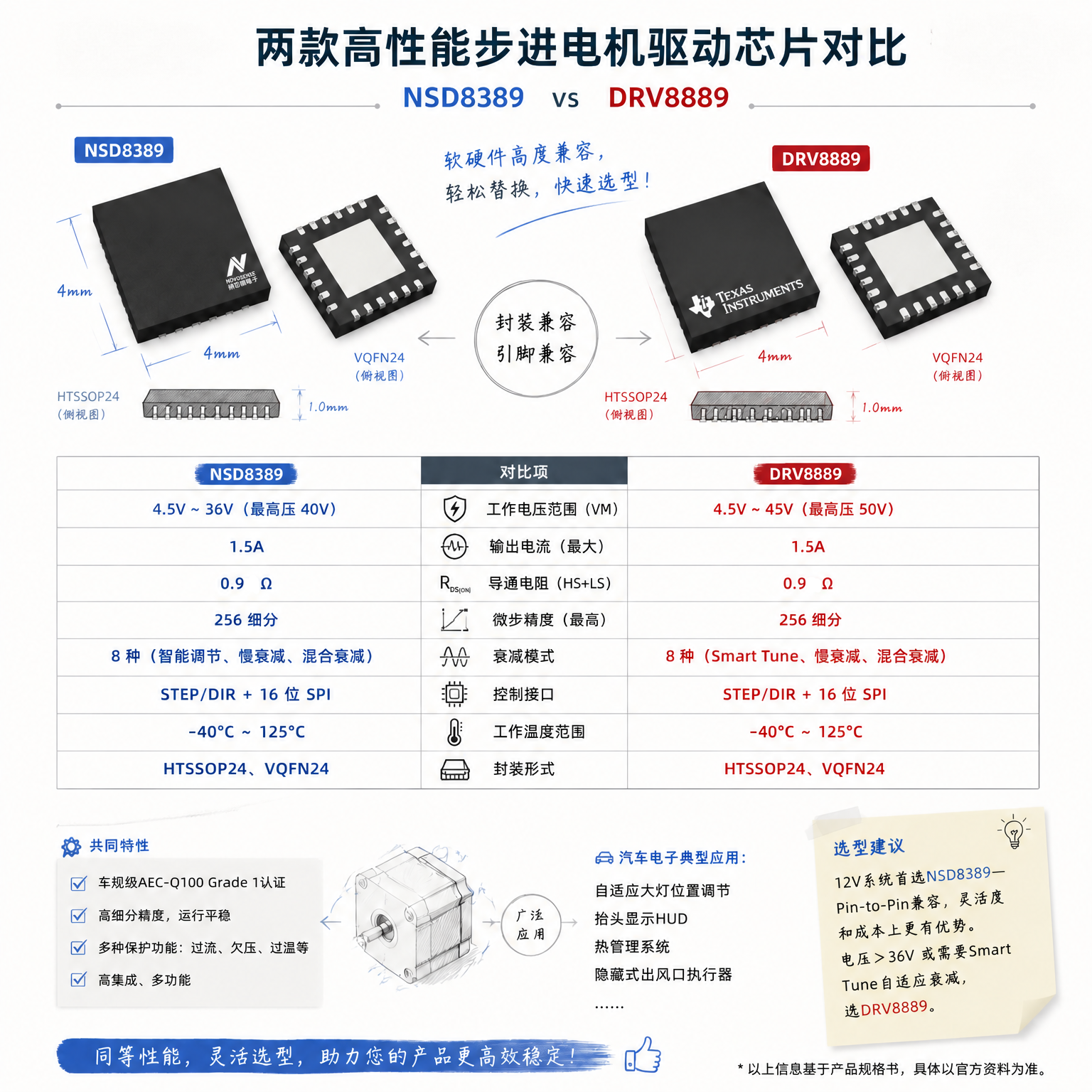
With the acceleration of automotive electrification and intelligence, stepper motors are increasingly widely used in automotive electronic systems. From adaptive headlights (ADB/AFS) and head-up displays (HUD) to electronic expansion valves (EXV) in thermal management systems and concealed air vents, all require high-precision, high-reliability stepper motor driver chips as core support.
NOVOSENSE's second-generation automotive-grade high-performance bipolar stepper motor drivers NSD8389-Q1/NSD8389A-Q1 (referred to as NSD8389 in this article) are highly compatible with TI's DRV8889-Q1/DRV8889A-Q1 (referred to as DRV8889 in this article) in software and hardware design, enabling seamless replacement. Under the current dual demands of cost reduction and efficiency improvement and supply chain security in the automotive industry, they provide a more practical choice for many automotive parts manufacturers and OEMs.
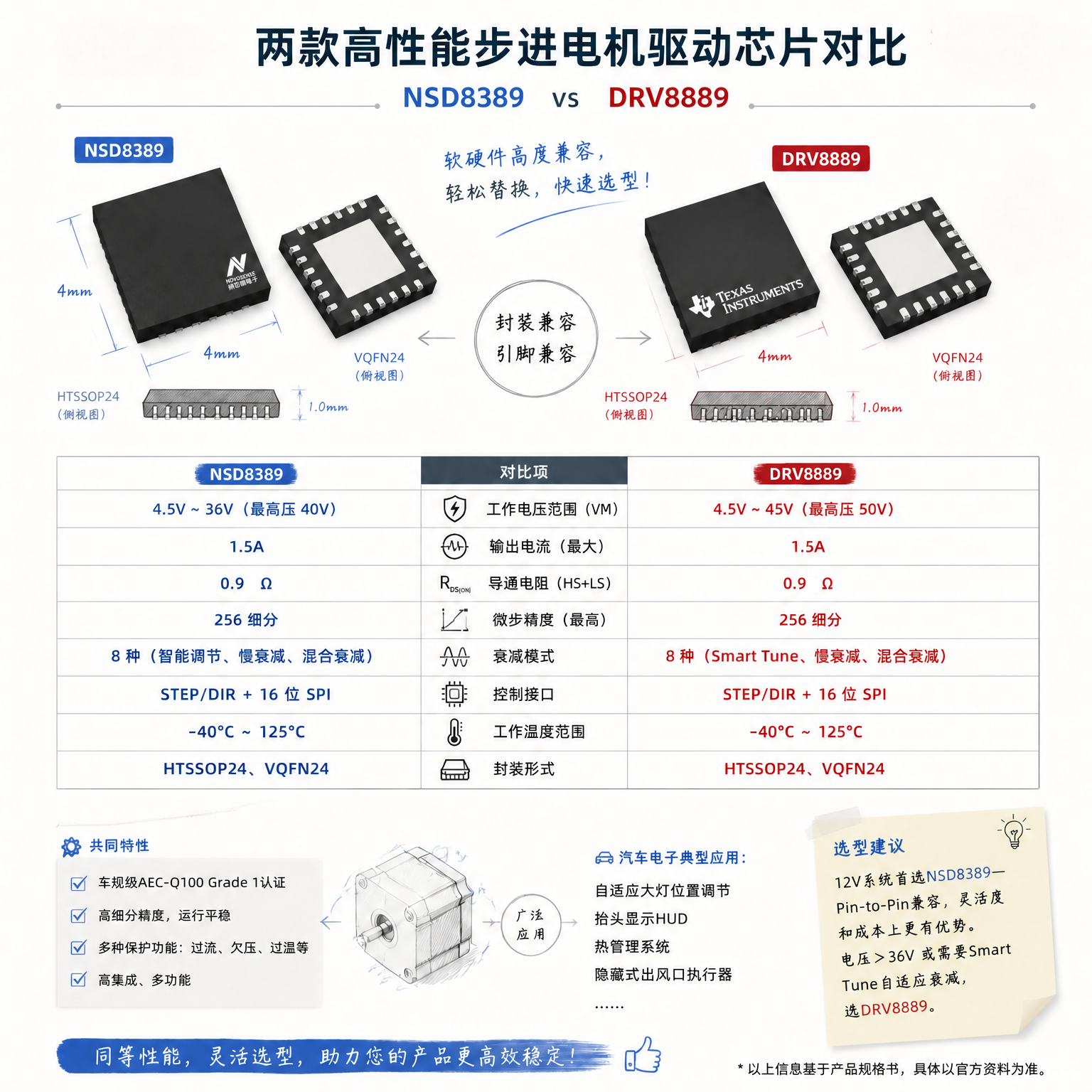
1. Core Parameter Comparison
NSD8389 and DRV8889 are highly consistent in core functions and technical parameters and can directly meet the needs of the vast majority of automotive electronic applications. The following is a comparison of the key parameters of the two chips:
| Parameter | NSD8389 | DRV8889 |
| Operating Voltage Range | 4.5V to 36V (40V max) | 4.5V to 45V (50V max) |
| Full-scale output current | 1.5A | 1.5A |
| On-resistance (HS+LS) | 900mΩ (typical) | 900mΩ (typical) |
| Microstep accuracy | Full step to 1/256 microstep | Full step to 1/256 microstep |
| Decay modes | 8 modes (intelligent adjustment, slow decay, mixed decay) | 8 modes (Smart Tune, slow decay, mixed decay) |
| Control interface | STEP/DIR + 16-bit SPI (daisy-chain supported) | STEP/DIR + 16-bit SPI (daisy-chain supported) |
| Operating temperature range | -40°C ~ 125°C | -40°C ~ 125°C |
| Package Type | HTSSOP24、VQFN24 | HTSSOP24、VQFN24 |
In terms of parameters, note that the maximum operating voltage of the DRV8889 is 45 V, while that of the NSD8389 is 36 V. For 12 V passenger-car systems, this 9 V difference is generally not an issue in practical use. A 12 V system typically operates at 9 to 16 V; even considering load-dump transients, the voltage after front-end protection is generally within 30 V. However, for 24 V commercial-vehicle systems, the 45 V headroom of the DRV8889 is more ample.
II. Software and Hardware Compatibility
For customers who have already designed with the DRV8889, the biggest advantage of the NSD8389 is its extremely high software and hardware compatibility: it enables direct “pin-to-pin” replacement, requires no major modifications to the hardware circuit, and only minor adjustments to the software code.
In terms of hardware compatibility, the pin functions of the NSD8389 and DRV8889 are almost identical in both HTSSOP24 and VQFN24 packages.
| Pin | DRV8889 | NSD8389 | Compatibility |
| Power supply VM/VS | Pins 4, 11 | 4 (VSA), 11 (VSB) | Fully compatible |
| Motor outputs AOUT1/2, BOUT1/2 | Pins 6, 7, 8, 9 | Pins 6, 7, 8, 9 | Fully compatible |
| STEP/DIR | Pins 21, 22 | Pins 21, 22 | Fully compatible |
| SPI(SCLK,SDI, SDO, NCS) | Pins 20, 19, 18, 16 | Pins 20, 19, 18, 16 | Fully compatible |
| DRVOFF | Pin 23 | Pin 23 | Fully compatible |
| nFAULT | Pin 14 | Pin 14 | Fully compatible |
| VREF | Pin 15 | Pin 15 | Fully compatible |
| Charge pump CPH, CPL, VCP | Pins 2, 1, 3 | Pins 2, 1, and 3 | Fully compatible |
| Enable/Sleep | Pin 24 (nSLEEP) | Pin 24 (EN) | Inverted logic; software adjustment required |
The only difference is at pin 24. The DRV8889 uses nSLEEP (active-low sleep), while the NSD8389 uses EN (active-high enable). The logic is inverted; it only requires changing one GPIO line in software. No hardware changes are needed at all.
The peripheral circuits are also basically the same: both chips integrate current sensing, so no external current-sense resistor is required; the VREF voltage range is the same, so the reference voltage circuit does not need adjustment; the charge pump peripheral components are fully compatible.
On the software side,the functional classification of the NSD8389 registers corresponds to that of the DRV8889; current setting, step mode, decay mode, protection configuration, and other functions all have corresponding register implementations. The control logic is also identical. The STEP/DIR interface operating mode and fault handling mechanisms remain consistent. The SPI register addresses and bit assignments differ, so the driver code must be adjusted according to the NSD8389 register map, but the functional-level porting approach is clear and the workload is manageable.
This high degree of hardware and software compatibility enables customers to complete the switchover at extremely low cost and with an extremely short development cycle, reducing the risk of product upgrades.
One more note: about the A version.
The naming logic of the two chips is the same. The version without A has its outputs enabled by default after power-up, while the version with A has its outputs disabled by default after power-up and turns them on via SPI only after MCU initialization is complete. This is a safety design consideration to prevent the motor from moving unexpectedly before the MCU is ready. If your project uses the DRV8889A-Q1, switching to the NSD8389A can maintain the same power-up safety strategy.
III. Detailed differences with different emphases
Compared with the DRV8889, the NSD8389 has more adjustment room for stall detection.The DRV8889's stall detection is based on BEMF phase shift and is quantified via the TRQ_COUNT register; the threshold can be self-learned or manually set. The NSD8389 uses direct ADC sampling. At the four zero-current positions of the stepper motor—0°, 90°, 180°, and 270°—it directly measures the back-EMF voltage at the coil terminals and compares it with the CVLL threshold. It has more adjustable parameters: gain can be selected as 1x, 2x, 5x, or 10x; sampling delay can be configured in PWM cycle counts; and the number of consecutive below-threshold judgments can also be set. Therefore, it can achieve finer matching to the characteristics of a specific motor.
Decay control: the two chips take different approaches.The NSD8389 offers 8 selectable decay modes. Its auto decay mode uses a preset strategy: current rising steps use slow decay (low ripple), while falling steps use mixed decay (fast response). Entry and exit switching are automatic, but it does not adjust in real time based on motor state. The DRV8889 adds Smart tune adaptation on top of auto decay. Dynamic Decay dynamically adjusts the proportion of fast decay in each PWM cycle: if decay was too slow in the previous cycle, it adds more; if too fast, it adds less. Ripple Control further switches to a variable off-time and determines when to turn the switches on again based on the time the current actually takes to reach IVALLEY. The difference is that the NSD8389's auto decay is automated — it executes fixed rules; the DRV8889's Smart tune is adaptive — it seeks the optimum every cycle. So if you are willing to manually select the decay mode best suited to the motor, the NSD8389 is fully sufficient; if you want the chip to adjust itself, the DRV8889's Smart tune is more convenient.
Both have spread spectrum.The DRV8889's spread spectrum is fixed, while the NSD8389's spread spectrum allows you to select the modulation frequency (15.625kHz or 62.5kHz) and frequency deviation amplitude (3%, 6%, or 12%). If you have an issue in a specific frequency band during EMC testing, this adjustability will be useful.
IV. Recommended Replacement Scenarios
Cases suitable for direct replacement:
- 12V passenger car systems, with an operating voltage not exceeding 36V;
- When project cost needs to be reduced and the NSD8389's baseline performance matches that of the DRV8889;
- If you are familiar with your motor's characteristics, the decay mode can be selected manually;
- BEMF stall detection schemes require precise matching to motor characteristics.
Situations that require further evaluation:
- For 24V commercial vehicle systems, a 36V voltage rating may be marginal;
- Heavy reliance on Smart tune automatic decay tuning;
- The project is already in its late stage, and changing the SPI register map would be too costly.
V. Conclusion
As a second-generation automotive-grade stepper motor driver launched by NOVOSENSE, the NSD8389 is highly compatible with the DRV8889 in both hardware and software, enabling replacement with minimal modification cost. In terms of core performance, the two are basically equivalent; the NSD8389 has certain advantages in stall detection configurability and spread-spectrum flexibility.
When making alternative selection decisions, engineers are advised to first evaluate whether their application requires the DRV8889's higher operating voltage or other specific functions. If not, the NSD8389 is an excellent alternative that can fully replace the functionality while offering cost and supply chain advantages.
For more information about NOVOSENSE product alternative selection or to request samples, contact the official authorized distributor: sales@chiplinkstech.com; +86 13924675549 Engineer Chen; WeChat Official Account: Zhilian Micro - Motor Control Chips.

Sample request attached

WeChat Official Account