
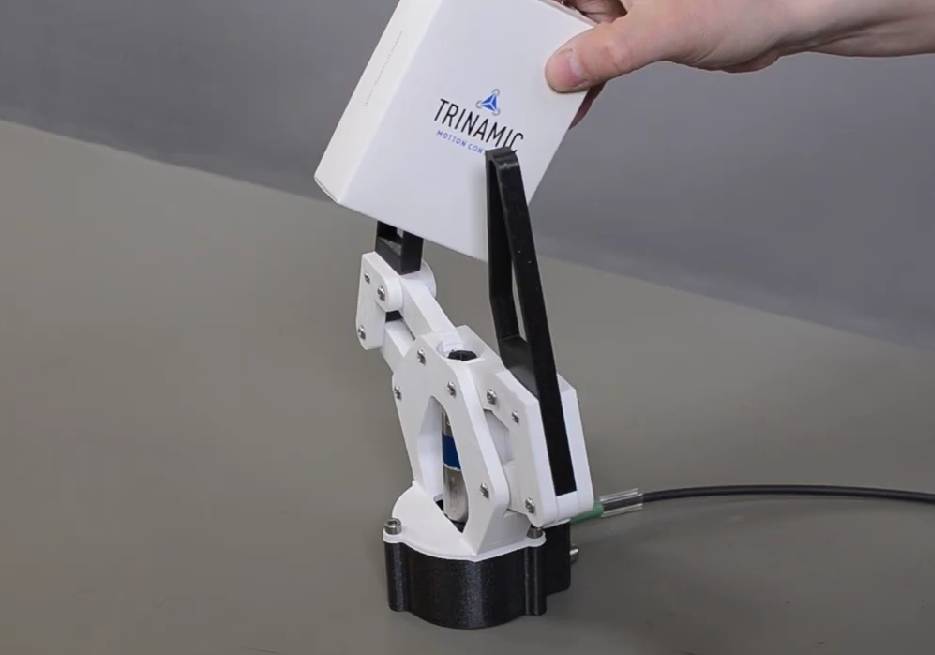
Grippers are used as end effectors for robots and robotic arms. Their stable, efficient, precise, and technologically advanced characteristics effectively improve production efficiency across industries and solve the challenges of industrial precision motion control. An electric gripper consists of a motor, transmission system, reducer, and gripper control system. The grippers at both ends can continuously close and open to perform grasping motions on actual objects according to different gripping forces.
I. Gripper Principle
The power source for the opening and closing motion of the gripper is usually a stepper servo, servo motor, or brushless DC motor, which offers the advantage of high response. The principle is to control the motor drive, speed, and direction through a controller so that the gripper performs gripping or releasing operations. The gripper's motion can be achieved through its position, gripping speed, and gripping force.

II. Servo Electric Gripper Control
Grippers driven by servo motors offer the advantage of high precision.
1. Position Control
Through closed-loop position control of the servo motor current, the gripper is controlled to grip an object at the specified position. In position-mode closed-loop control, the gripper position can be detected by a sensor, the error value is then calculated, and a signal is sent to make the motor move to the precise position.
2. Speed Control
Precise control is achieved through the motor speed. Generally, in special operating conditions where the size and specifications of the object are known and consistent, the gripper's movement speed is controlled by closed-loop control with speed detection feedback, or by open-loop control with a preset signal.
3. Torque (Moment) Control
The gripper's movement is controlled by the gripping force or the force used to grip the object. In closed-loop control, this is achieved through sensor detection; in open-loop control, it is achieved by presetting a gripping force signal to perform the gripping motion.
III. Application Fields
1. Industrial Automation: In multi-axis motion during industrial automation assembly line production, the gripper at the end of the robotic arm quickly grips and places objects, improving efficiency and production capacity.
2. Robotics: AI robots simulate the motion of human hands gripping objects, enabling robots to perform human-like automated operations.
3. Medical field: pipetting stations and liquid handling equipment, gripping and moving liquids, and precision motion for processing liquid samples. They are also commonly used in laboratories and scientific research testing.
4. Large-scale logistics and warehousing: rapid handling of large goods
IV. TMC Precision Motion Control Solutions
We have complete debugging results for the motor structure and driver modules. (See the video below.)
1. Stepper servo solution: TMC4361 is a stepper motor servo controller with a built-in closed-loop algorithm + current control, enabling torque-loop, velocity-loop, and position-loop control of the motor. Stepper servos feature low cost and high torque, and are also commonly used in gripper applications. The driver has a built-in ramp (curve acceleration/deceleration) generator with S-shaped ramp and SixPoint™ (six-point ramp) motion control, allowing switching during motion and avoiding vibration and motor wear during motor acceleration. In addition, the TMC4361A provides SPI and Step/Dir, as well as an encoder interface for closed-loop operation. ChopSync™ (a chopping mode) solves the low-frequency vibration problem of stepper servos at low speeds.

Cost-effective Trinamic closed-loop stepper motor drive options:
TMC4361 + TMC2130/TMC5130 (low power)
TMC4361 + TMC2160/TMC5160/TMC2240 (high power)
2. Servo, brushless DC, coreless, and permanent magnet synchronous motor solutions: The TMC4671 is a fully integrated servo controller that provides field-oriented control (FOC) for BLDC/PMSM and 2-phase stepper motor drives, as well as DC motors and voice coils. All control functions are implemented in hardware. It supports serial or CAN communication, and modes are set via the TMCL-IDE host software. Taking torque value as an example, commands are uploaded via software, such as setting the minimum/maximum current. When the motor operates, its current stays between the maximum and minimum values; the greater the load, the larger the current. When force control is required, we can set an appropriate value based on the encoder feedback value. When the external force reaches the set value, an output signal is triggered.