
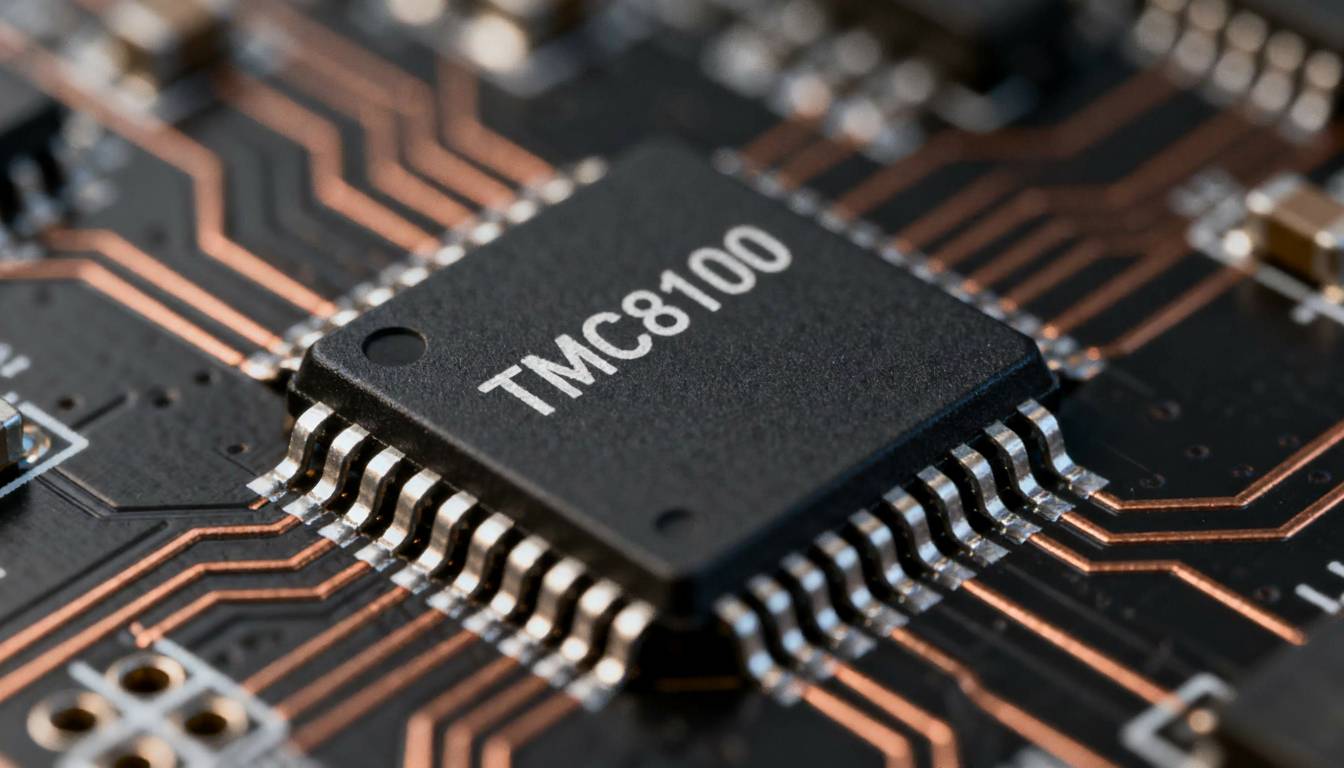
In fields such as industrial automation, collaborative robots, and smart logistics, high-precision position feedback in servo systems directly determines motion-control accuracy and equipment reliability. Traditional encoder interface solutions often suffer from poor protocol compatibility, high communication latency, and complex system integration. The TMC8100 universal encoder bus controller launched by Trinamic under Analog Devices, Inc. (ADI) addresses these pain points as a professional solution with three core advantages: multi-protocol compatibility, high integration, and industrial-grade reliability. It seamlessly connects absolute/incremental encoders with motion controllers to achieve accurate and efficient position-data transmission and processing.

(Note: This image was generated by AI and is for reference only.)
1. Product Overview and Core Positioning
The TMC8100 is a dedicated serial protocol converter IC, particularly suitable for absolute encoder bus protocols. Its core positioning is as a "protocol bridge between encoder and controller": it can be used as a bus controller for absolute encoder bus protocols, or as a peripheral connected to a microcontroller/motion controller via SPI or UART to extract, adjust, and output encoder position information in real time. It integrates a programmable high-performance serial communication engine (supporting synchronous/asynchronous data transmission at up to 16 Mb/s), a clock generator, counters/timers, a programmable CRC generator, and multiple interface types (SPI/UART/I2C), it can greatly simplify encoder interface circuit design and reduce the number of external components, meeting the stringent requirements of modern industrial applications for high-precision, high-reliability position detection and motion control.
 TMC8100 Simplified Block Diagram
II. Main Technical Features
The TMC8100 offers a range of advanced features that enable it to provide reliable and precise position feedback for various devices.
(I) Comprehensive Protocol Suite:The TMC8100 supports three major categories of protocols covering synchronous, asynchronous, and incremental encoders, and is compatible with mainstream industrial standards, allowing it to adapt to encoders from multiple brands without additional logic chips:
- Synchronous serial bus protocols: Supports SSI (Synchronous Serial Interface) and standard synchronous serial protocols; SPI (peripheral mode, not a master interface), providing high-speed peripheral interface communication; BiSS C (Bidirectional Synchronous Serial), supporting bidirectional synchronous serial communication; and EnDat 2.x, handling HEIDENHAIN high-performance absolute encoder protocols. It is fully compatible with mainstream industrial standards and meets the requirements for high-precision absolute position feedback.
- Asynchronous serial bus protocols: such as Nikon A-format®, supporting Nikon's proprietary asynchronous protocol; it also supports custom asynchronous protocols, allowing special frame formats to be implemented through programming.
- Incremental encoder interface: Supports A/B/Z quadrature signal input and provides three decoding modes: x1 (single-edge counting), x2 (dual-edge counting), and x4 (quadrature decoding/fourfold decoding). It supports precise positioning via the INDEX signal and HOME switch triggering, meeting the backward-compatibility requirements of traditional incremental encoders.
(II) High-Performance Communication Architecture Design
The TMC8100 uses a low-latency, high-reliability communication architecture design:
1. High-speed interface configuration:
- SPI interface: 25 MHz system interface (peripheral mode, not a host/master interface), providing a high-speed configuration and fast data transfer channel for the system, used for configuration, control, and position data readout, with a 64 × 32-bit FIFO transmit buffer (reduces the motion controller interrupt frequency).
- Dual UART interfaces: each channel independently supports a maximum communication rate of 16 Mbit/s, with an 8-byte receive buffer + 8-byte transmit FIFO, supports autobaud (automatic baud rate detection based on the 0x55 character) and timeout detection, and is used for configuration, control, and positioning to enable multi-device parallel communication.
- I2C interface: supports controller (Master) mode only, used to connect an external EEPROM (such as 24LC32/64) for standalone startup, or to connect peripherals such as temperature sensors, and supports an auxiliary low-speed configuration channel.
2. Clock and data processing
- Clock system: supports three clock sources—internal 15 MHz oscillator, external clock (1–32 MHz), and crystal oscillator (8/16/24/25/32 MHz, recommended load capacitance 9 pF). Built-in PLL frequency multiplication technology can output 75/100/128 MHz internal system clocks and supports clock loss detection (switching back to the internal oscillator), ensuring clock stability.
- Data reliability: integrates a 32-bit programmable CRC generator (supports custom polynomials) and a timeout counter (prevents data transmission stalls), ensuring error-free transmission of position data.
(III) Power Management
- Wide supply voltage range: 5 V to 5 V single-supply design, with an integrated 1.8 V LDO (the output must be connected to a 2.2 μF low-ESR ceramic capacitor). Quiescent current (VCCIO=3.3 V, RESETN low) is typically 100 μA; dynamic current (128 MHz PLL output) is typically 22 mA, adapting to various power environments such as industrial sites.
- Multi-level power management: integrated voltage regulator and power monitoring circuit.
- Intelligent power consumption management: dynamic power adjustment technology significantly reduces system power consumption and improves energy efficiency.
(IV) Industrial-Grade Hardware Specifications and Rich Interface Resources
The TMC8100 uses a compact package and robust design, adapting to harsh industrial environments:
- Package and heat dissipation: TQFN24 package (4 mm × 4 mm, 5 mm pin pitch), compact and highly integrated, saving valuable PCB space. The exposed pad (EP) must be connected to the GND plane with multiple vias reserved. Thermal resistance θJA is 60°C/W (four-layer PCB) and 68°C/W (single-layer PCB), ensuring heat dissipation efficiency under high loads.
- Reliability protection: all pins support ±2 kV HBM ESD protection; operating junction temperature range is -40°C to 125°C; supports overtemperature warning (120°C) and shutdown (143/150/157°C selectable), suitable for high- and low-temperature industrial scenarios.
 TMC8100 Pin Assignment
TMC8100Rich interface resources meet diverse hardware connection requirements:
| Programmable General-Purpose I/O | Multiple configurable GPIO pins provide design flexibility. |
| Direct Bus Interface | Dedicated I/O interfaces for connecting various bus transceivers |
| Dedicated Incremental Encoder Interface | ENC_A/ENC_B/ENC_Z (multiplexed with the DIRECT_IN2/3/ENC_Z pins) and HOME switch input, supporting position capture and reset triggering |
| Diagnostic Interface | The DIAG pin outputs fault signals, and the INDEX pin outputs one pulse per electrical cycle (used for homing calibration). |
With comprehensive protocol support, high-performance communication architecture design, and reliable industrial-grade hardware specifications, the TMC8100 provides an ideal solution for interface protocol design in automation.
III. System Architecture and Functional Features
(1) Core Processing Architecture: Hardware Acceleration + Programmable Flexibility
The TMC8100 adopts a "Harvard architecture" with separate program and data buses. Its core consists of two parts: a serial communication engine and an incremental encoder decoder, balancing hardware acceleration and software programmability:
1.Serial Communication Engine:
- 8 × 8-bit general-purpose register file, supports 16-bit instructions (single-cycle execution), and has a built-in 8-level call stack (supports nested subroutines);
- Hardware loop support (REP instruction): repeats execution of 1–4 instructions 1–8 times, reducing loop overhead and suitable for repetitive operations such as protocol frame parsing;
- Real-time error handling: integrated timeout counter (8-bit, programmable upper limit); after timeout, automatically jumps to a preset address to prevent communication lockup.
2.Incremental encoder decoder:
- 32-bit position counter (supports cyclic counting with programmable upper limit), supports x1/x2/x4 decoding modes, and can trigger position capture/reset via the Z signal or HOME signal (single or continuous trigger);
- Two 32-bit compare registers: configurable COMPARE_OUT signal (programmable pulse length), used to synchronize external devices (such as servo drive enable);
- Input filtering: ENC_A/B/Z and HOME signals support programmable sampling division (1–256 division), suppressing high-frequency noise and improving signal reliability.
(II) Data Processing and Buffering Mechanism
To balance communication real-time performance and stability, the TMC8100 adopts a hierarchical buffering design:
- SPI buffering: 64×32-bit FIFO transmit buffer, supports a “discard old data” mode (TX_SKIP=1), ensuring the motion controller always reads the latest position data;
- UART buffering: 8-byte receive buffer (supports configurable message lengths of 1–8 bytes) and 8-byte transmit FIFO; timeout detection (16-bit counter) automatically clears incomplete messages;
- Data synchronization: The DIRECT_IN/OUT interfaces support nanosecond-level delay (propagation delay mismatch ≤7 ns), meeting the clock and data alignment requirements of high-speed synchronous protocols (such as BiSS C).
IV. Wide Range of Applications
With multi-protocol compatibility and industrial-grade reliability, the TMC8100 is widely used in the following fields:
Industrial Manufacturing:
- High-precision CNC machine tools: The spindle absolute encoder is connected via the EnDat 2.x protocol to achieve ±001 mm-level high-precision position feedback, and 25 MHz SPI ensures real-time transmission of position data;
- Automated production lines: Conveyor positioning encoders are connected via the SSI protocol; x4 decoding mode improves positioning accuracy and supports multi-axis synchronization (e.g., coordinated dual conveyors).
Robots and Collaborative Robots:
- Joint Position Detection: Joint absolute encoders are connected via the BiSS C protocol, and 16 Mb/s UART enables low-latency data transmission, avoiding collision risks for collaborative robots;
- End Effectors: Gripper position feedback is achieved via incremental A/B/Z encoders, and the HOME signal triggers homing calibration to ensure gripping accuracy.
Automated Guided Vehicles (AGVs):
- Autonomous-Navigation AGVs/AMRs: LiDAR encoders are connected via SPI, and a 128 MHz internal clock ensures real-time processing of position data and supports multi-sensor data fusion, providing precise position and direction information for autonomous navigation vehicles.
Medical Equipment:
- Surgical Robots: High-precision joint position feedback is achieved via the EnDat 2.x protocol, and ±2 kV ESD protection ensures stable operation of the equipment in medical environments.
V. Complete Development Support System
ADI provides a complete development support system for the TMC8100. The TMC8100-EVAL-KIT evaluation board includes all necessary hardware and provides a complete evaluation kit. For development software, ADI's TMCL-IDE provides an advanced graphical development environment that simplifies configuration and debugging. The Landungsbruecke interface board provides convenient PC connection and real-time monitoring. After connecting the TMC8100-EVAL to the Landungsbruecke PC interface board, users can access the TMCL-IDE graphical user interface and its rapid development tools. There is also an example code library with rich code examples that help engineers further accelerate the development process. ADI also provides detailed design resources and documentation, including technical documents, application guides, reference designs, and more. The TMC8100's complete development support system helps developers quickly evaluate, design, and develop.

TMC8100-EVAL-KIT
VI. Technology Development Trends and Future Outlook
The TMC8100 universal encoder bus controller represents the advanced level of encoder interface technology. Its strong protocol compatibility, high-performance processing, and high integration make it an ideal choice for industrial automation, robotics, automated guided vehicles, and other fields. As Industry 4.0 upgrades toward flexible manufacturing and digital twins, encoder interface solutions need to meet the requirements of higher precision, lower latency, and more flexible compatibility. The TMC8100's programmable architecture can support future protocol upgrades such as EnDat 3.0, and its highly integrated design also makes miniaturized servo systems such as micro collaborative robots possible. In addition, ADI is expanding the TMC8100's multi-axis synchronization capability through firmware upgrades, such as supporting simultaneous decoding of two encoder channels, to further adapt to complex motion control scenarios such as multi-joint robots. With its excellent performance and broad application adaptability, the TMC8100 will become an important bridge connecting the digital world and the physical world, driving industrial automation to a higher level.
By adopting the TMC8100, equipment manufacturers can quickly develop intelligent devices with competitive advantages, seize the initiative in increasingly fierce market competition, and provide end users with higher device performance. For more information about the TMC8100 or Trinamic series products, please contact Shenzhen Zhilian Microelectronics (email: sales@chiplinkstech.com). We look forward to working with you.
Appendix: TMC8100 Feature and Benefit Comparison Table
| Feature | Core Advantage |
| Supports synchronous serial protocols (SSI/SPI/BiSS C/EnDat 2.x) | Compatible with mainstream absolute encoders, reducing protocol adaptation costs and meeting diverse application needs |
| Supports asynchronous serial protocol (Nikon A-format®) | Compatible with specialized equipment, expanding application boundaries |
| Supports incremental A/B/Z encoder interfaces | Ensures backward compatibility, eliminating the need to replace traditional incremental encoders and reducing upgrade costs for legacy systems |
| 25 MHz SPI system interface (configuration/control/position readout) | High-speed data transmission meets real-time control requirements and improves system response speed |
| Two 16 Mbit/s UART interfaces | Multi-device parallel communication, supporting complex system expansion |
| Crystal oscillator/external clock + PLL | High clock stability ensures data processing accuracy and communication reliability |
| 128 MHz internal system clock | Sufficient computing resources enable zero-latency data processing and adapt to highly dynamic scenarios |
| 2.5 V to 5 V single supply | Adapts to diverse industrial power supply environments and simplifies power supply design |
| -40°C to +125°C operating temperature | Withstands extreme high and low temperatures, improving system reliability in harsh environments |
| TQFN24 (4 mm × 4 mm) package | Compact size optimizes PCB layout, saves space, and supports miniaturized device designs |
| Evaluation kit: TMC8100-EVAL-KIT + Tools: TMCL-IDE + Development documentation | Comprehensive development support to facilitate development and design |