
Brushed DC motors are widely used in industrial automation, ATM financial equipment, ticket processing machines, multifunction all-in-one machines, and various other devices. These applications place clear demands on motor drivers: adequate peak output current, low conduction losses, complete protection and fault diagnosis capabilities, while simplifying peripheral hardware design under the premise of ensuring overall system reliability. NOVOSENSE NSD7315 is an integrated H-bridge driver designed around these requirements—40V absolute maximum supply, 10A peak drive capability, 150mΩ-class on-resistance, and available in SPI and hardware interface versions, targeting motor drive designs that require robustness and diagnosability in automotive and industrial scenarios.
1. Power Stage: Balancing 40V/10A and 150mΩ
The power stage of the NSD7315 consists of four N-channel MOSFETs forming a complete H-bridge, with an absolute maximum voltage rating of 40V, a recommended operating range of 4.5V to 35V, and peak output current up to 10A; continuous current capability ultimately depends on thermal design. For on-resistance, at TJ=25°C and VM=13.5V, the combined typical value of the high-side and low-side MOSFETs is 150mΩ; at TJ=150°C, it rises to 220mΩ. The device's operating temperature range is -40°C to 125°C, covering the ambient temperature requirements of industrial-grade and most automotive-grade scenarios.
| Supply Voltage (VM) | Absolute maximum 40V, recommended operating 4.5V~35V |
| Drive Capability | 10A Peak Current |
| On-Resistance (RDS(on)) | Typical 150mΩ (high-side + low-side @25°C, 13.5V) |
| Current Sensing | Integrated current mirror, proportional output (typical 1/1100) |
| Control Interface | SPI version (NSD7315S) / Hardware version (NSD7315H) |
| Control Mode | PH/EN, PWM (IN1/IN2), independent half-bridge control |
| Logic level | Supports 1.8V/3.3V/5V inputs |
| Operating ambient temperature | -40°C to 125°C (maximum junction temperature 150°C) |
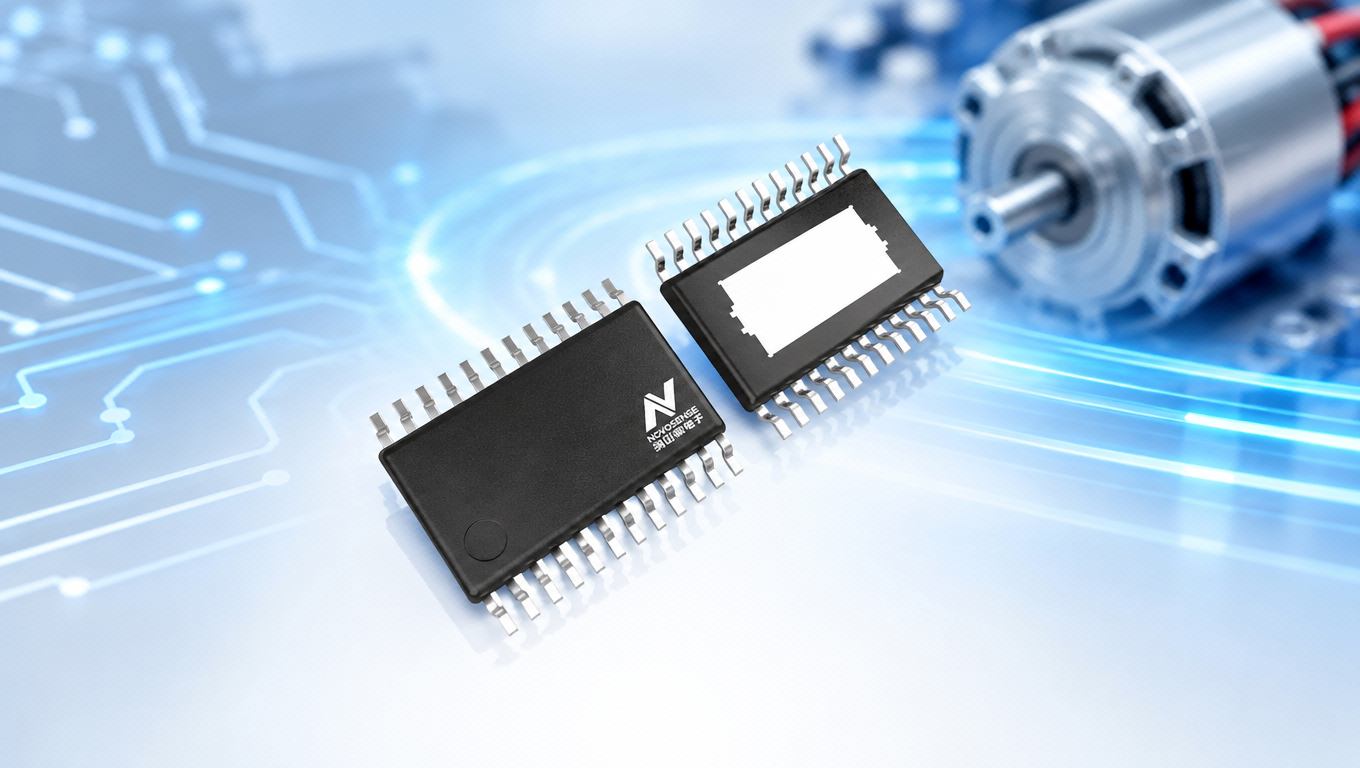
| Package | HTSSOP24 (with exposed thermal pad, 7.7 mm × 4.4 mm) |
II. Integrated current sensing: eliminates the need for high-power shunt resistors
The NSD7315 integrates current-mirror sensing inside the power stage. By placing a scaled-down "mirror" transistor in parallel with the internal high-power MOSFET, it outputs an analog current proportional to the high-side FET current from the IPROP1/IPROP2 pins, with a typical ratio of 1/1100. Therefore, the system does not need to insert a bulky high-power sense resistor in the main motor circuit; instead, an ordinary signal conversion resistor external to the IPROP pin provides a voltage signal proportional to the load current for stall detection, load-change detection, or closed-loop current control.
The value of the external conversion resistor depends on the maximum current to be monitored. Because the IPROPI pin voltage must not exceed 5 V, calculate it as RSENSE(max) = K × 5 V / IO(max) (with K = 1100): if the system needs to monitor a full-scale current of up to 10 A, the sense resistor must not exceed 550 Ω (500 Ω can be selected); if the system maximum operating current is 2.5 A, the upper limit from the formula is 2.2 kΩ, and 1.5 kΩ can be used to obtain a higher signal voltage amplitude during normal operation. If the resistor is selected too large and the voltage exceeds the limit under any operating condition, IPROPI will be clamped and the current regulation function will also be disabled.
This current sensing reflects the H-bridge current in forward drive, reverse drive, and high-side slow-decay modes. However, in fast-decay or low-side slow-decay modes, because the current does not flow through the high-side FET, the IPROP output no longer represents the half-bridge current; this should be noted during use. If only single-resistor sensing is required, IPROP1 and IPROP2 can be shorted together to share one RSENSE, and the output will then be proportional to the sum of the two high-side FET currents.
Complementing current sensing is an internal current regulation function. The NSD7315 uses a fixed-off-time chopping scheme. The ITRIP threshold is configurable in the SPI version as four levels: 4 A/5.4 A/6.5 A/7 A; the hardware version is fixed at 6.5 A. The off-time TOFF is selectable in the SPI version as 20/40/60/80 μs; the hardware version is fixed at 40 μs. When the current reaches ITRIP and persists for tDEG (typically 1 μs), the device enters slow decay and does not drive again according to the input state until the current falls below the threshold. This mechanism automatically limits current during motor startup and stall, reducing impact on the power supply and power stage.
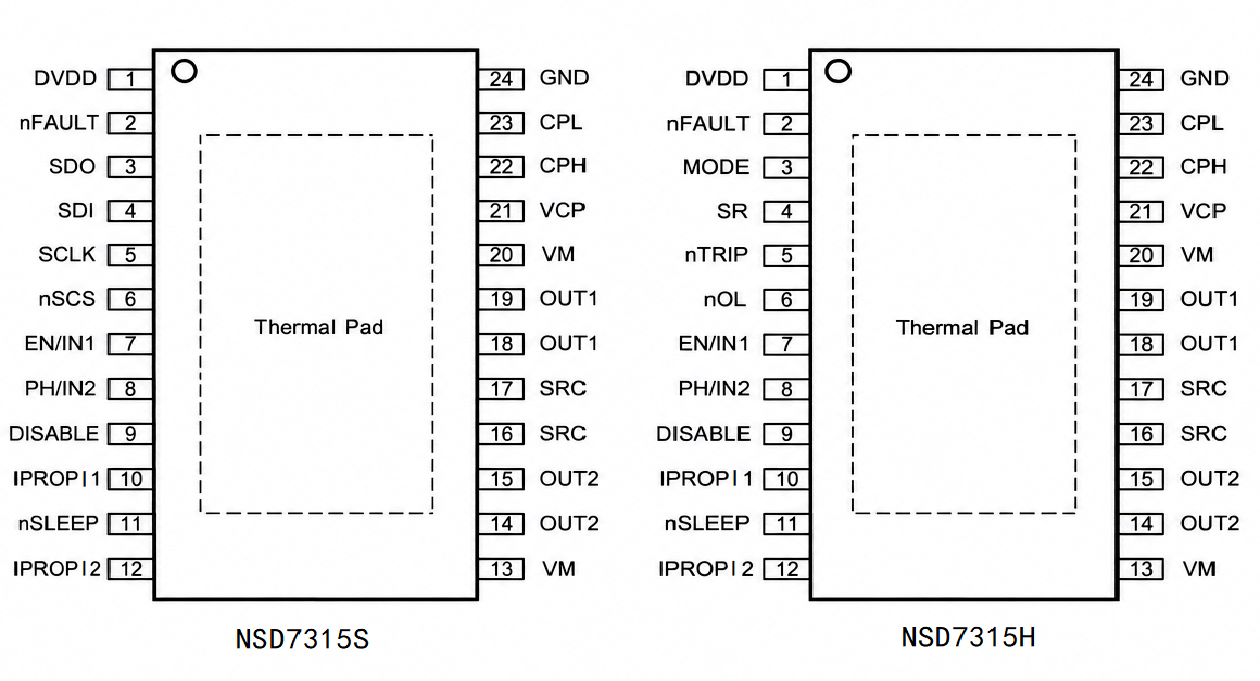
Pinout View
3. Three Control Modes and Flexible Interface Selection
The NSD7315 provides three control modes: PH/EN, PWM (IN1/IN2), and independent half-bridge. In PH/EN mode, EN/IN1 is the enable and PH/IN2 is the direction, suitable for conventional enable + direction interfaces; in PWM mode, motor control is achieved through logic combinations of IN1 and IN2, suitable for applications requiring speed control and slow-decay braking; independent half-bridge mode allows the two half-bridges to be controlled separately, for driving two solenoid valves or two unidirectional brushed motor loads.
The hardware version NSD7315H selects the mode via a three-level setting on the MODE pin: connect to GND for PH/EN; connect to DVDD or external 5 V for PWM; connect to ground through a 200 kΩ resistor or leave floating for independent half-bridge. The mode is latched at power-up or when exiting sleep. Changing the MODE pin during operation has no effect; a power cycle or sleep reset is required.
The SPI version NSD7315S does not have a dedicated MODE pin; the mode is configured through the MODE bit of the IC1 control register and is latched when the DISABLE signal transitions from high to low.
The choice between the two versions depends on the system's trade-off between flexibility and pin count. The hardware version uses a small number of external resistors to configure mode, slew rate, current regulation, and other settings, making it suitable for cost-sensitive designs that do not require real-time reading of fault registers; the SPI version accesses status registers and control registers through a 4-wire full-duplex interface and supports daisy-chain connection of up to 63 devices, making it suitable for multi-axis or multi-load systems that require centralized diagnostics and parameter adjustment.
IV. Protection and Diagnostics: Robustness Design for Automotive and Industrial Applications
NSD7315 protection covers VM undervoltage lockout (UVLO), charge pump undervoltage (CPUV), overcurrent protection (OCP), open-load detection (OLD), thermal shutdown (TSD), and overtemperature warning (OTW); faults are reported redundantly through the nFAULT pin and SPI status register, so the MCU can identify the fault type without polling.
OCP supports four responses: latched shutdown, auto-retry, report-only, and disabled; in independent half-bridge mode, the two overcurrent paths do not affect each other. Open-load detection is divided into standby (OLP) and running (OLA): OLP determines whether the motor is connected at power-up or when exiting sleep, while OLA determines whether the load is disconnected during PWM switching; however, OLA requires a high-side freewheeling condition and may falsely report under braking with low-side freewheeling. TSD can be configured as latched or auto-recovery, while OTW provides an early warning before the junction temperature approaches its upper limit.
For ESD and reliability concerns common to automotive and industrial scenarios, NSD7315 achieves HBM ±2000 V on all pins, CDM ±750 V on corner pins, and ±500 V on other pins; typical sleep current is 3 μA, helping reduce standby power consumption. The device uses an HTSSOP24 package (7.7 mm × 4.4 mm); the bottom thermal pad can be soldered to the PCB ground plane and dissipate heat through a via array, making it suitable for space-constrained control boards that still require certain power dissipation capability.
V. Typical Applications
In factory automation and robotics, NSD7315 can be used for conveyor belt drives, AGV drive wheels, or roller brush motors in sweepers/floor scrubbers. Industrial equipment often faces frequent start/stop and heavy-load conditions; the current sensing function integrated in the chip eliminates the need for external high-power shunt resistors and feeds load current directly back to the main controller, enabling precise torque control or collision detection; for systems with dense multi-axis control, the SPI version's daisy-chain topology can save IO resources on the main control chip.
In financial and commercial equipment—whether ATM cash machines, banknote sorters, or ePOS terminals—internal motors often require frequent start/stop operation and compact installation space. The NSD7315’s small package and highly integrated design perfectly meet this requirement. More importantly, jams are a common fault when handling banknotes or receipts; the chip’s built-in stall current limiting and open-load detection (OLD) allow the main controller to respond quickly and stop driving when a banknote jam occurs, preventing motor overheating or burnout and damage to paper.
In office and smart home scenarios, the paper feed mechanism of multifunction printers (MFPs) and the lift control of electric curtains are typical low-to-medium power brushed motor applications. For such cost-sensitive devices that rely heavily on hardware protection, the hardware version of the NSD7315 eliminates cumbersome software configuration, and its low sleep power consumption also meets the low standby power requirements of smart homes.
In addition, for automotive electronics applications, NOVOSENSE also offers an automotive-grade (-Q1) version of the NSD7315. With reliable performance mechanisms and automotive-grade certification, it is well suited to auxiliary motor drive scenarios such as hidden vehicle door handles and power-folding mirrors, helping ensure reliable vehicle operation.
VI. Conclusion
The positioning of the NSD7315 is clear: at the 40 V/10 A power level, it replaces high-power shunt resistors with integrated current sensing, reduces system stress with configurable current regulation and multiple protections, and covers different needs from simple speed control to centralized diagnostics with SPI and hardware dual versions. For brushed motor applications such as industrial automation, ATMs, printers, and electric curtains, as well as automotive scenarios requiring 125°C operating temperature and complete fault diagnostics, it provides a relatively balanced choice among power density, diagnostic capability, and design complexity.
For more information about the NSD7315 or to request samples, please contact: sales@chiplinkstech.com; Mr. Chen, 13924675549.
Sample request attached:

WeChat Official Account