
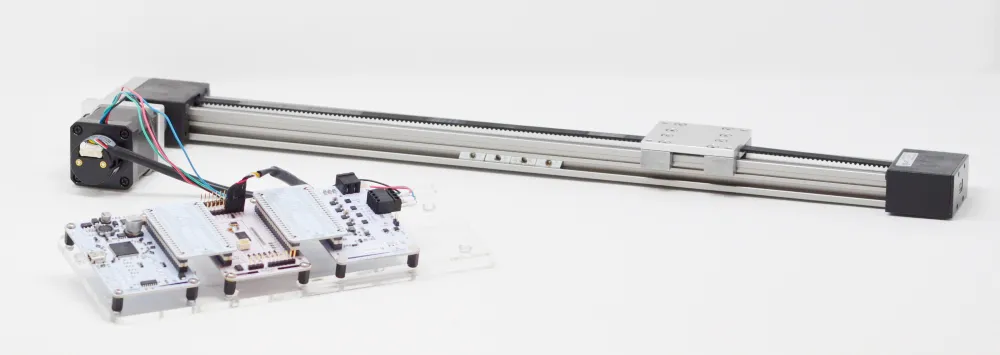

In the previous blog post, we were able to determine stable P-I parameters for the cascaded controller loop. With this knowledge, we would like to show you how we created a small example program and placed it in the Landungsbrücke firmware.
The basic function of this code is to initialize the stepper motor control.TMC4671This is done in init_Basics(...) by writing a few configuration registers, while reset_Basics(...) resets all registers used in this work to a defined 0 state. This replaces the first step of using the default button in the IDE configuration wizard.
The configure_ABN(...) function sets the ABN count to 0 after power-factor adjustment of the rotor to 0. To do this, we also need to apply voltage to the flux.
init_PosMode(...) sets the correct registers for the TMC4671 to enter position mode.
Using TMC4671_setAbsolutTargetPosition(...), the controller's target position is set to the desired value, causing the motor to turn until it reaches the target position. The absolute position here always refers to the zero position that we configured in the configure_ABN(...) function.
Note: If you want to move relative to the actual position, you can use the function TMC4671_setRelativeTargetPosition(...).
To find the minimum and maximum positions of my setup, I selected two unreachable target positions in “Find Target Position” (...). For me, these were 500000 and -500000. The controller waits a certain time to ensure that it reaches the end position. Then the actual position is saved using the function TMC4671_getActualPosition(...). The same setup is performed in the other direction. The two endpoint values can now be used for new target positions, which can again be set using TMC4671_setAbsolutTargetPosition(...).
During runtime, acceleration and deceleration can also be implemented using a linear ramp with the function TMC_ramp_linear_compute(...) and a structure of type TMC_LinearRamp (more information can be found in the API in files LinearRamp1.h and LinearRamp1.c). This creates a ramp in software that contains our trajectory information. I also set some parameters of the structure using the corresponding functions from the above files. I can set the ramp target position using TMC_ramp_linear_set_target position(...) in the structure. After that, I use the ramp position calculated in TMC4671_setAbsolutTargetPosition(calculated_ramp), looping until the actual target position is reached.
What does the ramp do? Instead of setting an absolute target position that can be reached with a single command, we divide the trajectory into multiple sub-target positions. In each iteration of the loop, we increment the target position, and the controller adjusts to the new target. However, Landungsbrücke increases the target position faster than our controller can adapt, so over time the difference between the target position and the actual motor position grows. As the offset between the actual position and the target position increases, this causes the motor to accelerate.
Deceleration is the opposite. Landungsbrücke reduces the rate at which the target position is set, and the controller slowly catches up until the end position is reached.
To increase the motor speed, I multiplied the actual ramp position by 1024. This must be compensated for by dividing the target position of the software ramp by 1024. This allows us to adapt the ramp to our application and increase the motor's acceleration and speed.
Why use a (software) ramp? Basically, it gives us a more stable way to reach our target position because we have a defined method for acceleration and deceleration; it greatly reduces the possibility of overshooting the target.
Landungsbrücke alternates these target positions in the TMC4671 registers, so the motor will alternate between the sliding positions.
Using the completed code, I generate a hex file for the Landungsbrücke bootloader and update it using TMCL-IDE.
I hope you can use some of the examples shown so that you can convert digital information into physical motion for your project!
The following code will initialize my driver, perform encoder initialization, and reset the origin at both end stops. Then, it will perform a back-and-forth motion.
I can upload the firmware to the Landungsbrücke using TMCL-IDE, and it will start automatically after power-on. I can monitor system behavior via RTMI.
Code example:
#include "boards/Board.h"#include "hal/derivative.h"
#include "hal/HAL.h"
#include "tmc/IdDetection.h"
#include "tmc/TMCL.h"
#include "tmc/VitalSignsMonitor.h"
#include "tmc/BoardAssignment.h"
#include "tmc/ramp/LinearRamp1.h"
#include "TMC-API/tmc/ic/TMC4671/TMC4671.h"
#include "TMC-API/tmc/ic/TMC4671/TMC4671_Register.h" //As I use the names of its registers this needs to be included//mydefines
#define STATE_START_INIT 1
#define STATE_RUN_1 2
#define STATE_RUN_2 3#define UD_EXT 3202
//Torque-Flux Limits 15000
#define TORQUE_FLUX_LIMIT 10000
//Velocity Limit 10000
#define VELOCITY_LIMIT 10000
//P-I-defines
#define TORQUE_FLUX_P 4952
#define TORQUE_FLUX_I 10939
#define VELOCITY_P 2200
#define VELOCITY_I 2000
#define POSITION_P 45
#define POSITION_I 0//for checking motor supply voltage
#define VM_FACTOR 713
#define ADC_VM_RES 65535 //Landungsbruecke define -- change for Startrampe//Software-Ramp defines
#define STEPDIR_FREQUENCY (1 << 17)
#define STEPDIR_MAX_VELOCITY (1 << 20)
#define STEPDIR_MAX_ACCELERATION 2147418111
#define STEPDIR_DEFAULT_ACCELERATION 100000
#define STEPDIR_DEFAULT_VELOCITY STEPDIR_MAX_VELOCITY
#define RAMP_SPEED_FACTOR 1024
//end mydefinesvoid init_PosMode(uint8_t motor)
{ //Set registers needed for position mode
//tmc4671_writeInt(motor, TMC4671_VELOCITY_SELECTION, TMC4671_VELOCITY_PHI_M_ABN);
tmc4671_writeInt(motor, TMC4671_PID_TORQUE_FLUX_TARGET_DDT_LIMITS, 32767); //max
tmc4671_writeInt(motor, TMC4671_PIDOUT_UQ_UD_LIMITS, 32767); //max
tmc4671_writeInt(motor, TMC4671_PID_TORQUE_FLUX_LIMITS, TORQUE_FLUX_LIMIT);
tmc4671_writeInt(motor, TMC4671_PID_ACCELERATION_LIMIT, 2147483647);
tmc4671_writeInt(motor, TMC4671_PID_VELOCITY_LIMIT, VELOCITY_LIMIT);
tmc4671_writeInt(motor, TMC4671_PID_POSITION_LIMIT_LOW, 0x80000001);
tmc4671_writeInt(motor, TMC4671_PID_POSITION_LIMIT_HIGH, 0x7FFFFFFF);
tmc4671_writeInt(motor, TMC4671_PHI_E_SELECTION, 0x00000003); //phi_e_abn
tmc4671_writeInt(motor, TMC4671_VELOCITY_SELECTION, TMC4671_VELOCITY_PHI_M_ABN);
tmc4671_writeInt(motor, TMC4671_POSITION_SELECTION, TMC4671_POSITION_PHI_M_ABN); //phi_m_abn
tmc4671_writeInt(motor, TMC4671_MODE_RAMP_MODE_MOTION, 0x00000003); //position mode//The following gain-values were determined using the USB-2-RTMI and following the PI-tuning guide
tmc4671_setTorqueFluxPI(motor, TORQUE_FLUX_P, TORQUE_FLUX_I); //(motor, P, I)
tmc4671_setVelocityPI(motor, VELOCITY_P, VELOCITY_I);
tmc4671_setPositionPI(motor, POSITION_P, POSITION_I);
}//Check VM
uint32_t current_VM()
{
uint32_t VM;VM = *HAL.ADCs->VM; // read ADC value for motor supply VM
VM = (VM*VM_FACTOR)/ADC_VM_RES; // calculate voltage from ADC valuereturn VM;
}
//End Check VMvoid init_Basics(uint8_t motor)
{
//Configure basic registers like motor type, adc-offsettmc4671_writeInt(motor, TMC4671_MOTOR_TYPE_N_POLE_PAIRS, 0x00020032); //x0002 - Stepper, x0032 = 50 polepairs
tmc4671_writeInt(motor, TMC4671_PWM_POLARITIES, 0x00000000);
tmc4671_writeInt(motor, TMC4671_PWM_MAXCNT, 0x00000F9F); //Maxcount of PWM-counter
tmc4671_writeInt(motor, TMC4671_PWM_BBM_H_BBM_L, 0x00001919); //Break before make times
tmc4671_writeInt(motor, TMC4671_PWM_SV_CHOP, 0x00000007); //turn on PWM//Configure ADC -- Values were taken from the ide after the set offset option was used
tmc4671_writeInt(motor, TMC4671_ADC_I_SELECT, 0x18000100); // configure ADC-Inputs
tmc4671_writeInt(motor, TMC4671_dsADC_MCFG_B_MCFG_A, 0x00100010); // configure ADCs
tmc4671_writeInt(motor, TMC4671_dsADC_MCLK_A, 0x20000000); // turn on clock-signal for group-A ADCs
tmc4671_writeInt(motor, TMC4671_dsADC_MCLK_B, 0x00000000); // turn off clock-signal for group-B ADCs
tmc4671_writeInt(motor, TMC4671_dsADC_MDEC_B_MDEC_A, 0x014E014E); // Constants for filter
tmc4671_writeInt(motor, TMC4671_ADC_I0_SCALE_OFFSET, 0x01005D80); // Fill in the offsets determined in the IDE
tmc4671_writeInt(motor, TMC4671_ADC_I1_SCALE_OFFSET, 0x01005CEF); // Fill in the offsets determined in the IDE// Open loop settings
tmc4671_writeInt(motor, TMC4671_OPENLOOP_MODE, 0x00000000);
tmc4671_writeInt(motor, TMC4671_OPENLOOP_ACCELERATION, 0x0000003C);
tmc4671_writeInt(motor, TMC4671_OPENLOOP_VELOCITY_TARGET, 0x00000000);
tmc4671_writeInt(motor, TMC4671_OPENLOOP_PHI, 0x00000000);// Feedback selection
tmc4671_writeInt(motor, TMC4671_PHI_E_SELECTION, 0x00000000);
tmc4671_writeInt(motor, TMC4671_MODE_RAMP_MODE_MOTION, 0x00000008);
//tmc4671_writeInt(motor, TMC4671_UQ_UD_EXT, 0x00000F9F);
tmc4671_writeInt(motor, TMC4671_ABN_DECODER_PPR, 0x00009C40);//Set Limits
tmc4671_writeInt(motor, TMC4671_PID_TORQUE_FLUX_TARGET_DDT_LIMITS, 0x7FFF); //max
tmc4671_writeInt(motor, TMC4671_PIDOUT_UQ_UD_LIMITS, 32767); //max
tmc4671_writeInt(motor, TMC4671_PID_TORQUE_FLUX_LIMITS, TORQUE_FLUX_LIMIT);
tmc4671_writeInt(motor, TMC4671_PID_ACCELERATION_LIMIT, 2147483647);
tmc4671_writeInt(motor, TMC4671_PID_VELOCITY_LIMIT, VELOCITY_LIMIT);
tmc4671_writeInt(motor, TMC4671_PID_POSITION_LIMIT_LOW, 0x80000001);
tmc4671_writeInt(motor, TMC4671_PID_POSITION_LIMIT_HIGH, 0x7FFFFFFF);}
void reset_Basics(uint8_t motor)
{
//reset registers of TMC4671 that will later be used to 0
wait(1500);
tmc4671_writeInt(motor, TMC4671_PWM_SV_CHOP, 0);
tmc4671_writeInt(motor, TMC4671_MOTOR_TYPE_N_POLE_PAIRS, 0);
tmc4671_writeInt(motor, TMC4671_PWM_POLARITIES, 0);
tmc4671_writeInt(motor, TMC4671_PWM_MAXCNT, 0);
tmc4671_writeInt(motor, TMC4671_PWM_BBM_H_BBM_L, 0);tmc4671_writeInt(motor, TMC4671_ADC_I_SELECT, 0);
tmc4671_writeInt(motor, TMC4671_dsADC_MCFG_B_MCFG_A, 0);
tmc4671_writeInt(motor, TMC4671_dsADC_MCLK_A, 0);
tmc4671_writeInt(motor, TMC4671_dsADC_MCLK_B, 0);
tmc4671_writeInt(motor, TMC4671_dsADC_MDEC_B_MDEC_A, 0);
tmc4671_writeInt(motor, TMC4671_ADC_I0_SCALE_OFFSET, 0);
tmc4671_writeInt(motor, TMC4671_ADC_I1_SCALE_OFFSET, 0);tmc4671_writeInt(motor, TMC4671_OPENLOOP_MODE, 0);
tmc4671_writeInt(motor, TMC4671_OPENLOOP_ACCELERATION, 0);
tmc4671_writeInt(motor, TMC4671_OPENLOOP_VELOCITY_TARGET, 0);tmc4671_writeInt(motor, TMC4671_PHI_E_SELECTION, 0);
tmc4671_writeInt(motor, TMC4671_MODE_RAMP_MODE_MOTION, 0);
tmc4671_writeInt(motor, TMC4671_UQ_UD_EXT, 0);
tmc4671_writeInt(motor, TMC4671_ABN_DECODER_PPR, 0);tmc4671_writeInt(motor, TMC4671_PID_TORQUE_FLUX_TARGET_DDT_LIMITS, 0);
tmc4671_writeInt(motor, TMC4671_PIDOUT_UQ_UD_LIMITS, 0);
tmc4671_writeInt(motor, TMC4671_PID_TORQUE_FLUX_LIMITS, 0);
tmc4671_writeInt(motor, TMC4671_PID_ACCELERATION_LIMIT, 0);
tmc4671_writeInt(motor, TMC4671_PID_VELOCITY_LIMIT, 0);
tmc4671_writeInt(motor, TMC4671_PID_POSITION_LIMIT_LOW, 0);
tmc4671_writeInt(motor, TMC4671_PID_POSITION_LIMIT_HIGH, 0);
tmc4671_writeInt(motor, TMC4671_PHI_E_SELECTION, 0);
tmc4671_writeInt(motor, TMC4671_VELOCITY_SELECTION, 0);
tmc4671_writeInt(motor, TMC4671_POSITION_SELECTION, 0);
tmc4671_writeInt(motor, TMC4671_MODE_RAMP_MODE_MOTION, 0);
tmc4671_writeInt(motor, TMC4671_PID_POSITION_TARGET, 0);
tmc4671_writeInt(motor, TMC4671_PID_POSITION_ACTUAL, 0);
tmc4671_setTorqueFluxPI(motor, 0, 0); //(motor, P, I)
tmc4671_setVelocityPI(motor, 0, 0); // (motor, P, I)
tmc4671_setPositionPI(motor, 0, 0); // (motor, P, I)}
void init_softwareRamp(TMC_LinearRamp *linearRamp)
{
tmc_ramp_linear_init(linearRamp);
tmc_ramp_linear_set_mode(linearRamp, TMC_RAMP_LINEAR_MODE_POSITION);
tmc_ramp_linear_set_maxVelocity(linearRamp, STEPDIR_DEFAULT_VELOCITY);
tmc_ramp_linear_set_acceleration(linearRamp, STEPDIR_DEFAULT_ACCELERATION);}
void find_targetPositions(uint8_t motor, int32_t *lower_End, int32_t*upper_End)
{
tmc4671_setAbsolutTargetPosition(motor, 500000); // ~ 7.5 motor turns
wait(1500);
/* After slide reached one end of the setup the absolute position is stored in memory
For convenience I reduce the value of the target position to be saved a little,
* as driving into the endposition with full force is annoyingly loud :)
* if this is your goal just remove the +/- 1000 */
*lower_End = (tmc4671_getActualPosition(motor)-1000);
tmc4671_setAbsolutTargetPosition(motor, 0); //return to the starting position
wait(1000);// Assumed an unreachable position so the slide reaches the other side of the setup
tmc4671_setAbsolutTargetPosition(motor, -500000); // ~ -7.5 motor turns
wait(1500);
// After slide reached the other end of the setup the absolute position is stored in memory
*upper_End = (tmc4671_getActualPosition(motor)+1000);
tmc4671_setAbsolutTargetPosition(motor, 0);
wait(1500);
}void configure_ABN(uint8_t motor, uint16_t startVoltage)
{
// set ABN_DECODER_PHI_E_OFFSET to zero
tmc4671_writeRegister16BitValue(motor, TMC4671_ABN_DECODER_PHI_E_PHI_M_OFFSET, BIT_16_TO_31, 0);
// select phi_e_ext
tmc4671_writeRegister16BitValue(motor, TMC4671_PHI_E_SELECTION, BIT_0_TO_15, 1);
// set an initialization voltage on UD_EXT (to the flux, not the torque!)
tmc4671_writeRegister16BitValue(motor, TMC4671_UQ_UD_EXT, BIT_16_TO_31, 0);
tmc4671_writeRegister16BitValue(motor, TMC4671_UQ_UD_EXT, BIT_0_TO_15, startVoltage);
// set the "zero" angle
tmc4671_writeRegister16BitValue(motor, TMC4671_PHI_E_EXT, BIT_0_TO_15, 0);
tmc4671_writeInt(motor, TMC4671_ABN_DECODER_MODE, 0x00001000);
//Set PHI_E to 0° angle so the rotor alignes itself with it
tmc4671_writeInt(motor, TMC4671_PHI_E_SELECTION, 0x00000000);
wait(4000);
tmc4671_readRegister16BitValue(motor, TMC4671_ABN_DECODER_PHI_E_PHI_M, BIT_16_TO_31);
//After the rotor has aligned this will set the ABN_DECODER_COUNT to 0 so there is a defined 0-position
tmc4671_writeInt(motor, TMC4671_ABN_DECODER_COUNT, 0);
}
void tmc4671setPositionModeAndRun(uint8_t motor, uint8_t *initState, uint16_t startVoltage, int32_t *upper_End, int32_t *lower_End, TMC_LinearRamp *linearRamp)
{
/*State Machine with state-pointer *initState and 3 states
* STATE_START_INIT: Sets TMC4671-registers for my application and configures the ABN-Encoder
* Drives to the ends of the track to get the actual min/max position values
* Drives to the first end position
*
* STATE_RUN_1: Drives to one end and changes direction when the *lower_End is reached
*
* STATE_RUN_2: Drives to the other end and changes direction when *upper_End is reached
*/
switch (*initState)
{
case STATE_START_INIT:
//reset TMC4671 registers
reset_Basics(motor);
//set TMC4671 registers with basic data like motortype, number of polepairs and so on
init_Basics(motor);//initialize the software ramp
init_softwareRamp(linearRamp);
//configure ABN
configure_ABN(motor, startVoltage);//Enter position-Mode
init_PosMode(motor);//configure the end positions and store them in *lower_End and *upper_End
find_targetPositions(motor, lower_End, upper_End);*initState = STATE_RUN_1;
//set the first target position using the software ramp
tmc_ramp_linear_set_targetPosition(linearRamp, (*lower_End/RAMP_SPEED_FACTOR));
break;
case STATE_RUN_1://drive from one end to the other: positive direction
tmc_ramp_linear_compute(linearRamp);
tmc4671_setAbsolutTargetPosition(motor, (RAMP_SPEED_FACTOR*tmc_ramp_linear_get_rampPosition(linearRamp)));
//When the target position is reached we will change direction
if(tmc4671_getActualPosition(motor) >= (*lower_End-RAMP_SPEED_FACTOR))
{
wait(50);
*initState = STATE_RUN_2;
tmc_ramp_linear_set_targetPosition(linearRamp, (*upper_End/RAMP_SPEED_FACTOR));
break;
}
*initState = STATE_RUN_1;
break;
case STATE_RUN_2:
//drive from one end to the other: negative direction
tmc_ramp_linear_compute(linearRamp);
tmc4671_setAbsolutTargetPosition(motor, (RAMP_SPEED_FACTOR*tmc_ramp_linear_get_rampPosition(linearRamp)));
//When the target position is reached we will change direction
if(tmc4671_getActualPosition(motor) <= (*upper_End + RAMP_SPEED_FACTOR))
{
wait(50);
*initState = STATE_RUN_1;
tmc_ramp_linear_set_targetPosition(linearRamp, (*lower_End/RAMP_SPEED_FACTOR));
break;
}
*initState = STATE_RUN_2;
break;
default:
*initState = 0;
break;
}
}const char *VersionString = MODULE_ID"V308"; // module id and version of the firmware shown in the TMCL-IDE
/* Keep as is! These lines are important for the update functionality. */
#if defined(Landungsbruecke)
const uint8_t Protection[] __attribute__ ((section(".cfmconfig")))=
{
0xFF, 0xFF, 0xFF, 0xFF, 0xFF, 0xFF, 0xFF, 0xFF, //Backdoor key
0xFF, 0xFF, 0xFF, 0xFF, //Flash protection (FPPROT)
0x7E, //Flash security (FSEC)
0xF9, //Flash option (FOPT)
0xFF, //reserved
0xFF //reserved
};struct BootloaderConfig {
uint32_t BLMagic;
uint32_t drvEnableResetValue;
};// This struct gets placed at a specific address by the linker
struct BootloaderConfig __attribute__ ((section(".bldata"))) BLConfig;
#endif/* Check if jumping into bootloader is forced */
/* */
/* In order to jump to bootloader e.g. because of an accidental infinite loop */
/* in a modified firmware you may short ID_CLK and ID_CH0 pins on start up. */
/* This will force the entrance into bootloader mode and allow to replace bad firmware. */
void shallForceBoot()
{
// toggle each pin and see if you can read the state on the other
// leave if not, because this means that the pins are not tied together
HAL.IOs->config->toOutput(&HAL.IOs->pins->ID_CLK);
HAL.IOs->config->toInput(&HAL.IOs->pins->ID_CH0);HAL.IOs->config->setHigh(&HAL.IOs->pins->ID_CLK);
if(!HAL.IOs->config->isHigh(&HAL.IOs->pins->ID_CH0))
return;HAL.IOs->config->setLow(&HAL.IOs->pins->ID_CLK);
if(HAL.IOs->config->isHigh(&HAL.IOs->pins->ID_CH0))
return;HAL.IOs->config->toOutput(&HAL.IOs->pins->ID_CH0);
HAL.IOs->config->toInput(&HAL.IOs->pins->ID_CLK);HAL.IOs->config->setHigh(&HAL.IOs->pins->ID_CH0);
if(!HAL.IOs->config->isHigh(&HAL.IOs->pins->ID_CLK))
return;HAL.IOs->config->setLow(&HAL.IOs->pins->ID_CH0);
if(HAL.IOs->config->isHigh(&HAL.IOs->pins->ID_CLK))
return;// not returned, this means pins are tied together
tmcl_boot();
}/* Call all standard initialization routines. */
static void init()
{
#if defined(Landungsbruecke)
// Default value: Driver enable gets set high by the bootloader
BLConfig.drvEnableResetValue = 1;
#endifHAL.init(); // Initialize Hardware Abstraction Layer
IDDetection_init(); // Initialize board detection
tmcl_init(); // Initialize TMCL communicationtmcdriver_init(); // Initialize dummy driver board --> preset EvalBoards.ch2
tmcmotioncontroller_init(); // Initialize dummy motion controller board --> preset EvalBoards.ch1VitalSignsMonitor.busy = 1; // Put state to busy
Evalboards.driverEnable = DRIVER_ENABLE;Evalboards.ch1.id = 0; // preset id for driver board to 0 --> error/not found
Evalboards.ch2.id = 0; // preset id for driver board to 0 --> error/not found// We disable the drivers before configurating anything
HAL.IOs->config->toOutput(&HAL.IOs->pins->DIO0);
HAL.IOs->config->setHigh(&HAL.IOs->pins->DIO0);IdAssignmentTypeDef ids = { 0 };
IDDetection_initialScan(&ids); // start initial board detection
IDDetection_initialScan(&ids); // start second time, first time not 100% reliable, not sure why - too fast after startup?
if(!ids.ch1.id && !ids.ch2.id)
{
shallForceBoot(); // only checking to force jump into bootloader if there are no boards attached
HAL.IOs->config->toOutput(&HAL.IOs->pins->ID_CLK);
HAL.IOs->config->toInput(&HAL.IOs->pins->ID_CH0);
}
Board_assign(&ids); // assign boards with detected idVitalSignsMonitor.busy = 0; // not busy any more!
}/* main function */
int main(void)
{
//initialise some pointers
//state pointer for fsm
uint8_t init_State = STATE_START_INIT;
uint8_t *initState;
initState = &init_State;//store one end of the track
int32_t upper_end = 0;
int32_t *upper_End;
upper_End= &upper_end;//store the other end
int32_t lower_end = 0;
int32_t *lower_End;
lower_End= &lower_end;//convenience
uint8_t motor = 0;//"flipflop"
uint8_t block = 0;//struct used for the software ramp - see \TMC-API\tmc\ramp\LinearRamp1.h for typedef etc.
TMC_LinearRamp adressRamp;
TMC_LinearRamp *aRamp;
aRamp = &adressRamp;init();
// Main loop
while(1)
{
// Check all parameters and life signs and mark errors
vitalsignsmonitor_checkVitalSigns();
// Perodic jobs of Motion controller/Driver boards
Evalboards.ch1.periodicJob(systick_getTick());Evalboards.ch2.periodicJob(systick_getTick());
// Process TMCL communication
tmcl_process();if (Evalboards.ch1.id != ID_TMC4671)
continue;if(current_VM()<20){
tmc4671_writeInt(motor, TMC4671_PWM_SV_CHOP, 0); // Turn off PWM after unexpected reset
reset_Basics(motor); // Set the registers needed in this example to a defined default state
continue;
}if(block == 0)
{
tmc4671_writeInt(motor, TMC4671_PWM_SV_CHOP, 0); //Turn of PWM-Register after SPI was initialized
reset_Basics(motor);
block = 1;
}
tmc4671setPositionModeAndRun(motor, initState, UD_EXT, lower_End, upper_End, aRamp);
}return 0;
}