
In the field of real-time control MCUs, TI's C2000 series is an unavoidable name. Motor control and digital power—scenarios with the most demanding real-time requirements—have long had their standards defined by C2000 over the past 30 years. It is not just a chip series, but a validated real-time control platform. Domestic chips have made progress in mid- and low-end replacement, but the high-end market has long been monopolized by international vendors, with almost no domestic solution able to reach it.
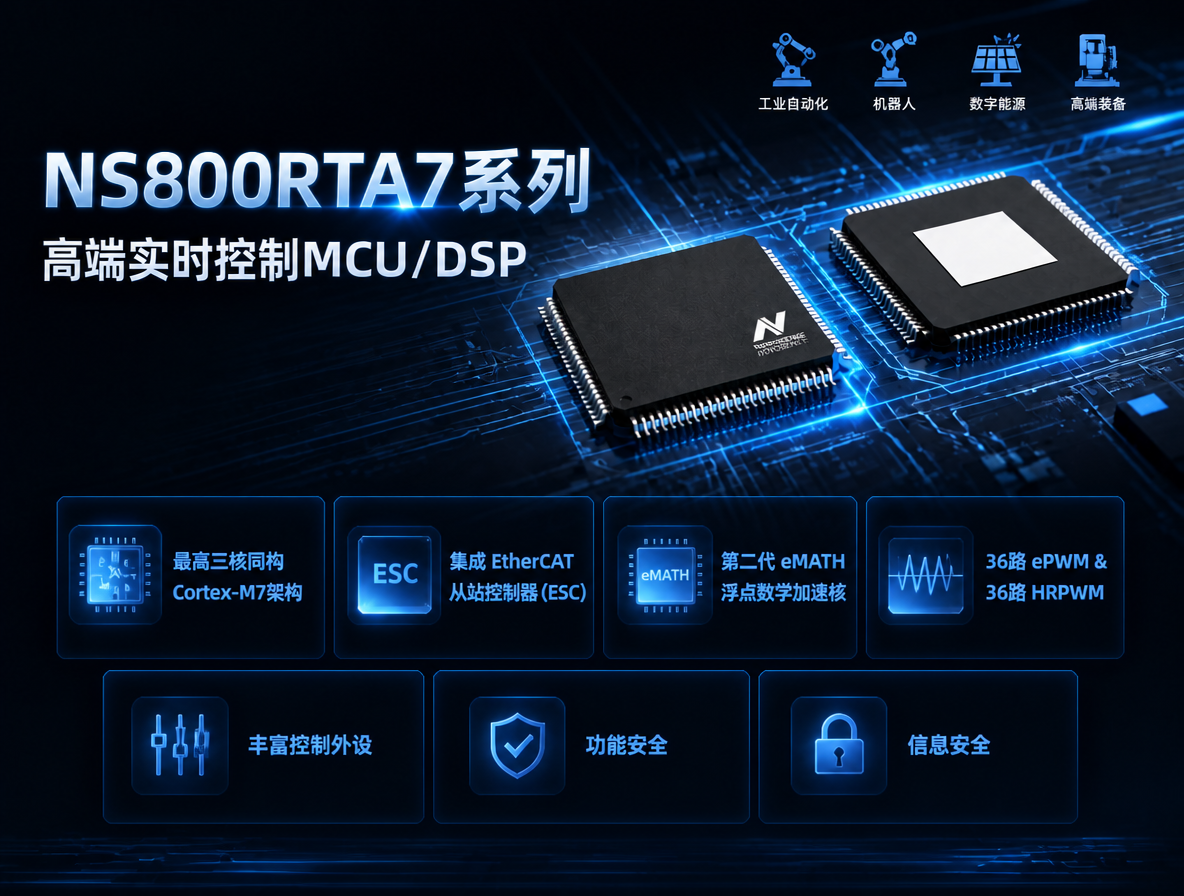
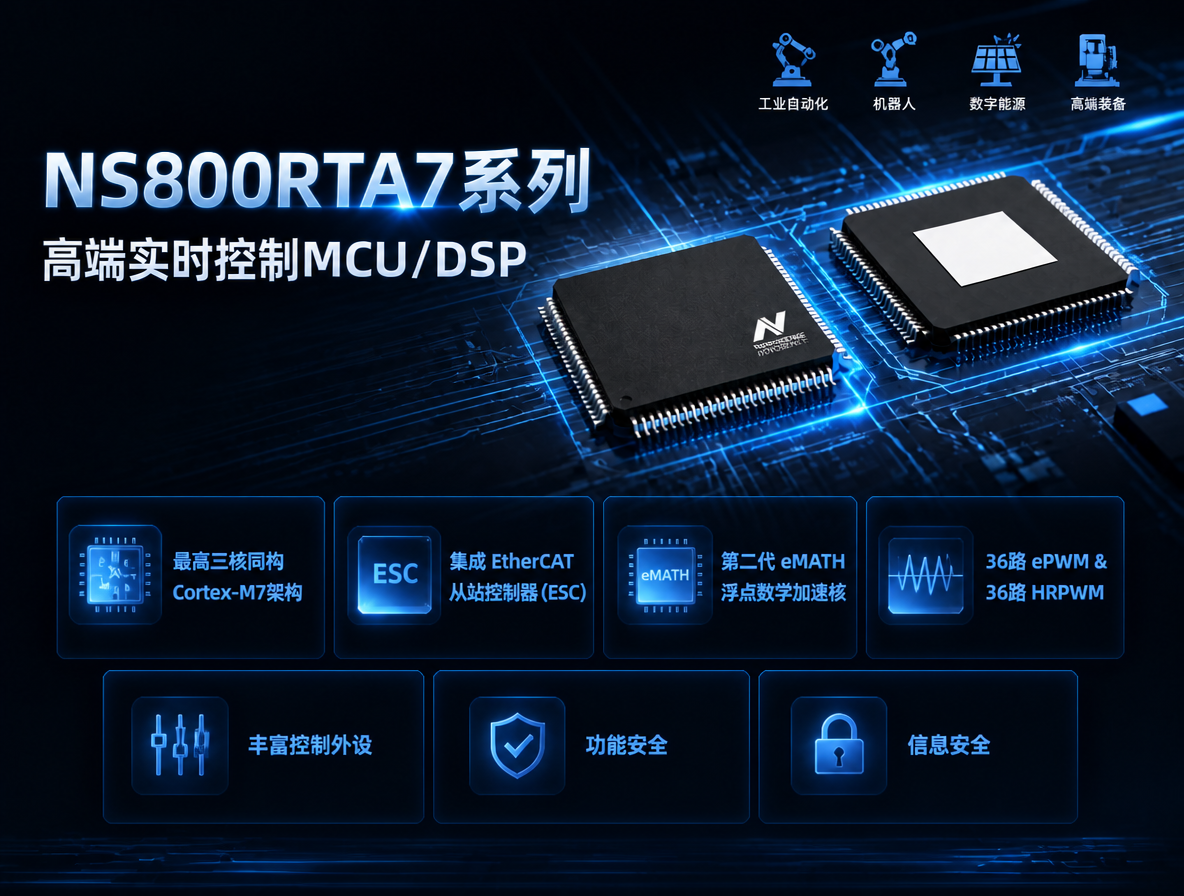
In July 2026, NOVOSENSE exhibited the NS800RTA7 series real-time control MCU at electronica China in Shanghai. This is its current product line with the highest computing power—up to triple-core Cortex-M7, an on-chip integrated EtherCAT slave controller, and a second-generation eMATH mathematical accelerator. The debut of this series completes NOVOSENSE's real-time control MCU platform with a full computing-power spectrum from the RT1 entry level to flagship, expanding its product line to five series and more than 90 standardized part numbers. Unlike the cost-effectiveness approach that domestic MCUs have used in the mid- and low-end markets in the past, this series directly targets the high-end market.
Domestic real-time control MCUs have launched a systematic assault on the high-end heartland. Parameters are only an entry ticket; can the NS800RTA7 gain a firm foothold here? The answer lies in more complex matters—when the opponent's moat is not just performance but also decades of accumulated trust, ecosystem, and functional safety certification system, on what basis and how can a domestic chip company bypass it?
I. Current State of Domestic Substitution: Volume in the Mid- and Low-End, Absence in the High-End
At present, the substitution landscape for domestic MCUs shows the characteristics of 'volume in the mid- and low-end, absence in the high-end.'
From a market share perspective, according to industry data, Chinese manufacturers' share of the mid- and low-end MCU market has risen to 35%, but their products are mainly concentrated in low-value-added fields such as consumer electronics and small home appliances. The low-end market is highly competitive, products are severely homogenized, and profit margins have been significantly compressed.
In the niche segment of real-time control MCUs, the landscape is even more uneven. The global real-time control MCU market has long been monopolized by Texas Instruments' C2000 series. With 30 years of technological accumulation and strong customer stickiness, TI has built barriers that are difficult to overcome. The C2000 series has long dominated fields such as motor control, digital power, industrial automation, renewable energy, and automotive electronics.
At present, in the mid- and low-end market, NOVOSENSE has already achieved a substantive breakthrough. Take the NS800RT5 series launched in November 2024 as an example: this series uses an Arm Cortex-M7 core and, in key metrics such as a 260 MHz main frequency, 100 ps HRPWM accuracy, and a TCM zero-wait memory architecture, has product capabilities comparable to C2000 products at the same level. In June last year, we publishedNOVOSENSE NSSine™ NS800RT Takes On TI C2000 Head-On: The 'Chip' Battle of Domestic Substitution—Is the Industrial Control MCU Market Facing a Shake-Up?In this article, we provided a detailed technical comparison and analysis; at the mid- and low-end level, the RT5 series already has the hardware foundation to replace mainstream C2000 models.
But the high-end market's requirements for chips are not just 'adequate specifications'—native deep integration of EtherCAT, real-time task allocation in multi-core architectures, functional safety certification systems, long-term stable supply, and on-site support. Each of these is a hard requirement that customers consider when making selection decisions, and they are also shortcomings that domestic chips have found difficult to cover in the past.
The emergence of the NS800RTA7 series is precisely a high-end breakthrough attempt against this backdrop.
II. Product Capabilities of the NS800RTA7 Series
The NS800RTA7 series currently includes three sub-models:
- NS800RTA7P65DE:200MHz + 400MHz dual-core M7, targeting single-axis servo;
- NS800RTA7P66DE:2×400MHz dual-core M7, targeting dual-axis servo;
- NS800RTA7P66TE:2×400MHz + 200MHz triple-core M7, targeting six-axis industrial robots.
All three models are pin-compatible across the full series and share consistent peripheral resources; the main differences are the number of cores and the frequency combination. Customers can upgrade from dual-core to triple-core solutions on the same PCB platform according to product positioning, without redesigning the circuit board.
Homogeneous triple-core architecture
The NS800RTA7 series chose a homogeneous M7 approach rather than heterogeneous multi-core. Song Kunpeng, MCU Marketing Director at NOVOSENSE, gave a clear explanation when discussing this choice: 'Most vendors on the market choose heterogeneous multi-core architectures, which impose many restrictions on customer task allocation. We abandoned the heterogeneous solution precisely to provide customers with highly flexible platform-based development space.'
In traditional heterogeneous solutions, the instruction sets of the main core and communication core are incompatible, task allocation is hard-locked by hardware, the communication core cannot run control algorithms, and running protocol stacks on the main core also takes up compute resources; adding new functions later often requires refactoring the code framework. The engineering value of the homogeneous architecture lies in the fact that code for the three M7 cores can be migrated seamlessly, developers do not need to learn two instruction sets and development paradigms, and compute resources are fully open to customers and can be freely allocated according to their own algorithm characteristics.
Take the typical application of the NS800RTA7P66TE triple-core model as an example:
- CPU1 (400MHz): responsible for the current-loop calculations of the first three axes' motors;
- CPU2 (400MHz): responsible for the current-loop calculations of the last three axes' motors;
- CPU3 (200MHz): handles EtherCAT communication and the speed-loop and position-loop calculations for all six axes.
The current loop is the most delay-sensitive part of real-time control and is handled separately by two independent 400MHz cores. EtherCAT communication is processed by an independent core and does not interfere with the control loops. Under the measured 125μs standard communication frame period, overall CPU load is only about 2%.
EtherCATOn-chip Integration
The EtherCAT slave controller of the NS800RTA7P6x series is directly integrated on chip and connected directly to the core through an internal bus, rather than through an external standalone ESC chip via SPI.
The engineering benefits of internal integration are directly reflected at multiple levels:
ESC operation requires almost no MCU involvement in data reading and writing, resulting in zero CPU usage for low-level communication; application-layer protocol stack processing accounts for about 2% CPU load and barely takes compute resources away from the control loops. At the same time, the ESC has a built-in independent 16KB dedicated RAM that does not occupy the chip's own SRAM resources.
In contrast, traditional solutions use an MCU with an external ESC chip communicating over SPI, which not only increases communication latency and overall system failure rate but also increases BOM cost and PCB area.
Measured data: RTA7 operates stably with an ultra-short 50 μs communication cycle; with the standard 125 μs communication cycle, the MCU's overall computational load is about 2%; multi-node clock synchronization jitter is less than 30 ns.
Second-Generation eMATH Math Accelerator
In the NS800RTA7 series, each CPU core is associated with a second-generation eMATH digital computing accelerator. Compared with the previous generation, the second-generation eMATH nearly doubles overall computing performance.
Specific figures: single-precision Sin operation is 6× faster than pure software on an ARM core; Cos is 7× faster; square root is 3× faster. Operations such as FFT, FIR, and convolution are all supported by hardware acceleration units.
NOVOSENSE conducted a comparison in an FOC control test—running the same FOC current-loop algorithm (Clarke transform, Park transform, inverse Park transform, and PID control) on a chip equipped with a 400 MHz M7 + second-generation eMATH and on a commercially available 600 MHz general-purpose MCU. The completion times were essentially the same. This FOC algorithm requires only 132 CPU cycles, for a total time of about 330 ns.
Functional Safety and Information Security
The hardware architecture of the industrial-grade NS800RTA7 series complies with IEC 61508 SIL2, while the automotive-grade products support ISO 26262 ASIL B. In terms of information security, this series is the first to integrate an asymmetric hardware encryption engine in a real-time control MCU—while retaining AES, SHA, and TRNG, it adds RSA 4096-bit and ECC 521-bit hardware encryption capabilities. ECC memory error correction covers eFlash, SRAM, and TCM across the board.
The package options include two compact BGAs: 9 mm × 9 mm BGA169 and 13 mm × 13 mm BGA256, while retaining HLQFP176 and HLQFP100.
Ecosystem Development
Software development for the NS800RTA7 series is compatible with Keil MDK and IAR EWARM, and Novosense's self-developed NovoStudio development platform is also provided. On the operating system side, Novosense has joined RT-Thread as a senior member; the entire RTA7 series has completed RT-Thread porting and also supports FreeRTOS and uC/OS-II. Supporting tools include the NovoMonitor real-time debugging tool, NovoClbConfig graphical CLB configuration software, evaluation boards, and hardware emulators.
III. Comparison with TI High-End Products
The following lists the model names and comparison relationships. The main comparison target is TI F28388D (currently the closest competitor on the market to the RTA7 positioning), while F29H850TU is also listed as a technology-direction reference for TI's latest-generation flagship.
| Model | NS800RTA7P66TE | TMS320F28388D | F29H850TU (Reference) |
| Core Architecture and CPU Configuration | Triple-core Cortex-M7 (2×400 MHz + 200 MHz), homogeneous design | Dual-core C28x (200 MHz) + Cortex-M4 (125 MHz) + 2×CLA, heterogeneous design | Triple-core C29x (200 MHz), configurable lockstep |
| Maximum clock frequency | 400MHz | 200MHz(C28x)/125MHz(CM4) | 200MHz |
| On-chip Flash capacity | 1792KB | 1.5MB | 4MB |
| ADC specifications | 4× 12-bit ADCs, 5 Msps, 55 channels | 4 ADCs (12/16-bit configurable), 3.5 Msps in 12-bit mode | 5 ADCs (2×16-bit + 3×12-bit), up to 80 channels |
| PWM channels and resolution | 36 channels, HRPWM 80ps @ 200MHz | 32 PWM channels (16 HRPWM channels), MEP minimum 150ps | 36 HRPWM channels, 75ps resolution |
| EtherCAT integration method | On-chip integration, direct internal bus connection | On-chip integration (CM-side access) | On-chip integration |
| Functional safety level | ASIL-B / SIL2 | Hardware ASIL-B / SIL2 (certified) | ASIL-D / SIL3 (target) |
| Package options | BGA256/169、HLQFP176/100 | NFBGA337、HLQFP176 | BGA256、HTQFP176/144/100 |
Note: The two chips have different architectures, so clock speed is not directly equivalent to compute performance. The C2000 series has advantages in DSP instruction density and industry ecosystem maturity; RTA7 has advantages in compute density, ARM ecosystem development cost, and integration level.
The F28388D uses a heterogeneous dual-core C28x + M4 solution, while the RTA7 follows a homogeneous triple-core M7 route—two different architectural design philosophies, each with its own applicable scenarios in real-time control. The F29H850TU is TI's latest-generation C29 VLIW architecture, with a functional safety target of ASIL D, representing TI's technical direction in high-end real-time control MCUs.
IV. Where does the difficulty in breaking into the high-end market lie?
"Parameter benchmarking is only an entry ticket. The real barriers in the high-end real-time control MCU market are not in the chip itself." As Song Kunpeng said in the interview, NOVOSENSE has a clear understanding of this judgment.
The first barrier is accumulated trust. TI's C2000 series has more than a decade of supply history in the high-end market and tens of thousands of volume shipment cases. However good a new chip's specifications may look, without volume validation and field refinement with customers, most customers will not risk replacing a mature solution. A major engineering taboo is validating the reliability of a new chip during mass production.
The second barrier is ecosystem lock-in. Customers' existing control code, debugging processes, and test plans are all built on the C2000 architecture. Changing the main controller is not swapping one chip; it is swapping an entire development toolchain and validation system.
The third barrier is the functional safety certification cycle. ASIL B certification typically takes one to two years from design to approval, and ASIL D takes even longer. This is a hard threshold for entering automotive electronics and high-end industrial scenarios, and it cannot be bypassed.
Facing these three barriers, NOVOSENSE's response is systematic, with each barrier matched by concrete implementation actions.
Addressing the trust barrier: controllable supply chain + platform-based pin compatibility + trust base in mid- to low-end products
At the supply chain level, NOVOSENSE uses fully domestic wafer manufacturing and packaging/testing processes, is not affected by overseas export controls and geopolitical fluctuations, and can sign long-term supply agreements with core customers, fundamentally avoiding the risk of supply chain disruption.
At the product level, models in the same series with different performance tiers use a platform-based pin-compatible design, with highly consistent pin definitions. Customers can derive multi-tier products from a single PCB platform, reducing hardware trial-and-error costs.
In terms of the trust foundation, the mid- and low-end models of the full NS800RT series (RT1/RT3/RT5) have achieved volume shipments in scenarios such as wind and solar energy storage, industrial servo, and automotive OBC, accumulating reliability validation data from leading customers and laying a trust foundation for the introduction of the high-end RTA7 series.
Addressing the ecosystem barrier: the ARM ecosystem reduces migration costs
The strategic rationale for the RT5 series choosing the ARM architecture lies precisely here—the ARM ecosystem's developer resources and toolchain maturity are far higher than those of proprietary architectures, and migration costs are controllable. Based on the standard Cortex-M7 architecture, it natively supports mainstream development tools such as Keil and IAR, so engineers do not need to relearn a proprietary toolchain.
At the software level, NOVOSENSE provides turnkey solutions for typical scenarios such as FOC motor control and digital power loops, along with complete peripheral driver libraries and algorithm libraries, shortening customers' product development cycles. At the operating system level, adaptation and porting for RT-Thread, FreeRTOS, and uC/OS-II have been completed.
Addressing the certification barrier: front-loaded hardware design + reuse of certification paths + synchronized automotive-grade planning
At the hardware level, the RTA7 series natively integrates safety mechanisms such as a Fault Management Unit (FMU), full-memory ECC, and multi-layer watchdog monitoring. Its hardware architecture meets ASIL-B/SIL2 requirements and provides a solid certification foundation.
At the process level, mid-range models such as the RT5 have already completed functional safety certification, establishing a validated certification process and methodology. The RTA7 series can reuse this mature path to shorten the certification cycle.
At the product planning level, AEC-Q100 Grade 1 automotive-grade models are offered, covering application requirements such as automotive OBC, thermal management, and BMS, aligning with the pace of localization in automotive electronics.
Individually, none of these conditions is enough to crack the high-end market. However, a complete product line, an open ARM ecosystem, a proven certification path, a controllable supply chain, and pin compatibility within the same series—combined—become factors that high-end customers actually consider during evaluation.
V. Conclusion
From the launch of the first RT5 product in November 2024 to the debut of the RTA7, in less than two years, NOVOSENSE has completed a full product line rollout from RT1 to RTA7—five series and more than 90 standardized models, covering the full computing power spectrum from entry-level to flagship. At the same time, it has advanced functional safety certification, implementation of the EtherCAT roadmap, construction of ARM ecosystem toolchains, and adaptation and porting to mainstream OSs such as RT-Thread.
Winning the high-end market will not happen overnight because of the launch of a single new product. But returning to the question at the beginning: On what basis can domestic vendors challenge the high-end heartland of the market?
With a product capability foundation built on homogeneous tri-core architecture, native EtherCAT, and hardware math acceleration; with the migration convenience brought by the ARM ecosystem; and with a complete product matrix from entry-level to flagship—these individual capabilities, taken together, form a systematic answer that bypasses the moat.
When someone is continuously building a complete product portfolio, obtaining certifications, building an ecosystem, and validating customer case studies, a noteworthy variable has already emerged in this market.
For more information about the NS800RTA7 series or to request samples, please contact: sky.xu@chiplinkstech.com; Mr. Xu, 18820174321.

Sample request attached

WeChat Official Account