
1. Mass-Production Surge: The Logic of Supply-Chain Cost Calculation Is Shifting

In July 2026, at a press conference, the Ministry of Industry and Information Technology (MIIT) gave a figure: China's complete humanoid robot output this year is expected to exceed 100,000 units. For reference, data from the Gaogong Robotics Research Institute shows domestic shipments of about 18,000 units in 2025—more than a fivefold increase within a year.
Behind the figure is intensive production capacity coming online. The retrofit of Tesla's Optimus Gen-3 Fremont factory is expected to be completed in Q3 (reports point to initial production in late July to August), civil construction at the Texas plant fully began in late June, and Musk said at the shareholder meeting that Phase I is expected to start production in 2027. Domestically, according to public plans: after UBTECH's Liuzhou plant begins production, its 2026 capacity will climb toward 10,000 units/year; AgiBot's 15,000th Genie G2 rolled off the line in June, with four factories—Shanghai Lingang Phase I, Zhangjiang, Chengdu, and Wuxi—running simultaneously; Unitree's IPO-funded capacity is 75,000 humanoid robots plus 115,000 quadruped robots; XPeng Robotics' Guangzhou plant Phase I is planned for 50,000 units, with monthly output expected to reach 1,000 units by year-end.
Mass production has arrived, but the supply chain's cost ledger is far from settled.
The industry consensus is currently: for a humanoid robot with a target selling price of $20,000, hardware BOM costs account for 50% to 60%. Joints are the most chip-dense part of the whole robot—for a mid-to-large humanoid robot with 31 degrees of freedom, a single joint module needs at least one magnetic encoder for angle feedback, one to three gate-driver ICs to drive a MOSFET full bridge, and six MOSFETs to form the bridge. For these three chip types alone, whole-robot demand exceeds 248 units. According to common industry BOM breakdown estimates, at first-tier brand price ranges, the chip BOM for one joint is between $20 and $40, and the joint chip cost for the whole robot is between $600 and $1,200.
In the R&D and testing phase, for the first-generation design, to be safe—R&D needs rapid validation without surprises—most joint chips tend to come from mature imported supply chains. Encoders from Melexis, Heidenhain, and Broadcom; gate drivers from TI, ST, and Infineon; MOSFETs from Infineon, Vishay, and others.
Doing this during the testing phase is reasonable. But mass production and testing follow two different sets of logic.
During the testing phase, with dozens of prototypes running in the lab, the engineering team's core requirement is to "get the functionality working first." Choosing a thoroughly validated imported chip—with clear datasheets, mature reference designs, and responsive FAE support—trades investment for certainty; no one argues over BOM cost at this point.
In the mass-production phase, as complete machines move from prototypes to the production line and scale from dozens of units to tens of thousands, three issues that could previously be set aside become unavoidable hard constraints.
Cost. The BOM cost of joint chips is USD 600 to 1,200 per unit, accounting for 5% to 10% of total hardware cost. When the complete machine's selling price must be kept within a certain range, the unit price of every chip is scrutinized under a microscope. During testing, a few dollars' difference per chip does not matter, but at a procurement scale of tens of thousands of units, it is magnified into a difference on the order of hundreds of thousands to millions of dollars.
Supply stability. In the sample phase, a few hundred chips are used, and either original manufacturer stock or small-batch supply from distributors is fine. But at tens of thousands of units per year, total demand for joint chips reaches the millions. At this point, batch-to-batch parameter consistency, predictability of production capacity, and stable lead times each directly affect whether the production line can be scheduled normally. The electronics industry as a whole already paid the price from 2021 to 2023 for the fragility of transoceanic supply chains during chip shortages and geopolitical fluctuations.
Technical support. When building prototypes, a datasheet plus a set of reference designs is basically enough. Once a mass-production line is involved, engineering problems in how chips fit with structural parts tend to erupt all at once—for example, if the current waveform ripple at a joint is too large, the cause may be parasitic inductance from the PCB layout or the selected value of the gate drive resistor. If EMC testing fails, PWM switching noise may have coupled onto sensor signal lines. For imported solutions, the barrier in such problems is not insufficient technical capability, but a natural pace mismatch between standardized technical support processes and the non-standardized real-world problems on the production line. Local chip vendors' technical support is relatively more convenient.
These three hard constraints—low cost, stable supply, and rapid response—will become entry barriers in the mass-production stage. Imported solutions win the first round in the testing stage thanks to maturity and ecosystem advantages, but in mass production, shortcomings such as cost premiums, delivery lead times, and localized engineering support will be exposed one by one.
And these three are exactly the natural strengths of domestic chips.
The general rule of industry selection cycles is: before the complete-machine solution is frozen, the supply chain has an evaluation window of one to two years. Humanoid robots are currently at the point where the first-generation solution has been delivered and the second-generation solution is under evaluation—mass-production lines are running, but the seats on the BOM list are not yet fully occupied. The window for domestic chips to enter the joint supply chain is not "promising in the future" but "happening now."
II. Teardown of the Joint Module: Three Layers of the Chip Signal Chain
The window argument holds, but where exactly do the opportunities within the window lie? To answer this question, first take apart a joint module and see clearly the chip signal chain inside.
A joint module of a humanoid robot is not a single part but a highly integrated electromechanical system. The most classic architecture includes a frameless torque motor, a reducer (harmonic/planetary), dual encoders, and a drive control circuit board, all compactly packaged in a single housing. The role of chips in this entire system can be divided into three layers by function:
Sensing layer—encoders. The joint needs to know the current angle of the motor rotor and the actual position reached by the output end after reduction. A magnetic encoder chip performs this task. A permanent magnet is attached to the end face of the motor rotor, and the encoder is fixed to the motor end cover. It senses changes in magnetic field direction without contact and outputs absolute angular position in real time. This position data is the eyes of the FOC vector control algorithm—a 0.1-degree angle error means a 0.1-degree deviation in torque control accuracy.
Drive layer — gate driver IC. The MCU calculates three-phase PWM signals based on the position error fed back by the encoder. However, the MCU only outputs 3.3 V logic levels; neither the voltage amplitude nor the drive current is enough to drive the six MOSFETs downstream. The role of the gate driver IC is to amplify the low-voltage logic signal to a 10–15 V gate drive voltage while providing electrical isolation between the control side and the power side. One dual-channel gate driver IC can drive two MOSFETs; a three-phase half-bridge requires three.
Power layer — MOSFETs. The signals output by the gate driver must ultimately become real current flowing into the motor windings. This task falls to the full bridge composed of six MOSFETs—they chop the DC bus voltage at high speed into three-phase AC waveforms; the magnetic field rotates, and the rotor follows. The MOSFETs' on-resistance and switching speed directly determine the joint's heat generation and efficiency.
These chips connected together form a complete signal chain:Encoder reads angle → MCU computes FOC → gate driver amplifies → MOSFETs chop → motor rotates → encoder reads angle again; the closed loop iterates repeatedly.At the reducer output end there is a second encoder, responsible for compensating for backlash and elastic deformation in the transmission chain—the motor-end encoder tells you 'the rotor rotated 10 degrees,' while the output-end encoder tells you 'the joint actually rotated 9.97 degrees'; the 0.03-degree difference in between is the error that the FOC algorithm needs to dynamically compensate. This is the dual-encoder full-closed-loop architecture recognized by the industry in 2026.
The three layers of chips each face challenges in the mass production stage, and the requirements they face are also different. This article focuses on the perception-layer encoder—what requirements mass production places on the perception layer, and where domestic solutions stand.
III. Domestic solutions for the perception layer: from magnetic encoders to inductive
The requirements that mass production places on perception-layer encoders can be summarized into four dimensions. Performance meets standards—different joints have hard thresholds for resolution, accuracy, and update rate; this is the entry ticket. Scenario adaptation—different working conditions such as light load, heavy load, and strong magnetic interference require differentiated technical routes; a one-size-fits-all solution does not hold up in mass production. Cost controllability—under the hard constraint of a $20,000 total machine price, the cost of a single encoder must fall within the target range set by the machine manufacturer; otherwise, no matter how excellent the performance, it will be difficult to deploy on a large scale in mass-produced models. Supply reliability—shipments at the ten-thousand-unit level mean demand for encoders at the million-unit level; batch consistency and delivery cycles are directly related to production line rhythm.
Among domestic encoder brands, MagnTek is one of the earliest brands to layout magnetic encoder chips in China, with over ten years of establishment, and has first-mover advantages and shipment accumulation in the domestic sensor track. After being acquired by NOVOSENSE in 2024, it stepped up to a new level—NOVOSENSE's digital isolator and driver product lines are exactly complementary to MagnTek's magnetic sensor product line. The same supplier can provide a complete chip combination of encoder + digital isolation + gate driver in joints, which is a real efficiency advantage in supply chain management.
In terms of technical routes, MagnTek's products cover three paths: differential Hall, AMR, and inductive, corresponding to joint scenarios with different accuracy levels and cost ranges. Below is a brief introduction to some models suitable for robot joints.
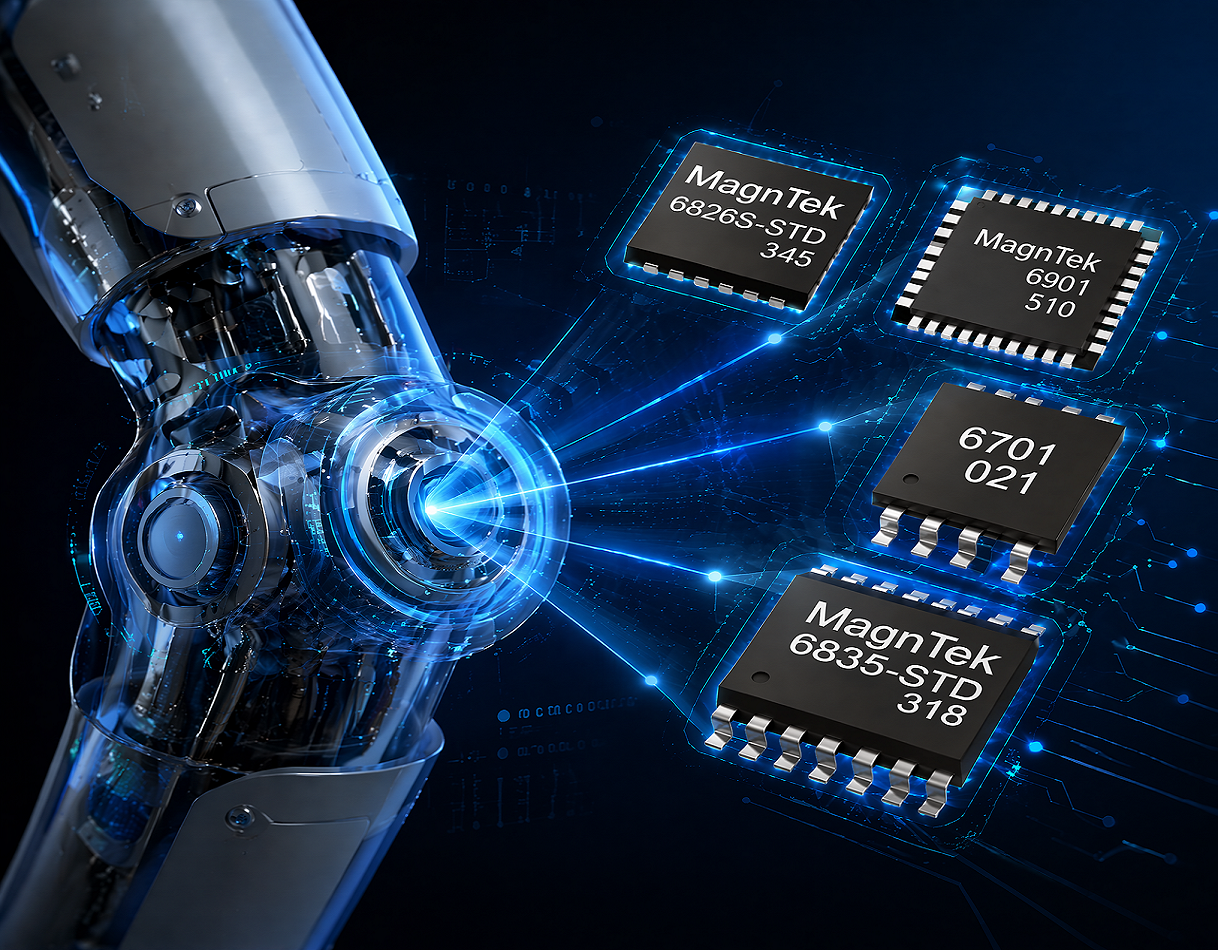
MT6701——Differential Hall, 14-bit absolute angle, SOP-8/QFN3×3 package, integrated with six output interfaces: I2C, SSI, ABZ, UVW, PWM, and analog voltage. Positioned for end effectors (finger grippers, expression servos), it provides 14-bit accuracy and complete interfaces at low cost. The engineering convenience of solving multiple signal requirements with a single chip is the core selling point.
MT6826S——AMR, 15-bit SPI absolute angle, ABZ supports 1 to 4,096 pulses/revolution, INL less than ±0.07 degrees after self-calibration. Positioned for light-load joints such as arms; the 15-bit resolution just crosses the threshold line for light-load joints.
MT6835——AMR flagship, 21-bit core resolution, ABZ maximum 16,384 pulses/revolution, angle output delay as short as 2 microseconds, INL less than ±0.07 degrees after self-calibration. Positioned for heavy-load leg joints; 21 bits far exceed the 17-bit threshold requirement, and the data update rate is also significantly higher than the 2kHz industry standard. The MT6826S and MT6835 both belong to the AMR series, providing an upward-compatible path within the same series for unified platform selection from light load to heavy load.
MT6901— Inductive, 21-bit SPI/23-bit UART absolute angle output, INL after self-calibration < ±0.02°, QFN 5×5 package, operating temperature -40 to 125°C, ESD and latch-up evaluated with reference to AEC-Q100. Positioned for high-torque joints such as hip and knee joints and for harsh electromagnetic interference environments. The core advantage of inductive sensing over Hall and AMR lies at the physical principle level—it measures angle through eddy-current coupling rather than sensing a magnetic field. Motor leakage flux and magnetic crosstalk from adjacent joints have no impact on its accuracy, which eliminates the need for a magnetic shielding design in densely packed multi-joint heavy-load locations. In addition, both MT6901 and MT6701 support off-axis mounting.
Benchmarking against mainstream international solutions, Melexis has launched high-end products such as the 22-bit inductive encoder MLX90520 and the 18-bit magnetic encoder MLX90384, creating direct competition. At the same accuracy level, the 21-bit AMR solution of the MT6835 matches comparable imported products on INL; the 21-bit inductive solution of the MT6901 benchmarks against the accuracy range of conventional optical encoders, while its interference immunity is an inherent advantage of inductive sensing. In terms of mass production, at the same accuracy level, domestic solutions have a significant price-gap advantage in large-scale procurement; the requirement for 62 encoders per unit at the 10,000-unit scale will be amplified into a considerable complete-system BOM advantage; local technical support response chains are shorter and troubleshooting more direct, which has already been demonstrated in production-line validation at some complete-machine manufacturers.
IV. Conclusion
As humanoid robots move from prototypes to mass production, the way the supply chain does its accounting is changing. The certainty of functional validation pursued during the testing phase will give way to the systematic requirements of mass production for cost, supply, and response speed.
Among the three technical layers of joint chips, the sensing layer serves as the first signal entry point for joint closed-loop control; its accuracy and reliability directly determine the motion performance of the complete robot. At this layer, the encoder performs the function of 'proprioception for the robot'—without precise angle feedback, FOC vector control loses its reference, and neither the gait coordination of bipedal walking nor the force-control accuracy of arm manipulation can be discussed.
Taking MagnTek (NOVOSENSE) encoders as an example, the three technology routes of Hall, AMR, and inductive provide progressive options from entry-level to flagship for joint encoder selection—at a mass-production scale of 10,000 units, this accuracy gradient, together with the cost and response advantages of the local supply chain, constitutes the core advantage of domestic encoder solutions entering BOM evaluation.
The story of the sensing layer is complete. Next article: Humanoid robots enter mass production—the opportunity window for domestic chips—the drive chapter. The encoder tells the MCU where the rotor is, but what actually makes the motor turn is the drive and power devices.
For more information about MagnTek (NOVOSENSE) encoder products or to request samples, please contact: sales@chiplinkstech.com; Mr. Chen, 13924675549.

Sample request attached

WeChat Official Account