
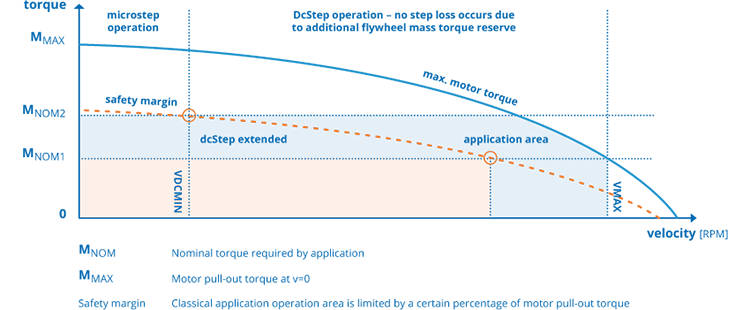
Applying DcStep to reduce the system safety margin (a measure of negative-feedback system stability and usable to predict overshoot in closed-loop step response). To accommodate a suddenly sharply increased load resistance, this professional advanced technology can ensure an additional torque increase, thereby ensuring that your application reaches the target position without losing steps, thus maintaining the integrity of the position counter.
I.What is DcStep?
DcStep is dedicated to using most of the available output torque of the stepper motor at 80% of the maximum pull-out torque; it isTrinamican efficient commutation scheme for stepper motors. DcStep can automatically adapt the speed to the actual motor load, so the motor can move as fast as possible without losing steps and achieve your intended purpose. To a certain extent, DcStep narrows the gap between cost-effective open-loop systems and fully featured closed-loop stepper drives; it is a qualitative leap.
II. DcStep™ (load-dependent speed control): stepper motor drivers have the characteristics and performance of DC motors
Unlike most open-loop stepper motor drivers, the DcStep stepper motor driver reduces speed, while most open-loop stepper motor drivers lose steps under overload conditions. This solves the problem of resistance under heavy loads and maintains the integrity of the position counter; in terms of energy efficiency, this feature is similar to the approach used by DC motors. In addition, this new technology rotates the stepper motor as fast as possible under actual load conditions to achieve operation at maximum efficiency. Of course, DcStep can also perform automatic ramping by adapting the ramp curve to the real-time torque load.

3. How Does DcStep Work?
Typically, 40% to 50% of a stepper motor's maximum pull-out torque is used as its safety margin, because degradation and torque loss of mechanical components in an open-loop system caused by resonance require this margin to compensate for unforeseen overload peaks. In addition, the torque of a stepper motor decreases at higher speeds due to the specific dependence of rotor back EMF on rotor speed. Sensorless technology uses 80% of the available output torque of most stepper motors to ensure that the stepper motor will not lose steps even under very high overload; if the overload exceeds the stepper motor'soutput torqueat the actual operating point, it will move along the shape of the stepper motor's torque curve, automatically adapting the stepper motor's speed to the actual motor overload; this behavior is very similar to that of a DC motor.

DcStep's back EMF significantly affects the maximum output torque and motor coil current, and it is used at medium and high speeds. This meansstepper motor drivetechnology allows more torque to be delivered at the same speed or the maximum speed to be increased to expand the stepper motor's operating range. This technology enables engineers to achieve the same desired results with more economical and smaller stepper motors.
