
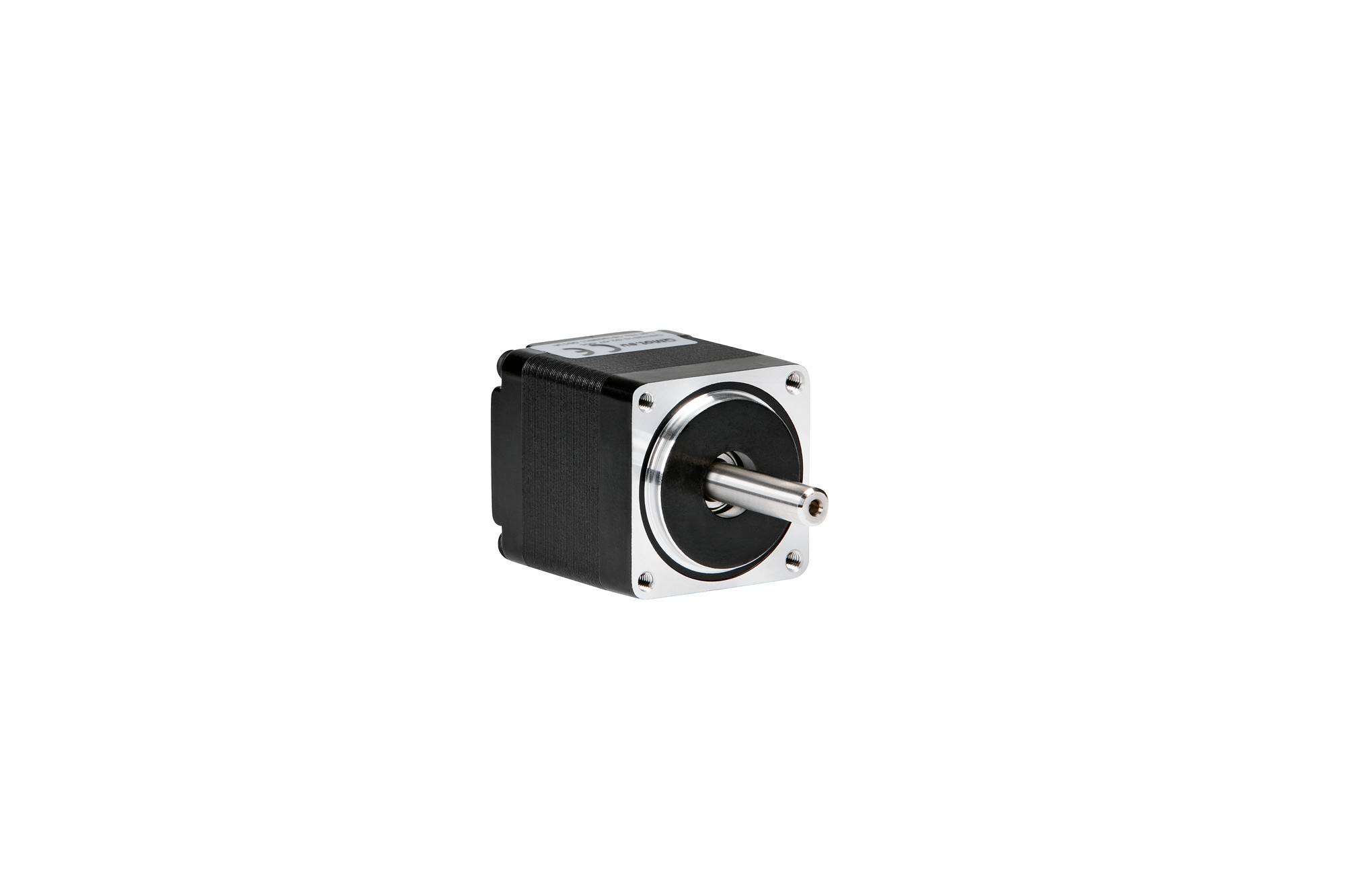
Today, an increasing number of electronic devices require maximum precision and stable motion. This is thanks toTrinamicTMC's microstepping control, which enables stepper motor drivers to control sinusoidal current waveforms by dividing full steps into smaller microsteps. The resulting current control scheme reduces noise and vibration while increasing available torque and precision.
Stepper motors are open-loop, inexpensive, easy-to-use, and durable motors. Compared with other motors, they offer these advantages: high torque at low speed and standstill; speed is very easily controlled by input pulses; their incremental positioning error is non-cumulative; and they have excellent response to start/stop. When precise and reliable positioning is required, this makes stepper motors the obvious choice. Passing current through the motor coils generates a magnetic field that drives the electromagnetic rotor to the required position. This control can be achieved using other current operating states in full steps, half steps, or smaller microsteps.
Microstepping improves application precision, torque, efficiency, and smoothness while reducing step loss, vibration, and noise. This relates to the mechanical characteristics of stepper motors: a stepper motor is similar to a mass-spring system. When moving from one position to another, the rotor cannot immediately settle at the correct position. Instead, it overshoots and oscillates around the target position until it reaches it. As with a mass-spring system, the larger the difference between one position and the next, the greater the oscillation.

Microstepping focuses on driving the motor with a sinusoidal current waveform. This means the stator coils are neither driven with full current or zero current; instead, over four full steps, they are driven at intermediate current levels that closely approximate a sine waveform. This positions the permanent-magnet rotor precisely at an intermediate position between two successive full steps. It even allows custom current waveforms tailored to the stepper motor's physical characteristics or application. The maximum microstep resolution is defined by the A/D and D/A capabilities of the driver electronics. When using hybrid stepper motors,TMCTMC's 256x microstepping can provide 51,200 microsteps per 360° revolution. The accuracy per revolution is as high as 0.00703125°.
Microstepping is a standard basic feature of this product. The motion controller and its motion control IC integrated into the cDriver product provide 256-microstep resolution. However, for many other manufacturers developing components for stepper drivers, 256x microstepping exceeds their capabilities. To make it easier to integrate into motion and motor control systems that do not yet provide such high step resolution,TrinamicMicroPlyer™ was developed. By inserting a time interval between step pulses, MicroPlyer can convert a lower step resolution into microsteps. The microstep interpolator reduces the need to tune the entire system and can reliably provide industry-leading stepper motor control for your application.