
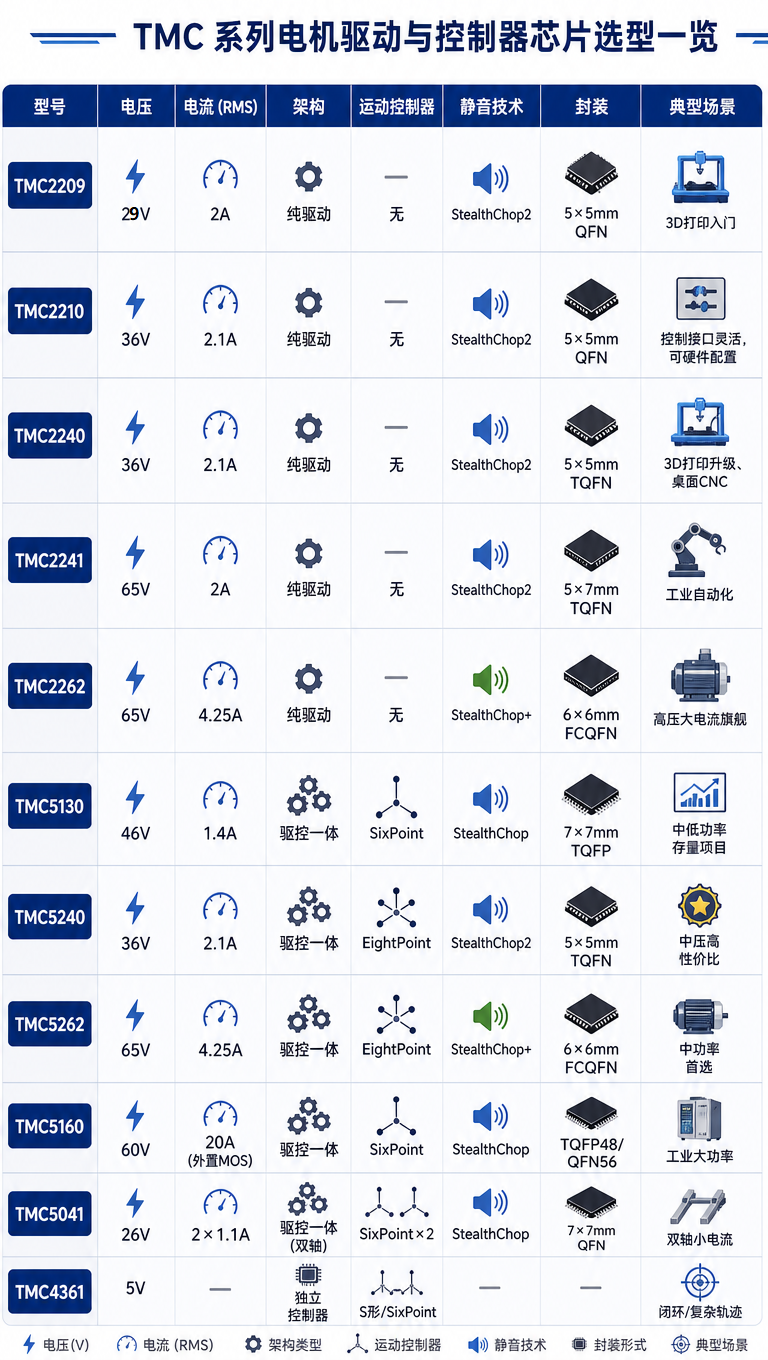
ADI Trinamic's stepper driver product line now spans a complete spectrum from low voltage and low current to high voltage and high current, from pure drivers to integrated driver-controllers, and from single-axis to dual-axis. Faced with such a rich product matrix, the key to selection is not only comparing numerical values in datasheets; understanding each chip's position in the product line is equally important—which architecture category does it belong to? Which generation of algorithm does it use? What problem in what scenario does it solve? What are its core differences from similar models? Starting from architecture classification, this article clarifies algorithm generations and analyzes each chip's architectural features, application scenarios, and selection logic category by category.
1. Core classification: architecture determines role
A core classification dimension for TMC stepper driver ICs is whether they integrate a motion controller. This dimension determines the chip's role in the system and what scenarios it is suitable for.
1Pure driver chips (Driver): power output only
Definition: focused on power output and chopping algorithms; motion planning relies entirely on an external MCU via STEP/DIR or SPI commands.
System role: the main controller performs motion planning → the chip executes power output.
Representative models: TMC2209, TMC2210, TMC2240, TMC2241, TMC2262, etc.
Use cases: single-axis or simple motion, and projects where the host controller has ample processing power and cost sensitivity is relatively high.
Pros and cons: The advantages are low cost, simple design, and mature community support; the disadvantage is that all motion planning burden is placed on the host controller, and in multi-axis systems the host controller's interrupt load increases linearly with the number of axes.
2Integrated driver-control chips (cDriver): with a built-in “brain”
Definition: Built-in ramp motion controller; the MCU only needs to send the target position or speed via SPI, and the chip autonomously performs trajectory calculation and pulse generation.
System role: The host controller only issues commands → the chip plans motion autonomously.
Representative models: TMC5130, TMC5160, TMC5240, TMC5262, etc.
Use cases: multi-axis systems, applications where host controller processing power is limited, and smooth motion requiring S-curve acceleration/deceleration.
Pros and cons: The advantage is that it greatly frees up the main controller's computing power; in multi-axis systems, the main controller is reduced from processing every pulse to issuing commands and reading status. The disadvantage is the higher cost per chip and the need for SPI communication for configuration, which is more complex.
3Independent motion controller: purely a "brain" and must be paired with a driver stage
Definition: A pure control chip that does not integrate a power stage and must be used with an external driver chip.
System role: Separation of control and drive, with high flexibility.
Representative model: TMC4361.
Applicable scenarios: Scenarios requiring closed-loop control and complex trajectory planning (S-shaped/SixPoint ramp).
Pros and cons: The advantages are the most powerful control functions, closed-loop support, and flexible pairing; the disadvantage is that system design is more complex and requires an additional driver stage.
II. Algorithm generations: Understanding the differences between each generation of technology
Trinamic stepper driver chips share a motion control algorithm family with similar naming but different generations—names such as StealthChop, StallGuard, and CoolStep recur across more than ten models—so before analyzing chip models one by one, it is necessary to first understand their motion control algorithm family.
1. Silent chopping: StealthChop → StealthChop2 → StealthChop+
StealthChop is Trinamic's signature silent drive technology and has now evolved through three generations:
- StealthChop (first generation):Voltage chopping, open-loop control. It provides silent operation only at low speeds, with noise gradually increasing at medium and high speeds. It is used in early models such as TMC5130 and TMC5041.
- StealthChop2:Adds automatic tuning on the basis of the first generation; at power-up, parameter matching is completed through one-time coil resistance learning. The silent range extends to medium speeds. It is used in TMC2209, TMC2240, TMC2241, TMC5240, and others.
- StealthChop+ (latest):Upgrades from open loop to dual-PI closed loop—the current PI loop stabilizes the coil waveform, and the angle PI loop continuously corrects the phase deviation between the current vector and the rotor, suppressing mid-speed resonance. Automatic coil resistance measurement (R_COIL_AUTO) replaces the one-time learning scheme, continuously tracking copper resistance temperature drift during operation for stable current control across the full temperature range. The silent range covers the full speed range, automatically switching to SpreadCycle dynamic mode only at extremely high speeds when maximum torque is required. It is used in TMC2262 and TMC5262.
2. Load Detection and Adaptive Energy Saving: StallGuard, CoolStep
StallGuard(Sensorless load detection): Trinamic's load detection technology has evolved in step with the evolution of quiet chopper modes.
- StallGuard2:In SpreadCycle mode, load torque is estimated by sampling the phase difference of the coil back-EMF, with 10-bit resolution; it is available on most models such as TMC2240/2262/5130/5262.
- StallGuard4:Load detection solution tailored for StealthChop2, with 9-bit effective resolution, four independent phase measurements plus digital filtering. It is available on StealthChop2 architecture chips such as TMC2240/TMC2241.
- StallGuard+:Load detection solution tailored for the StealthChop+ dual-PI closed-loop architecture. It uses real-time rotor phase data from the angle PI loop and coil waveform data from the current PI loop for comprehensive load estimation, achieving better accuracy and response speed than the previous two generations. It is available on TMC2262 and TMC5262. When StallGuard+ is used in StealthChop+ mode, sensorless load monitoring can be achieved across the full speed range (except extremely high speeds).
CoolStep(Adaptive energy-saving current control):
- CoolStep:Based on real-time load feedback from StallGuard2/4, current is automatically reduced under light load and restored to full current under heavy load, with energy savings of up to 75%. It is available on TMC2209, TMC2240, TMC5130, etc.
- CoolStep+:Based on full-speed-range feedback from StallGuard+, combined with real-time current data from the dual-PI closed loop, the energy-saving adjustment has finer resolution, with energy savings of up to 90%. It is available on TMC2262 and TMC5262.
3. Motion Controller and Other Special Features
Motion Controller (Ramp Generator):
- SixPoint:Trapezoidal three-segment motion profile (acceleration-constant speed-deceleration) with jerk-suppressed transitions. Available on TMC5130, TMC5160, and TMC5041.
- EightPoint:S-shaped five-segment acceleration-deceleration, with smoother acceleration/deceleration transitions and better vibration control than SixPoint. Available on TMC5240 and TMC5262.
Other Special Features:
- SpreadCycle:High-speed dynamic chopper mode, four-stage decay (on-slow decay-fast decay-secondary slow decay), smooth zero-crossing, torque priority. Used together with StealthChop: automatic switching between low-speed silent mode and high-speed dynamic mode.
- ICS (Lossless Current Sensing):Uses the Rds(on) of the built-in MOSFETs for current sampling, eliminating external current-sense resistors, saving PCB space and BOM cost, and eliminating sense-resistor power loss.
- DcStep (Load-Adaptive Step-Loss Prevention):When the motor load approaches the stall limit, it automatically reduces the operating speed, trading speed for greater torque and preventing step loss. It is mainly used in medium-to-high-speed, high-load applications and is available on TMC5130, TMC5160, TMC5041, etc.
- µDcStep (Microstep Load-Adaptive Step-Loss Prevention):It uses the same principle as DcStep but focuses on low-speed conditions—using microstep interpolation to achieve finer speed control, replacing traditional DcStep in applications such as low-speed precision pumps. It is available on TMC2262 and TMC5262.
The above is an overview of the algorithm suite.
III. Driver-Only Series: Different Power Levels for Different Requirements
Driver-only chips can be further subdivided internally by voltage/current class—low voltage/low current, medium voltage/medium current, and high voltage/high current—each corresponding to different motors and applications.
1TMC2209 — Entry-Level Quiet Operation
Key specifications: voltage range 4.75V–29V DC, peak current 2.8A, continuous current 2A, on-resistance 340mΩ.
Equipped with StealthChop2, StallGuard4, etc., without ICS. Suitable for entry-level 3D printers, small automation, and relatively cost-sensitive projects.
Advantages: high cost-effectiveness and well-established community support; disadvantages: limited current and voltage, no SPI diagnostic interface, and configuration mainly via UART.
2TMC2210 — a driver-only upgrade with flexible control interfaces
The TMC2210 is a high-performance stepper motor driver IC that supports multiple control interfaces—SPI, UART, and STEP/DIR—and also allows basic configuration via hardware pins, so it can operate without software. Its key specifications are: voltage range 4.5V–36V DC, peak current 5.0A, RMS current 2.1A, and on-resistance 230mΩ. It features StealthChop2 silent technology and lossless integrated current sensing (ICS), among other features.
Compared with the TMC2209, the key differences are higher voltage (36V vs. 29V) and multiple interface options with direct pin configuration, offering greater flexibility during development.
3TMC2240 — the performance benchmark for medium-voltage driver-only solutions
Key specifications: 4.5V–36V DC, peak 5.0A, RMS 2.1A, on-resistance 230mΩ.
Equipped with StealthChop2 + ICS + StallGuard2/4 + CoolStep, etc. Built-in temperature sensor and motor temperature estimation, supports SPI/UART diagnostics.
Compared with the TMC2209, its advantages center on three points: higher parameters deliver better performance; dual SPI+UART communication interfaces provide full diagnostics and configuration capabilities; richer protection and detection functions improve system reliability. It is suitable for heat-sensitive 3D printer upgrade models, desktop CNC, laboratory automation, and other scenarios that require status monitoring. If only basic quiet operation is needed, the TMC2209 is more cost-effective; if heat dissipation performance, fault diagnostics, and long-term reliability are important, the TMC2240 offers more performance headroom.
4, TMC2241 — 65V high-voltage driver-only
Core parameters: 4.5V–65V DC, RMS 2A at 24V (2.8A peak), RMS 1.7A at 48V, on-resistance 310mΩ, 5mm × 7mm TQFN38 package.
Equipped with StealthChop2 + ICS + StallGuard2/4 + CoolStep, etc.
Compared with the TMC2240, the main difference is that the voltage is increased from 36V to 65V, enabling it to drive higher-torque motors (such as Nema 23/24). It is suitable for industrial automation and scenarios that require 65V high voltage and do not need an integrated driver/controller.
5, TMC2262 — high-voltage, high-current driver-only flagship
The TMC2262 is a high-end model in the driver-only series and integrates Trinamic's next-generation motion control algorithms.
Key specifications: voltage range 4.5V to 65V DC, RMS current 4.25A (6A sinusoidal peak), on-resistance 80mΩ, package 6mm×6mm FCQFN30.
Features StealthChop+ quiet chopping, StallGuard+/2 load detection, CoolStep+ energy-saving control, µDcStep, and more.
Compared with the TMC2241: both are 65V, but current jumps from 2A to 4.25A, RDSon drops from 310mΩ to 80mΩ, and the algorithm advances from StealthChop2 to StealthChop+ (full speed range), with µDcStep added.
IV. Integrated Driver-Controller Series: From Entry-Level Classic to High-Power Flagship
Integrated driver-controller chips are TMC's 'technical high ground'—they integrate the motion controller and power stage. Within this series there is a clear evolution path.
1TMC5130 — the 'classic of a generation' in integrated driver-controllers
The TMC5130 is one of Trinamic's earliest widely adopted integrated driver-controller chips, with broad community support and a mature ecosystem. Its key specifications are: voltage range 4.75V to 46V DC, peak current 2.5A, and 1.4A RMS.
It features the SixPoint ramp motion controller, StealthChop quiet technology, StallGuard2, CoolStep, DcStep, and more, in a 7mm×7mm TQFP48 package.
From the current product lineup, its current capability, quiet performance, and package integration have fallen behind the new-generation models, but thanks to its mature ecosystem and large base of existing designs, it remains a common choice for maintaining low-to-medium-power legacy projects and ensuring compatibility with older equipment.
2TMC5240 — A Cost-Effective Choice for Medium-Voltage Integrated Drive and Control
Compared with the TMC5130, the TMC5240 delivers upgrades across multiple aspects of the user experience and is positioned as a "cost-effective integrated drive and control" solution.
Key specifications: 4.5V–36V DC, 5.0A peak current, 2.1A RMS current, 230mΩ on-resistance, 5mm × 5mm TQFN32 package.
The motion controller uses the EightPoint architecture for better jitter control; the quiet-operation technology is StealthChop2, with support for StallGuard2/4 and CoolStep, making it a cost-effective choice for integrated drive-and-control needs in the 36V voltage range and low-to-medium-power applications.
3TMC5262 — The "All-Rounder" of Integrated Drive and Control
Key specifications: 4.5V–65V DC, 4.25A RMS (6A peak), 80mΩ on-resistance, 6mm × 6mm FCQFN30 package. It features an EightPoint motion controller + StealthChop+ quiet technology + StallGuard+/2 load detection + CoolStep+ adaptive current regulation + µDcStep + ICS, etc.
As a fully upgraded model, it can directly drive NEMA 17, NEMA 23, and even NEMA 24 stepper motors. It is a high-end solution for medium-power multi-axis systems, significantly offloading the main controller's compute load while balancing quietness, efficiency, and reliability.
4TMC5160 — High-Power Solution with External MOSFETs
The TMC5160 differs from other models in that it must be used with external N-channel MOSFETs. Its key parameters are: voltage range 8 V–60 V DC, supporting 1 A–20 A coil current (depending on the external MOSFET selection); it is equipped with a SixPoint ramp motion controller, StealthChop quiet technology, DcStep, StallGuard2, and CoolStep; package options are TQFP48 or QFN-56. It is suitable for industrial applications with currents above 4 A and NEMA34 high-torque motors.
V. Special Categories: Dual-Axis and Standalone Controllers
1TMC5041 — Integrated Dual-Axis Driver and Controller
The TMC5041 is a compact, high-performance dual-axis stepper motor controller and driver IC. Its key parameters are: voltage range 4.75 V–26 V DC, RMS current 1.1 A per axis (1.5 A peak). It integrates two independent SixPoint ramp motion controllers, StealthChop quiet technology, DcStep, StallGuard2, and CoolStep. The package is 7 mm × 7 mm QFN48.
For dual-axis scenarios with low current requirements, a single chip can replace two single-axis driver/controller chips, offering space and cost advantages in applications such as security camera gimbals, small pump and valve control, laboratory automation, and printing and scanning equipment.
2TMC4361 — Standalone Motion Controller (Closed-Loop)
The TMC4361 is a pure control IC, featuring a highly flexible "control and power separation" architecture, aimed at professional applications with high requirements for trajectory accuracy and closed-loop control.
Key parameters: 3.3 V or 5 V supply; provides SPI and STEP/DIR interfaces, plus an encoder interface dedicated to closed-loop operation; supports S-curve and SixPoint ramp generation, with strong trajectory planning capabilities.
It must be used with an external driver-only chip or discrete power stage and is not paired with an integrated driver-and-control chip. This separated architecture allows users to freely select the driver side according to power requirements while achieving high-precision closed-loop control and complex trajectory planning, making it suitable for professional applications such as laboratory automation, high-end 3D printing, precision scanning, and industrial robots.
6. Case Demonstration
The following uses a typical desktop 3D printer with a Prusa i3 architecture as an example to demonstrate how to make selection decisions using the aforementioned architecture classification and algorithm system.
Scenario description: A desktop FDM 3D printer with a 24 V power system needs to drive four NEMA17 stepper motors—X-axis (print head lateral movement, reciprocating speed up to 200 mm/s, silent operation required), Y-axis (drives the heated bed forward/backward, heavy load and high torque requirement), Z-axis (lead screw lifting, extremely low speed, moving only 0.1–0.3 mm layer height each time, noise-insensitive), and extruder (pushes filament at constant speed, medium precision requirement).
Note: In the real Voron community and Klipper configurations, it is common practice to mix different driver chips across axes—each axis has significantly different requirements for quietness, torque, and diagnostic capability. This case is only a simplified demonstration.
Requirements analysis for each axis:
- X-axis (high-speed reciprocation): low noise required (both StealthChop2/StealthChop+ satisfy this), medium torque (standard NEMA17 motor at ~0.8 A RMS is sufficient), diagnostics optional (helpful when troubleshooting homing issues).
- Y-axis (heavy-duty heated bed): requires low noise and high torque (heated bed plus glass plate is about 2–3 kg and needs 1.0–1.2 A RMS); heat control is important (high temperatures inside an enclosed chassis make low RDSon advantageous).
- Z-axis (very low speed): noise is almost irrelevant (the lead screw mechanism itself has no high-frequency noise), torque requirements are moderate, and diagnostic capability requirements are low—Z-axis step loss is almost impossible during printing.
- Extruder (constant-speed feeding): medium noise sensitivity, low torque requirement (0.5–0.7 A RMS is sufficient), and an additional need for overload protection.
Based on the requirements of each axis, the selection targets are divided into three typical strategies, corresponding to different cost and performance budgets.
Strategy 1: Cost-priority type (suitable for personal DIY, educational kits, and high-volume entry-level models)
| Axis | Recommended model | Selection rationale |
| X/Y | TMC2209×2 | Mature quiet operation, easy UART tuning, supports StallGuard4 sensorless stall detection and CoolStep energy-saving control, and performs well at medium and low print speeds |
| Z | TMC2209 | Operates at low speed, no quiet-operation requirement; using a common model can reduce inventory and firmware complexity |
| Extruder | TMC2209 | 2 A RMS current is sufficient for common filaments; StallGuard4 can be used for stall detection and sensorless homing |
Main controller load: all motion planning is handled by the MCU (e.g., Cortex-M3); the interrupt load for 4 axes is relatively high, but entry-level printers have lower print speeds (30–60 mm/s, max 150 mm/s), which is acceptable.
Cost: relatively low; abundant community resources; short development cycle.
Shortcomings: UART interface only (no SPI), noticeable heat generation (requires an additional heatsink), and relatively low performance.
Strategy 2: Balanced-performance type (suitable for mid-range consumer machines and mass-produced products that prioritize quality and reliability)
| Axis | Recommended Model | Selection Rationale |
| X/Y | TMC2240×2 | Dual SPI/UART interfaces, 230 mΩ low on-resistance reduces heat, supports StallGuard2/4 and CoolStep, suitable for medium- and high-speed printing |
| Z | TMC2209 | Low-speed operation, no SPI required, holding torque meets requirements, and cost is reduced |
| Extruder | TMC2240 | Uses CoolStep to monitor load changes and prevent stalls, while SPI diagnostics provide real-time temperature and fault status readings |
If the system uses a 48 V supply or requires higher torque, the X/Y axes can be replaced with the TMC2262—also a pure driver architecture—with the power stage upgraded from 36 V/2.1 A to 65 V/4.25 A and the algorithm upgraded from StealthChop2 to StealthChop+.
Main controller burden: still a pure driver; the MCU must handle all motion planning, but X/Y can configure better decay modes via SPI to reduce resonance.
Cost: higher than the TMC2209, but the overall cost remains controllable.
Advantages: critical axes gain real-time diagnostics and low heat generation, supporting higher print speeds—commercial models using the TMC2240 have achieved 600 mm/s print speed and 20,000 mm/s² acceleration.
Strategy 3: Integrated driver-controller type (suitable for high-end models with high-speed printing, multi-axis coordination, and limited main-controller compute)
| Axis | Recommended Model | Selection Basis |
| X/Y | TMC5262×2 | EightPoint autonomous planning; StealthChop+ enables quiet operation across the full speed range (breaking the limitation of StealthChop2 being quiet only at low/medium speeds); µDcStep prevents step loss; on-resistance 0.08Ω |
| Z | TMC2240 | Low-speed operating conditions do not require an integrated driver-controller; SPI diagnostics and 230 mΩ low impedance meet the requirements. |
| Extruder | TMC2240 | Sensorless load monitoring + SPI diagnostics; for constant-speed extrusion, an integrated driver-controller is likewise performance overkill. |
Main-controller burden: lower than with a pure driver solution—the MCU interrupt load for X/Y drops from "once per step" to "once per motion segment," and the freed compute can be used for G-code parsing, thermal control, human-machine interaction, etc.
Cost: higher cost, but it can reduce main-controller upgrade costs and the need for external heat-dissipation design.
Advantages: With cost kept under control, it achieves full-speed-range quiet operation and extremely low heat generation, and supports very high acceleration. The dual TMC5262 devices for X/Y each plan their own S-shaped trajectories; the main controller only issues target positions, leaving ample compute headroom.
Decision logic:
The same application scenario under different constraints (budget, performance requirements, main-controller capability, target positioning) will lead to different selection conclusions. In actual projects, a common practice is to mix and match by axis—high-performance chips on highly sensitive axes (such as X/Y) and basic chips on less sensitive axes (such as Z), avoiding over-design without sacrificing core experience. This selection approach also applies to other application scenarios such as CNC, robotics, and security PTZ systems; just perform a similar breakdown based on each axis's motion frequency, load size, and noise tolerance.
VII. Summary
The landscape of the TMC stepper driver product line can be summarized into three main lines: the pure driver series meets cost-sensitive scenarios with the most simplified system design; the driver-controller integrated series frees up the host control computing power of multi-axis systems through a built-in motion controller; the standalone controller series provides the highest flexibility for closed-loop and complex trajectory planning. Understanding the architecture classification and algorithm generations helps select the right chip for the corresponding scenario.
For more information about TMC stepper driver products or to request samples, please contact: sales@chiplinkstech.com; Mr. Chen, 13924675549.
| Model | Voltage | Current (RMS) | Architecture | Motion Controller | Quiet Technology | Package | Typical Scenarios |
| TMC2209 | 29V | 2A | Driver Only | None | StealthChop2 | 5×5mm QFN | Entry-Level 3D Printing |
| TMC2210 | 36V | 2.1A | Driver Only | None | StealthChop2 | 5×5mm QFN | Flexible control interface, hardware-configurable |
| TMC2240 | 36V | 2.1A | Driver only | None | StealthChop2 | 5×5mm TQFN | 3D printing upgrades, desktop CNC |
| TMC2241 | 65V | 2A | Driver only | None | StealthChop2 | 5×7mm TQFN | Industrial automation |
| TMC2262 | 65V | 4.25A | Driver only | None | StealthChop+ | 6×6mm FCQFN | High-Voltage, High-Current Flagship |
| TMC5130 | 46V | 1.4A | Integrated Drive and Control | SixPoint | StealthChop | 7×7mm TQFP | Medium/Low-Power Existing Projects |
| TMC5240 | 36V | 2.1A | Integrated Drive and Control | EightPoint | StealthChop2 | 5×5mm TQFN | Medium-Voltage, Cost-Effective |
| TMC5262 | 65V | 4.25A | Integrated Drive and Control | EightPoint | StealthChop+ | 6×6mm FCQFN | Preferred for Medium Power |
| TMC5160 | 60V | 20A (External MOSFET) | Integrated Drive and Control | SixPoint | StealthChop | TQFP48/QFN56 | Industrial High Power |
| TMC5041 | 26V | 2×1.1A | Integrated Drive and Control (Dual-Axis) | SixPoint×2 | StealthChop | 7×7mm QFN | Dual-Axis Low Current |
| TMC4361 | 5V | — | Standalone Controller | S-Curve/SixPoint | — | — | Closed-Loop/Complex Trajectory |

Sample Request Attached

WeChat Official Account