
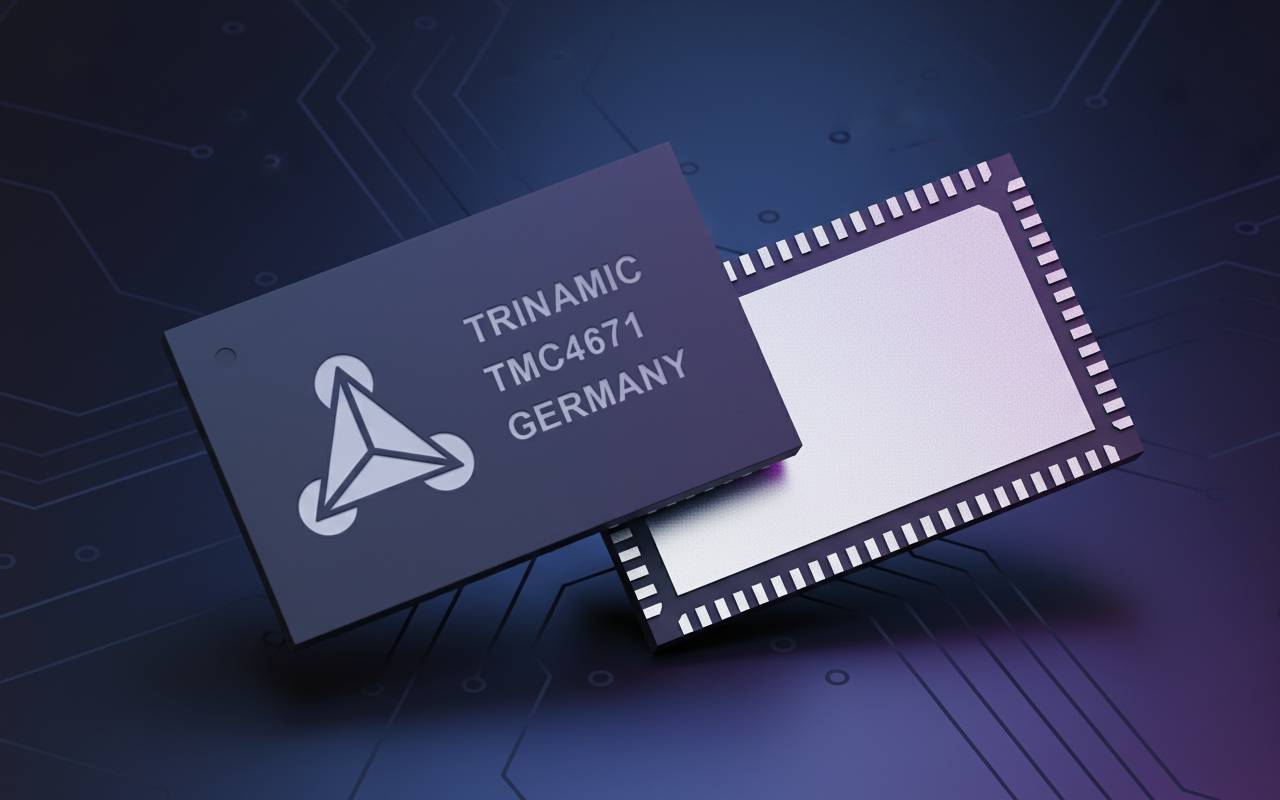
Against the backdrop of surging demand for precision motion control in industrial automation control, intelligent manufacturing equipment, and new energy—China's servo system market is expected to exceed RMB 30 billion in 2025 and reach RMB 50 billion by 2030, with a compound annual growth rate of over 10%—traditional servo control solutions, when facing precise control challenges, often require complex hardware and software design, making the development process lengthy and expensive. To address this pain point, Trinamic (now part of ADI) launched theTMC4671——fully integrated servo controller, with high dynamic response, low power consumption, and high integration, becoming a core component for simplifying servo system design and providing the market with a better servo control solution.

I. Product Overview
The TMC4671 is afully hardware-integrated servo controller designed for multiple motor types, it integrates hardware-level FOC (field-oriented control) and flexible interfaces into a single chip, enabling field-oriented control (FOC) of three-phase permanent magnet synchronous motors (PMSM)/brushless DC motors (BLDC), two-phase stepper motors, single-phase DC motors, and voice coil motors. All control functions are implemented in hardware, without relying on software calculations. It also integrates ΔΣ-ADCs, multiple types of position sensor interfaces, and a position interpolator, making it a full-scenario servo core device covering applications from consumer electronics to industrial automation. The TMC4671 uses a 76-pin QFN package (10.5 mm × 6.5 mm), has a wide operating temperature range (-40°C to 125°C), and a core supply voltage of 3.3 V (range 3.15 V–3.45 V), allowing it to adapt to various harsh operating environments. Whether for industrial robots requiring precise position control or smart electronic devices requiring smooth speed regulation and silent operation, the TMC4671 delivers excellent performance.
| Features |
| Servo controller/field-oriented control (FOC) |
| Torque control (FOC), speed control, position control |
| Integrated ADCs, ΔΣ-ADC front end |
| Encoder engine: Hall analog/digital, encoder analog/digital |
| Supports three-phase permanent magnet synchronous motors/brushless DC motors, two-phase stepper motors, and single-phase DC motors |
| High-speed PWM engine (25 kHz to 100 kHz) |
| Application SPI + Debug (UART, SPI) |
| Step/Direction Interface (S/D) |

TMC4671 Simplified Block Diagram
II. Fully Integrated Servo Control: Redefining System Design
The core competitive advantage of the TMC4671 lies in its highly integrated hardware architecture—Full FOC chain implemented in pure hardware, hardwiring the entire servo control chain to replace the traditional “MCU + discrete devices” solution. Unlike conventional software-based servo controllers, the TMC4671 integrates all key control loops (including torque, speed, and position control) entirely on-chip and executes them in real time in pure hardware, rather than relying on processor software computation.
This high level of integration brings multiple advantages. First is extremely low response latency: the hardware FOC algorithm can complete complex calculations within microseconds, ensuring the system responds instantly to dynamic load changes. Second is a significant reduction in CPU load: the main processor no longer needs to bear heavy real-time control tasks and can focus on higher-level application logic processing and system management.
In addition, TMC4671 provides a rich set of interface options, enabling it to flexibly adapt to various system requirements: the main communication interfaces include SPI and S/D (Step/Direction) interfaces, facilitating communication with external processors and reception of control commands; it also integrates a UART interface (debug/configuration), parallel register access, supports real-time monitoring data output, and an RTMI (real-time monitoring) interface, supporting high-frequency sampling (>1MHz) and automatic tuning.
III. Technical Advantages: A Perfect Balance of Performance, Precision, and Energy Efficiency
In terms of performance and precision, TMC4671's high-speed PWM engine frequency of up to 100kHz ensures stable control even in the most demanding high-dynamics applications, while 256-microstep interpolation technology (MicroPlyer™) provides extremely smooth motion trajectories, effectively reducing vibration and noise. TMC4671 also integrates a high-resolution ADC and multiple encoder interfaces, supporting Hall sensors, analog encoders (such as sine/cosine), and digital encoders (such as ABN). This flexibility allows designers to choose the most suitable sensor solution based on the precision requirements and cost targets of specific applications.
Energy efficiency is a major highlight of TMC4671. First, static standby power consumption is low—when VCCIO has no load and the clock is off, it is ≤3mA, and V5 current is ≤25mA (at a 25MHz clock). Second, braking saves energy—the Brake Chopper function monitors the bus voltage via ADC_VM and activates an external braking resistor when the threshold (ADC_VM_LIMIT_HIGH) is exceeded, preventing voltage breakdown caused by energy feedback. Combined with comprehensive overcurrent and overtemperature protection mechanisms, TMC4671 delivers excellent performance while also ensuring low power consumption and high reliability for the system.
IV. Application Scenarios: From Industrial Automation to Precision Instruments
In industrial automation, TMC4671 is redefining the possibilities for robot joint drives. Traditional robot servo drives usually require multiple chips and complex software debugging, whereas TMC4671 greatly simplifies this process through hardware integration.
For electric mobility applications, the TMC4671-LEV-REF reference design provides a complete solution that meets the strict reliability and efficiency requirements of electric vehicle pump control systems. Its hardware FOC architecture ensures stable operation under harsh temperature and vibration environments, which is crucial for automotive applications.
In consumer electronics applications, such as smart curtain motors, TMC4671 can provide quiet and smooth operation, solving the noise pain point in the daily operation of curtain motors.
In addition, in fields requiring high precision, such as laboratory automation and medical devices, the high accuracy and reliability of the TMC4671 ensure the accuracy of experimental results and the safety of medical operations. For example, in medical devices such as infusion pumps and insulin pumps, the embedded motion control technology of the TMC4671 can provide higher accuracy, convenience, and safety. From automatic sampling systems to precision infusion pumps, the TMC4671 provides a trustworthy control core for these critical applications.
V. Development Support: Accelerating the Journey from Concept to Product
As the saying goes, advanced chips require well-developed development tools, and Trinamic also provides comprehensive ecosystem support for the TMC4671 to help users develop quickly. The TMC4671-EVAL full-featured evaluation board allows engineers to quickly verify design concepts and monitor and adjust control parameters in real time. For high-voltage and high-current applications, the TMC4671+TMC6100-BOB prototyping kit provides a complete solution, greatly shortening the development cycle.
On the software side, the graphical TMCL-IDE configuration environment enables engineers to complete complex parameter tuning with simple click operations, without needing to master every detail of the underlying algorithms. At the same time, a rich open-source firmware library provides a customization foundation for users with special requirements, balancing ease of use and flexibility.
This comprehensive development support significantly lowers the design threshold for motion control systems, helping engineers build high-performance solutions in a short time and accelerating time to market.
VI. Conclusion
Through its 'hardware FOC + high integration' design, the TMC4671 addresses the pain points of traditional servo solutions—long development cycles, low reliability, and large size. Compared with traditional 'MCU + discrete FOC' solutions, it reduces external components by about 30% and shortens the development cycle by about 50%, while achieving position accuracy of ≤0.1° and drive efficiency of >98%. As demand for motion control grows across industries, integrated servo controllers such as the TMC4671 will become an important force driving technological innovation and product differentiation. By implementing complex control algorithms in hardware, it provides engineers with a 'simplified design, maximized performance' solution.
For more information about the TMC4671 or to request samples, please contact us—Shenzhen Chiplink Microelectronics Co., Ltd. (Email: sales@chiplinkstech.com). We look forward to working with you.

Sample request attached

WeChat Official Account