
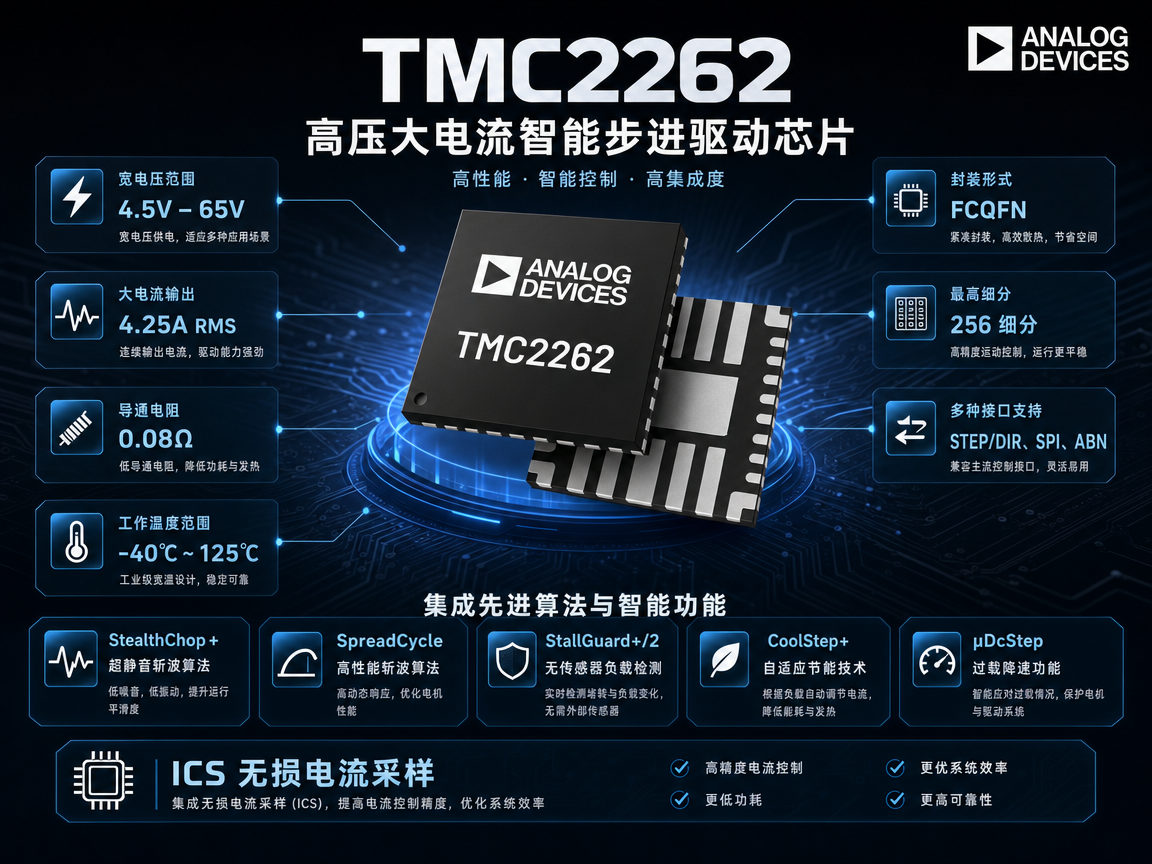
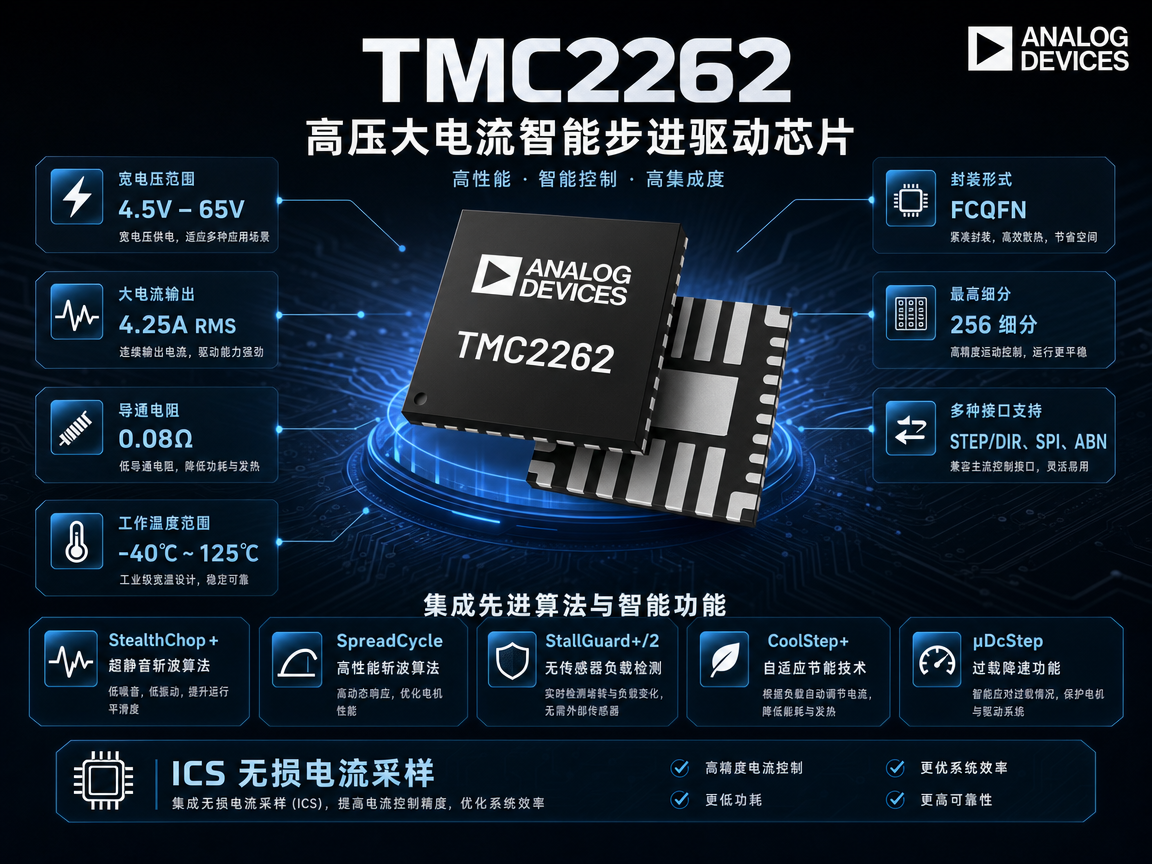
As industrial automation and high-end equipment evolve toward higher power density and more intelligent control, stepper drive systems face challenges such as limited voltage and current boundaries, balancing noise and dynamic performance across the full speed range, and relatively high hardware complexity and energy consumption. As Trinamic's (now ADI) new-generation high-voltage, high-current smart stepper driver IC, the TMC2262 features 65V high voltage tolerance and 4.25A RMS, and combines a highly integrated single-chip architecture with a new-generation algorithm system to provide an integrated drive solution with both high reliability and high energy efficiency for various precision motion scenarios.
1. Hardware Architecture and Core Electrical Parameters
The TMC2262 is a highly integrated single-chip solution that abandons the traditional discrete design approach internally and integrates the power path, signal sampling, algorithm computation, communication control, and protection circuits into one. Its internal architecture is mainly divided into six modules: dual H-bridge power stage, lossless current sampling unit, clock and PLL module, motion algorithm computation unit, multi-interface controller, and fault diagnosis and protection unit. Externally, only a few filter capacitors are required for operation, greatly simplifying BOM and PCB design.
Core Electrical Parameters
| Motor Supply Voltage | 4.5V~65V DC |
| Single H-Bridge Current Capability | 4.25 A RMS (continuous), 9 A peak |
| On-resistance (HS + LS) | 0.08 Ω (typical) |
| Operating temperature range | -40℃~125℃ |
| Microstep resolution | Up to 256 microsteps, supports MicroPlyer interpolation |
| System clock | Built-in 16 MHz, supports 1–32 MHz external clock |
| Communication Interface | STEP/DIR, SPI (up to 8 MHz) |
| Auxiliary Interface | ABN incremental encoder interface, dual configurable diagnostic outputs |
| PWM Chopping Frequency | 20 kHz to 60 kHz (8 programmable levels) |
| Package | FCQFN 6mm×6mm |

Package Pinout View

System Block Diagram
II. Dual Chopper Algorithm Architecture: StealthChop+ and SpreadCycle
The TMC2262 features two major chopper algorithms—StealthChop+ (voltage-mode silent chopping) and SpreadCycle (cycle-by-cycle current chopping)—and supports fully automatic seamless switching based on speed thresholds, covering all operating conditions from low to medium to high speed and overcoming the performance limitations of a single algorithm.
1. StealthChop+ Voltage-Mode Silent Chopping
The TMC2262 is equipped withthe StealthChop+ silent algorithm, which is Trinamic's new-generation voltage-modulated chopping technology. Its core goal is absolutely silent operation at low speed and even standstill, while also incorporating medium-speed resonance suppression.
Unlike the single-PI open-loop voltage control architecture of the previous-generation StealthChop2,the current control loop of StealthChop+ uses an architecture in which a current PI loop and an angle PI loop operate in parallel as dual closed loops—the current loop precisely stabilizes the coil current waveform, while the angle loop corrects the phase error between the current vector and the rotor position in real time.The PI parameters of both loops (CUR_P / CUR_I and ANGLE_P / ANGLE_I) can be programmed independently via SPI, adapting to motor types with different impedance and inductance. The angle PI loop is a capability that StealthChop2 completely lacks; it is specifically used to suppress the resonance oscillation that stepper motors are very prone to in the medium-speed range (typically occurring near full-step frequencies of 50 Hz to 150 Hz).
Another key upgrade is automatic coil resistance measurement (R_COIL_AUTO). StealthChop2 relies on one-time resistance learning at power-up, and accuracy drifts during long-term operation or in scenarios with large temperature differences. TMC2262's R_COIL_AUTO changes to online real-time measurement, continuously acquiring the actual resistance at low speed/standstill and compensating for temperature drift, keeping current control stable across the full temperature range.
Supporting features: supports two standstill modes—freewheeling and passive braking—so the stop state can be selected according to device requirements, balancing energy consumption and braking effect.
2. SpreadCycle cycle-by-cycle current chopping
After the speed exceeds a set threshold, the TMC2262 can automatically switch to SpreadCycle mode. This mode is Trinamic's classic algorithm, focusing on high dynamic response, strong torque output, and wide load adaptability, suitable for high-speed motion and sudden dynamic load changes. The chopping cycle is divided into four phases:
- ON: The H-bridge drives the current up, and the coil stores energy;
- Slow Decay: same-side freewheeling is maintained, the coil current decreases slowly, and current continuity is good;
- Fast Decay: reverse freewheeling, rapid current discharge, meeting the need to quickly establish reverse current in the negative half-cycle;
- Mixed Decay (secondary slow decay): The tail of the decay transitions smoothly to prevent "step" distortion at current zero crossings.
The timing proportions of the four phases in each cycle are calculated automatically by the chip and do not require external settings. The core benefits are: smooth current zero crossings, so at high speed there is no torque ripple caused by current "discontinuity"; in terms of EMC, mixed decay spreads the switching spectrum, making it easier to pass industrial EMC certification than simple fast-decay schemes.
In addition, the output slope (SLOPE_CTRL) supports multiple settings, allowing adjustment between EMC performance and switching loss: a low slope gives lower EMC radiation but slightly higher switching loss; a high slope gives better switching efficiency but requires more careful layout.
III. Intelligent Load Detection and Energy-Efficiency Suite: StallGuard+/2, CoolStep, and µDcStep
To address industry pain points such as varying loads, overload-induced step loss, and high energy consumption in industrial equipment, the TMC2262 integrates three interlinked functions to achieve integrated "sensing, adjustment, and protection."
1. Dual-system sensorless detection:The TMC2262 pairs dedicated load-detection algorithms with the two chopper modes. It requires no external encoder or limit sensor and determines load and stall conditions based on the motor back EMF.
- StallGuard+Compatible with StealthChop+ quiet mode, it uses the precise current and angle information provided by dual closed-loop control to accurately output load margin values, distinguish light load, heavy load, and near-stall conditions, and support stable load detection at speeds as low as about 1 RPM. This solves the detection drift and inaccuracy of traditional StallGuard at low speeds caused by insufficient back EMF.
- StallGuard2Compatible with SpreadCycle high-speed mode, it calculates mechanical load based on back-EMF energy difference, providing high detection resolution and can be used for high-speed sensorless homing and overload warning.
In addition, the TMC2262 adds a Low Velocity Stall Detection subsystem—it does not rely on absolute thresholds but determines mechanical collision by monitoring the falling slope of SGP_RESULT. With a configurable continuous full-step counter and filter enable, it significantly reduces the probability of false triggering in end-position detection scenarios.
2. CoolStep+ Load-Adaptive Energy-Saving Technology
CoolStep is already a mature solution on chips such as the TMC2209/TMC2240: based on StallGuard's real-time load value, it automatically reduces current when SG_RESULT is above the SEMAX upper threshold and restores it when below the SEMIN lower threshold. The current ramp-up/ramp-down step sizes are configured via SEUP/SEDN parameters, achieving energy savings of up to 75%.
TMC2262'sCoolStep+has been upgraded on this basis,improving the resolution and response speed of energy-saving regulation. Combined with the sense-resistor power consumption eliminated by ICS lossless detection,Up to 90% reduction in energy consumption, while significantly reducing temperature rise in the motor and driver chip, making it particularly suitable for pumps/valves and conveying equipment that operate under light load for long periods or intermittently.
3. µDcStep Overload-Adaptive Speed Reduction Technology:When the motor encounters a sudden overload or insufficient torque, the chip does not directly trigger stall protection; instead, it automatically reduces the operating speed, using the motor's flywheel effect to increase output torque and avoid step-loss faults. After the load recovers, the speed automatically rises again. Unlike traditional DcStep, which targets medium-to-high speed and heavy loads, this technology specifically solves step-loss problems caused by load fluctuations under low-speed operating conditions and is suitable for scenarios such as precision pumps. The threshold can be flexibly configured through registers such as TUDCSTEP.
4. Lossless Current Sensing System: ICS
The TMC2262 uses ADI's patented non-dissipative lossless current sensing architecture (Integrated Current Sensing, ICS), leveraging the on-resistance Rds(on) of the built-in power MOSFETs as the sensing element and combining it with an on-chip high-precision ADC to sample the coil current in real time. The core value of this architecture lies in threefold simplification:
1. BOM Simplification—Completely eliminating external power sense resistors, which is the most significant cost and space saving in applications above medium power.
2. Energy Efficiency Improvement— There is no longer I²R loss from resistors in the sampling chain, reducing overall system power consumption under the same driving conditions.
3. Batch Consistency— The sampling chain is concentrated inside the chip, avoiding board-to-board differences caused by precision drift of external resistors and parasitic parameters of PCB traces.
In addition, the system integrates programmable blanking time to mask spike noise at the instant of MOS switching, and supports multiple current range configurations to match motors of different power levels.
V. Interface System and Programmable Configuration Capabilities
The TMC2262 balances compatibility with traditional equipment and expansion for digital platforms. It is equipped with multiple types of interfaces and exposes a large number of programmable parameters, making it suitable for legacy retrofits and new platform development.
1. Core Control and Communication Interfaces:
- STEP/DIR Standard Pulse InterfaceFully compatible with common stepper drive protocols, enabling direct replacement of traditional driver chips for retrofit and upgrade of existing equipment;
- SPI Serial InterfaceSupports communication rates up to 8 MHz and a standard 40-bit data frame, can read and write all registers for parameter configuration, status readback, and algorithm tuning, and also supports multi-chip daisy-chain cascading, significantly saving host controller I/O resources in multi-axis systems;
- A/B/N Incremental Encoder InterfaceCan connect to an external quadrature encoder for closed-loop position verification, compare commanded and actual positions in real time, and detect step loss, addressing the accuracy limitations of open-loop control and making it suitable for precision servo applications.
2. Programmable Extended Functions:The chip supports 256 standard microsteps and also allows custom sine current tables to optimize current waveforms for special motors and reduce torque ripple; internal/external clocks are selectable, and chopping frequency and output slew rate are adjustable in eight levels, providing one-stop adaptation to different design goals such as EMC, noise, and losses; the full set of speed-threshold registers finely divides the speed ranges for resistance measurement, load detection, and algorithm switching, enabling refined operating-condition management.
6. Protection and Diagnostics Architecture
Industrial scenarios impose stringent requirements on driver IC reliability and fault traceability. The TMC2262 establishes a three-tier system of hardware protection, real-time diagnostics, and visual debugging, covering the entire workflow of fault protection, status monitoring, and on-site debugging.
All protection mechanisms are enabled by default: Five basic protections: output short-circuit protection, cycle-by-cycle overcurrent protection, multi-level overtemperature protection, VS/VCC_IO undervoltage lockout, and motor open-load detection. Overtemperature protection provides multi-level warning and shutdown: when the junction temperature exceeds the threshold, it warns first; at extreme high temperature, it directly turns off the output. A short circuit or overcurrent instantly shuts down the H-bridge to limit fault current; undervoltage locks the output to prevent motor runaway.
Real-time diagnostics:SPI can read back data such as chip junction temperature, bus voltage, real-time resistance of the two-phase coils, operating status of each algorithm, and load margin values. Two configurable diagnostic pins (DIAG0/DIAG1) can be mapped respectively to different faults such as short circuit, overtemperature, undervoltage, and stall detection, directly triggering the host controller interrupt without requiring the host to poll registers. Based on these data, equipment health management can be built, shifting from reactive maintenance to proactive operations and maintenance.
The most valuable feature from an engineering perspective isRT-OCSI(Real-Time On-Chip Scope Interface)—the chip's built-in dual-channel DAC can convert any internal signal (such as coil current, PWM waveform, PI regulator output, StallGuard value, etc.) into an analog voltage output on a dedicated pin, observable with an ordinary oscilloscope. This greatly reduces the difficulty of tuning integrated functions and shortens debugging time.
VII. Conclusion
As a new-generation intelligent driver chip from ADI Trinamic for medium- to high-voltage, high-power stepper motors, the TMC2262 achieves comprehensive upgrades across four dimensions: hardware integration, algorithm innovation, intelligent diagnostics, and reliability. Its 65V wide-voltage and 4.25A high-current hardware specifications break through the application boundaries of traditional low- and medium-power drivers; the StealthChop+ and SpreadCycle dual-chopper architecture resolves the conflict between noise and dynamic performance across the full speed range; lossless current sensing simplifies hardware design and reduces losses; and the combined intelligent functions of StallGuard, CoolStep, and μDcStep upgrade stepper driving from a pure power switch to an intelligent control node with sensing and self-regulation.
Against the backdrop of continuous upgrading in industrial automation, medical equipment, high-end intelligent manufacturing, and other industries, the TMC2262 is suitable both for performance upgrades of existing equipment and as the core drive solution for new platforms. It is a preferred integrated solution for high-power stepper applications.
For more information about the TMC2262 or to request samples, contact: sales@chiplinkstech.com; 13924675549, Engineer Chen.

Sample Request Attached

WeChat Official Account