
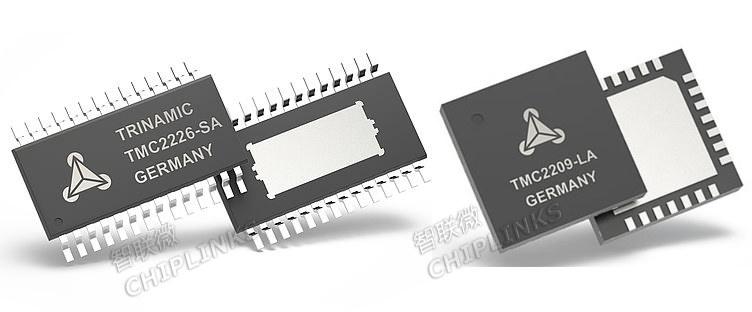
Many users who have used Trinamic chips before are deeply impressed by the TMC2209. Its integrated MOSFETs support a maximum current of 2.8 A and provide good heat dissipation. It also has latest-generation technologies such as quiet operation, anti-vibration, sensorless torque detection, and dynamic current regulation, and multiple advanced functions can be used at the same time—all at a very low price. However, the TMC2209 uses a QFN package, so users who previously used HTSSOP packages cannot replace it pin-to-pin, which is truly a bit regrettable. Now, the TMC2226—the 'brand-new' version of the TMC2209 you'd never have expected—has arrived.
Hamburg, Germany, May 11, 2020 — TRINAMIC announced the launch of its latest stepper motor driver for two-phase bipolar stepper motors, the TMC2226. It is programmable via UART and incorporates some of Trinamic's latest-generation technologies, making it ideal for design upgrades using compatible drivers. Trinamic founder and CEO Michael Randt explained: 'Step/direction is still the most common interface for existing motion controllers to communicate with stepper motor drivers. With the TMC2226 stepper driver IC, engineers can easily upgrade existing designs or develop new applications without leaving the S/D interface. Programming and debugging of the chip are done via UART, making it a user-friendly stepper motor driver IC with all the benefits of our latest technologies, simplifying system development and reducing indirect costs.'
The figure below compares the packages of the TMC2226 and TMC2209:

Features and specifications:
- Two-phase stepper motor, coil current (peak) up to 2.8 A, 2 A RMS
- Voltage range: 4.75…29 V DC
- STEP/DIR interface with 8, 16, 32, or 64 microstep pin settings
- Single-wire UART and OTP provide advanced configuration options
- MicroPlyer™ (microstep interpolator) interpolation enables smooth 256-microstep operation
- StealthChop2™ (quiet chopper mode), SpreadCycle™ (high-precision chopper algorithm), StallGuard4™, and CoolStep™ (current-saving control)
- Low RDSon and low heat generation: LS 170 mΩ and HS 170 mΩ (typical at 25°C)
- Low-power standby to meet standby energy regulations
- Internal sense resistor option (no sense resistor required)
- Passive braking, freewheeling, and automatic power-down
- Integrated pulse generator for standalone motion
- Comprehensive protection and diagnostics
- Thermally optimized HTSSOP package for optical inspection
Functional block diagram

Operating modes

- Standalone mode: Uses the chip's default register configuration, does not use the UART interface, and directly uses S/D to send pulses and direction
- OTP mode: OTP (one-time programmable), with register configuration pre-programmed. (Can only be programmed once and cannot be changed afterward.)
- UART mode: Through the UART interface, various advanced functions are set by modifying register values.
Applications
- Compatible Design Upgrades
- 3D Printers
- Printers, POS Machines
- Office and Home Automation
- Textile, Sewing Machines
- Video Cameras
- ATM Machines
- HVAC
- Battery-operated equipment
- and other applications requiring quiet operation and vibration suppression