
As Trinamic chips continue to be upgraded, new versions of TMCL-IDE have also been released. TMCL-IDE is the companion test software for TMC evaluation boards and is a full-featured host PC application.
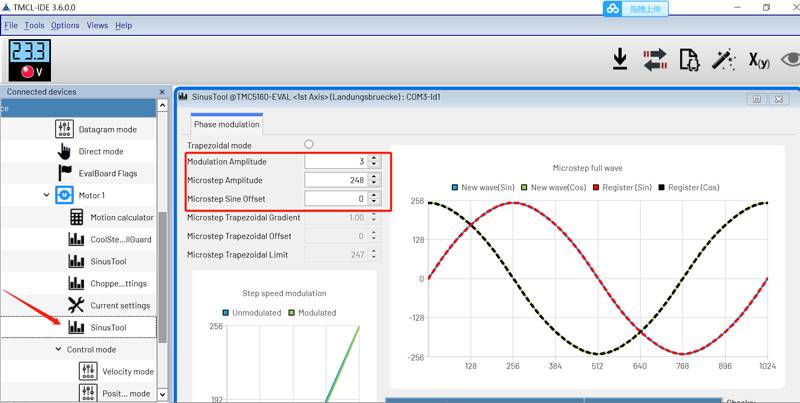
Sometimes testing reveals that even when the motor current waveform is a very good sine wave, problems such as motor resonance, loud operating noise, and insufficient accuracy after microstepping can still occur. The new version of TMCL-IDE adds a sine microstep adjustment tool (Sinus tool), which can quickly match the microstep table. By adjusting the microstep table, it reduces motor operating noise and reduces system resonance—for example, in cases where the motor has system resonance at low speed, insufficient accuracy, or high noise, especially with high-torque motors and PM motors.

Configure Microstep Table Registers
Test Results Using an 86 Stepper Motor
Next, we found an 86 stepper motor. The motor was large enough and loud enough; in particular, the resonance noise generated when it was placed on a desktop was a very troublesome issue. This time, the tmc2160-EVAL board was used for testing, with 27 V supply, 64 microsteps, and 60 RPM. First, test with the default microstep table. As can be seen from the video, the current waveform is already very good, but the noise is really loud—of course, this includes noise generated by the motor vibrating on the desktop.
The method for adjusting microstepping is to change the amplitude value in the Modulation Amplitude field. Because each motor is different, its value is not fixed. Later, when I adjusted the microstep table and reduced the value in the Modulation Amplitude field to a certain small value, the motor noise became much lower.
The video demonstrates Trinamic chips with the MSLUT microstep subdivision register and how to quickly find optimal microstep table settings in TMCL-IDE; by configuring the TMC microstep table registers, resonance is reduced, noise is lowered, and accuracy is improved.
Because the TMC22209/TMC2208/TMC2225 die is too small, their internal microstep table registers are not exposed.