
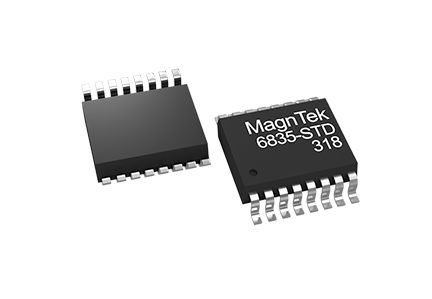
In servo controllers, robotics, new energy vehicles, and many other high-end manufacturing fields, accurate angular-position sensing is the cornerstone of system performance. Traditional optical encoders offer high accuracy but are sensitive to oil, dust, and vibration, and are complex and costly. The MT6835 magnetic angle encoder chip introduced by MagnTek (now part of NOVOSENSE), based on advanced anisotropic magnetoresistance (AMR) technology, combines high performance, high integration, and high reliability, making it a popular choice for replacing traditional solutions.

1. Core Technology: AMR Sensing Principle and Signal Chain
The core competitiveness of the MT6835 comes from AMR technology. Its physical basis is that the resistance of a ferromagnetic material (such as nickel-iron alloy) changes with the angle between its internal magnetization direction and the current direction.
The key engineering advantage of this technology is that the AMR devices inside the chip operate in the magnetic saturation region (30–1000 mT). In this state, the chip responds only to the direction of the magnetic field parallel to its surface and is almost insensitive to changes in magnetic field strength. Therefore, the machining tolerances of the magnet itself, deviations in mounting distance between the chip and magnet, and magnetic field strength fluctuations caused by temperature changes will not significantly affect the chip's measurement accuracy. This fundamentally reduces the stringent requirements for structural assembly precision and greatly improves system consistency and production line first-pass yield.
At the same time, this non-contact design completely avoids the sensitivity of traditional optical encoders to oil, dust, and strong vibration. It has a lower failure rate than optical solutions and is better suited to harsh industrial environments. In addition, through the ingenious combination of an external two-pole magnet and an internal 45° bridge, the MT6835 successfully overcomes the inherent limitation that a single AMR element can only sense 180°, achieving 0–360° absolute angle detection and ensuring accurate measurement with no dead zones over the full range.

The signal processing chain of the MT6835 is as follows: when a two-pole radially magnetized magnet above the chip rotates, two pairs of AMR Wheatstone bridges integrated inside the chip, with a 45° offset from each other, output differential sine and cosine signals related to the magnetic field rotation angle. After these signals are amplified and filtered by the analog front-end circuit, they are synchronously sampled by an on-chip high-precision 16-bit SAR ADC; the digitally quantized sine and cosine signals then enter the DSP, where angle calculation is completed by a hardware CORDIC algorithm accelerator. The calculated absolute angle data can be output through SPI or PWM interfaces, and can also be further processed to synthesize incremental ABZ and UVW signal outputs.
In addition, the MT6835 integrates complete functional modules such as a low-dropout regulator (LDO), clock oscillator (OSC), and electrically erasable programmable memory (EEPROM).

Chip functional block diagram
II. Performance Specifications and Three-Level Calibration System
Performance specifications are the most intuitive calling card of a device. The MT6835 supports a maximum rotational speed of 120,000 rpm. Even under extreme operating conditions such as motorized spindles and high-speed fans, it can effortlessly capture every angular transient.
At the same time, the chip's internal core resolution reaches 21 bits, and its unique three-level calibration system pushes accuracy to an even higher level:
- Factory calibration: linearity error is controlled within ±0.5°, ensuring out-of-the-box usability;
- User-side self-calibration: When the motor rotates at a constant speed, pulling the CAL-EN pin high enables the chip to automatically perform error harmonic compensation and store the result in the built-in EEPROM. Linearity can be improved to <±0.07°, and the entire process requires no host computer to perform complex calculations;
- NLC back-to-back calibration: For application scenarios that demand extreme accuracy, the MT6835 can be operated back-to-back with a higher-precision reference encoder. By comparing the reference angle data, a 256-point nonlinearity compensation lookup table is generated and written into EEPROM, ultimately achieving linearity with INL <±0.02°.
This self-learning and self-optimizing capability enables the MT6835 to compensate and calibrate the nonlinearity introduced by different magnets and different mounting structures, reducing debugging time and cost.
| Core measurement range | 0–360° full-circle absolute angle detection |
| Angular resolution | 21-bit |
| Angle noise (RMS) | Typical value 0.0015° |
| Differential nonlinearity (DNL) | Typical value ±0.005° |
| Maximum supported rotational speed | 120000rpm |
| System output latency | 2~10μs |
| Step response time | Typical value 100 μs |
| Operating supply voltage | 3.0V~5.5V |
| Quiescent operating current | Typical value 22 mA |
| Operating Temperature | -40℃~125℃ |
| Package | TSSOP-16 |

Package Appearance Diagram
III. Low Latency and Flexible Interfaces
In high-speed servo positioning, low latency is essential for precise real-time control. The MT6835 keeps system transmission latency between 2 and 10 μs, ensuring that the controller obtains every angle reading in a timely manner and laying the foundation for highly dynamic response control. In terms of interfaces, the MT6835 offers strong compatibility:
- Incremental output ABZ mode: provides programmable ABZ pulses at any integer resolution from 1 to 16,384 pulses/revolution (up to 65,536 steps/revolution), and can directly replace traditional optical or incremental encoders;
- Incremental UVW mode: can replace three Hall-effect switches, providing commutation signals for brushless DC motors and supporting programmable settings of 1 to 16 pole pairs/revolution;
- Absolute position PWM mode: outputs 12-bit absolute angle or speed information over a single data line; the PWM frequency supports two programmable settings, 497 Hz and 994 Hz, making it suitable for applications with limited wiring harness space;
- 4-wire SPI interface: supports communication rates up to 16 MHz, allowing a host computer or MCU to directly read the internal 21-bit absolute angle data; supports full parameter configuration, calibration control, fault diagnosis, automatic zero-point setting, and other functions, as well as multiple operation modes such as single-byte read/write and continuous angle read; the CSN falling edge can automatically latch the current angle data, and together with the CRC8 verification mechanism, it ensures data accuracy under high-speed communication.
This integrated "incremental + absolute" design significantly reduces the number of components on the BOM.
| ABZ incremental output | 1 to 16384 pulses per revolution, programmable |
| UVW incremental output | 1 to 16 pole pairs per revolution, programmable |
| PWM output | 12bit |
| 4-wire SPI | 21bit |
IV. Full-Chain Diagnostics and Typical Applications
The MT6835 integrates a complete real-time diagnostic mechanism that can monitor fault conditions such as magnetic field anomalies, undervoltage, and chip overtemperature in real time, and report alarm information via the STATUS register over the SPI interface. This makes system faults predictable, locatable, and manageable, improving equipment safety and reliability and making the device suitable for scenarios with stringent functional safety requirements.
With the above high-performance advantages, the MT6835 is widely suited to high-end rotary position detection across various fields:
- High-end servo control: 21-bit absolute accuracy is suitable for 17-bit+ absolute servo motors; microsecond-level latency ensures smooth closed-loop position control and replaces imported optical encoders at lower cost;
- Industrial robots: high-precision position feedback for joint motors of collaborative robots and SCARA robots; vibration- and contamination-resistant characteristics suit complex robot motion scenarios;
- High-speed spindle equipment: position detection for high-speed spindles in CNC machining centers and precision power tools; compatibility with high speeds up to 120,000 rpm addresses the pain point of conventional encoders failing in high-speed scenarios;
- Semiconductor and medical equipment: high-precision rotary stage control for wafer lithography machines and surgical robots; ±0.02° linearity accuracy ensures the accuracy of nanometer-level positioning and micrometer-level operations;
- Automotive electronics: position detection for electric power steering (EPS), thermal management water pumps in new energy vehicles, and electronic throttle; the wide -40°C to 125°C temperature range and high reliability meet stringent automotive environment requirements;
- General automation: motor position and speed detection for AGVs, conveyor rollers on automated production lines, and smart logistics equipment, simplifying system design and improving long-term operational stability.
V. Conclusion
With a single non-contact chip, the MT6835 combines 21-bit absolute angle sensing, multi-mode incremental output, hardware-level real-time computation, and self-learning calibration, fundamentally simplifying servo system structural design and lowering the barriers to assembly and commissioning.
As industrial automation advances toward higher precision and reliability, the MT6835 not only provides a high-performance domestically sourced option for high-end servo systems, robotics, new energy vehicles, and other fields, but also, with its unique three-level calibration system, makes “extreme precision” no longer dependent on expensive precision alignment and adjustment, instead becoming a standard capability within reach for every device.For more information about the MT6835 or to request samples, please contact: sales@chiplinkstech.com; Phone: Engineer Chen, 13924675549 (same number on WeChat); WeChat Official Account: Zhilian Micro - Motor Control Chips,We provide part selection services and technical support.

Sample Request Attached

WeChat Official Account