
Customers familiar with Trinamic products often have questions like these:
- Trinamic's stepper and servo chips offer excellent performance, but are there driver chips for other types of motors?
- We have our own stepper drive algorithms and cannot use Trinamic's integrated algorithms. Are there products that can work with ours?
- Are there high-voltage, high-current motor driver chips?
- We use solenoid valves and brushed motors in large quantities. There are many drive solutions, but control performance is not good enough. Does Trinamic have products for these?
Trinamic now has good answers to these questions. Let's take a look!
1.Solenoid and Solenoid Valve Drivers
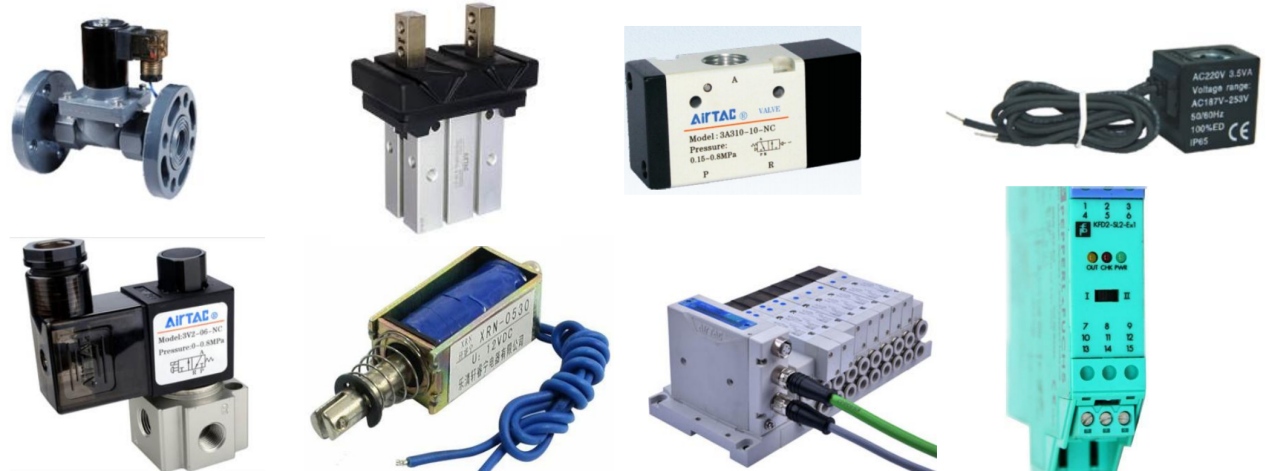
An electromagnetically controlled industrial device and a basic automation component used to control fluids; it is an actuator and is not limited to hydraulic or pneumatic applications. It is used in industrial control systems to adjust the direction, flow rate, speed, and other parameters of the medium.
Main application areas:
- Automatic control systems
Solenoid valves are widely used to control the automatic opening and closing of valves, thereby regulating the flow rate of various liquids, gases, and media in pipelines,
pressure, and temperature. Solenoid valves are also used to control air conditioning, water systems, and power supply systems in buildings
- Manufacturing
In manufacturing, solenoid valves are used in mechanical equipment and production lines. In hydraulic and pneumatic systems, solenoid valves are used to control
and regulate the flow of fluids and gases in equipment. Solenoid valves are also used in machine tools and industrial robots.
- Medical Equipment
Solenoid valves are widely used in the medical field, where they can control the flow of gases such as anesthetic gas, oxygen, and air, and control the delivery of drugs and
liquids. In medical equipment such as MRI machines, solenoid valves are used to control the flow of liquid helium and hydrogen gas in scan pipes.
- Household Appliances
Used to control water flow, airflow, and membrane filters in household appliances such as washing machines, air conditioners, water purifiers, water heaters, and coffee machines.
Control and regulation of water temperature and water level...
- Automotive Electronics

1, MAX22200 - 36V Eight-Channel Serial Smart Solenoid Controller IC

MAX22200 Feature Overview:
► Fully independent channel control
▪ The current and energization time for each channel can be programmed independently. Users can optimize the driver for different solenoid valves.
No other device on the market offers this flexibility.
► Two programmable levels with closed-loop regulation can save>60% power consumption
▪ Two programmable current levels for optimal driving of solenoid valves and bistable valves
► Current Drive Regulation (CDR) – Closed-loop current regulation
▪ Closed-loop control enables precise current drive, unaffected by variations in system parameters (coil resistance, temperature, and supply voltage).
▪ No need to overdesign the coil drive circuit and power supply to compensate for changes in these environmental factors.
► Integrated Current Sensing (ICS) – Saves >40% of PCB space and simplifies layout
▪ Eliminates the need for power resistors. External sense resistors are bulky and consume significant space, especially for multi-channel drivers.
► Full suite of diagnostic tools. In particular, Plunger Movement Detection (DPM)
▪ Simplifies system commissioning and repair
- Why is current control (CDR) better than voltage control (VDR)?

▪ Compared with current control mode, voltage control mode requires a larger margin to achieve the minimum drive current and hold current.
▪ Voltage control is susceptible to variations in coil resistance and input voltage.
▪ Current control mode eliminates these inaccuracies, saves power consumption, and reduces solenoid valve wear.

- Plunger motion detection (DPM)
► Problem: In a stuck valve, the plunger does not move even when the HIT current is reached. How can the plunger motion status be detected?
► Solution: DPM significantly reduces system commissioning and maintenance, especially in complex systems with dozens of valves.
▪ A diagnostic tool that allows "dynamic" detection of local peaks
▪ Detection is performed separately for each channel
▪ The detection threshold can be configured by the user via SPI
▪ When a fault is detected, the nFAULT pin is activated and a bit is set in the fault register for future query

2, MAX22216 - 36V diagnostic-capable4channel smart solenoid valve and DC motor driver IC

►MAX22216, MAX22217 – single-ended control

►MAX22216, MAX22217 – full-bridge control

►MAX22216, MAX22217 – DC Motor Control

- Key Features:


►MAX22200 vs. MAX22216 Parameter Comparison

►MAX22216 - MAX22221 Product Family Composition

3, MAX22215 – Electromagnetic Motor Brake/Solenoid Valve Driver

II. Stepper Motor Drive
Advantages of Integrated Lossless Current Sensing in Driver Chips:
- Reduce board size: eliminate bulky resistors
- Reduce BOM items and cost: power resistors are relatively expensive
- Simplify PCB layout: simplify routing
- Improve robustness: no parasitic inductance in the current path
- Improve efficiency: eliminate external losses
- Enable an updated adaptive mixed decay mode algorithm based on soft decay detection.

1, MAX22204 – 65V, 3.8Apk/2ARMS, 128 microsteps – stepper motor driver

- MAX22204 vs. competitors: parameter comparison:

2. MAX22210 – 65 V, 3.8 Apk / 2 ARMS, 128 microsteps – Stepper Motor Driver

III. Brushed Motor Drivers, Bridge Drivers
1. MAX22201, MAX22202, MAX22207 – 36 V / 3.5 Apk / Integrated Current Sensing – Brushed DC Motor Drivers

- Parameter comparison of MAX22201/MAX22202 brushed motor driver ICs with competing products:

MAX22203 – 65 V / 3.8 Apk / 2 ARMS, driver IC for two brushed motors or a PWM-controlled stepper motor

- MAX22203 parameter comparison with competing products:


3. MAX22205 – 65 V / 7.6 Apk / 4 ARMS Brushed DC Motor Driver

4. MAX22208 – 65 V, 3.8 PK / 2 ARMS, 4-channel half-bridge driver with integrated current sensing

5. MAX22211 – 36V, 3.8AMAX/2ARMS dual full-bridge driver IC

- MAX22211 vs. competitor parameter comparison:

6. MAX22212 – 36V, 7.6AFS/4ARMS single full-bridge driver IC

7. MAX22213 – 36V, 3.8APK/2ARMS, 4-channel half-bridge driver with integrated current sensing

Differentiated features of ADI Trinamic's former Maxim products

