
In the early days, the Internet of Things (IoT) largely served as the “eyes and ears” of cloud-based services, collecting data from sensors, cameras, and other input devices residing in the physical world, with less emphasis on manipulating or controlling what it monitored. IoT-enabled automation and robotics applications have begun to converge, but their cost has generally limited their use to high-end industrial and commercial markets. Recently, however, embedded motion control devices have begun to enable intelligent, secure, low-cost motorized products that can complement the IoT’s eyes and ears with arms and hands of comparable capability.
What Is Embedded Motion Control?
The term “embedded motion control” refers to highly integrated devices that embody precise motor control, high-performance computing, and, in many cases, communications capabilities within a single device. This is the next stage in the evolution of embedded computing, which began in the late 1970s when the emergence of low-cost single-chip microcontrollers made possible intelligence in everything from microwave ovens and children’s toys to cash registers and medical equipment. Much of the efficiency gains delivered by modern automobiles are realized through embedded computing.
Nearly two decades later, the rise of the Internet, wireless data, and higher levels of silicon integration brought embedded connectivity to everyday items such as bathroom scales, fitness monitors, and home entertainment devices. Embedded connectivity also found use in some motorized consumer products, such as the Roomba cleaning robot. Unfortunately, the cost of separate MCU, motor controller, and analog motor driver components, along with the complexity of developing motor control software, meant that connected motion control was mainly used in manufacturing automation and other industrial applications.
Higher integration helps reduce the cost and component count of motion control platforms, so that only a general-purpose MCU and a few analog components are needed to implement a complete solution (Figure 1):
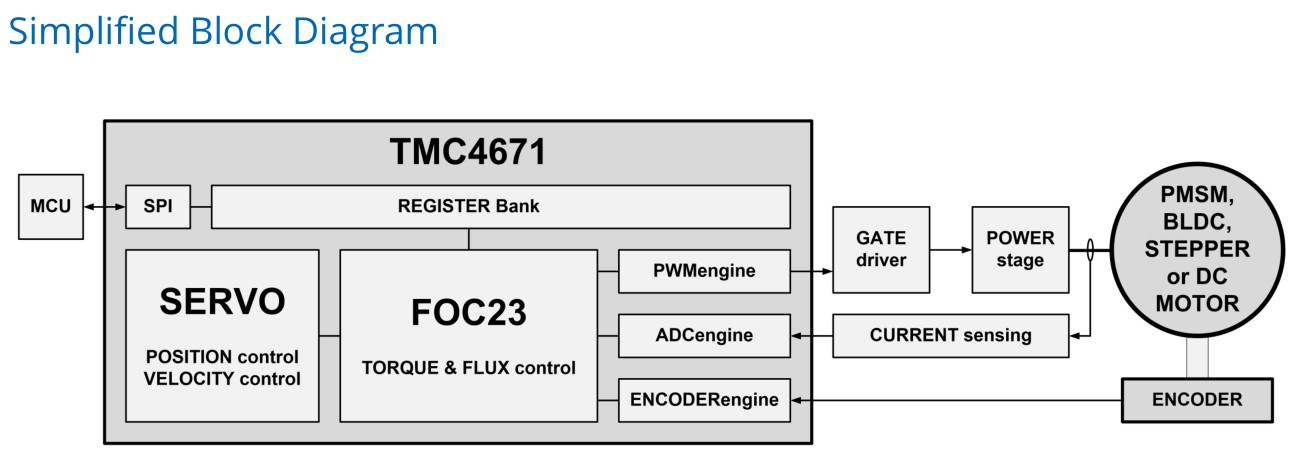
(Figure 1): Trinamic TMC4671 chip, an integrated motor control solution with an external MCU。Further integrating motion control requirements into software not only enables smaller electronic devices but also offloads real-time critical tasks from the MCU.*
Recently, embedded motion controllers have emerged that integrate these functions with powerful MCUs (Figure 2). In most cases, the on-chip processor has sufficient computing power to support the complex algorithms required for precise control of one or more motors. In many cases, these devices also include Ethernet, CAN bus, or other interfaces for IoT communication. For low-power applications, a single package can even contain the final output stage required to drive medium-sized stepper motors, brushless PMM (BLDC/BLAC), or other types of motors. The MCU can also be programmed to drive other types of motion-generating devices, such as linear actuators and voice coils.
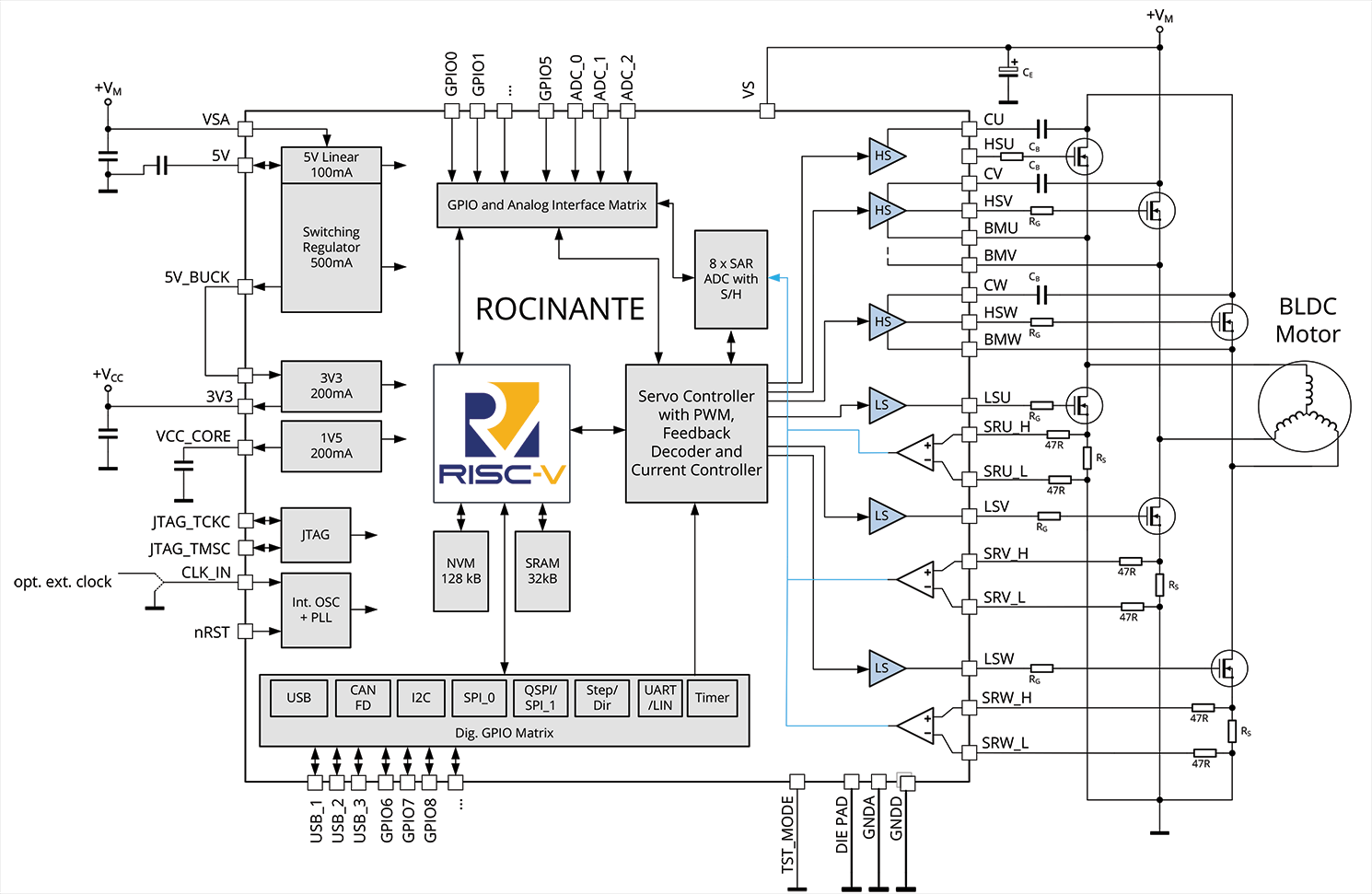
To accelerate development, these controllers are usually supported by firmware libraries that provide designers with a rich set of functions callable through standard APIs. These libraries typically include algorithms for several common motor control modes (torque, speed, and position), for torque control, namely field-oriented control (FOC), and motion modes (such as profiled position, profiled speed, and profiled torque).
Application Areas
Medical Products
Medical equipment is one of the first markets in which embedded motion control is changing expectations for product capability and safety. For example, infusion pumps must deliver precisely metered therapeutic agents to patients at a stable flow rate. IoT-enabled embedded controllers can program and monitor these pumps at the patient's bedside or in centralized management applications. Similarly, IoT-enabled controllers used in wearable insulin pumps and other personal drug delivery devices can support autonomous operation while providing patient health metrics in real time to cloud-based analytics applications.
Industrial Products
Industrial automation has been an early beneficiary of embedded motion control. Low-cost, compact motor controllers can be placed close to or even built into motors or actuators. The embedded controller in each module performs most basic motion control functions locally, creating a distributed control architecture that brings intelligence close to the point where data is converted into motion. This, together with the controller's ability to monitor and record its motor's vital signs, makes embedded motion control systems more responsive and delivers higher speed and accuracy at a lower price.
Embedded motion controllers can also monitor and record, in real time, the operating conditions of motors and the machines they drive, enabling faster response to faults or alarm conditions and, in some cases, preemptive problem resolution to avoid product defects or costly downtime. At its simplest, this includes tracking the number of movements of each subcomponent and comparing it with schedules for adjustments, parts replacement, and other routine maintenance. This can be combined with information collected from the motor to look for early indications of excessive friction somewhere in the mechanism, which could soon lead to more serious and expensive problems.
In these applications, the controller's embedded communications capabilities enable machines to be easily monitored and controlled across the IIoT via a local application server or cloud-based applications.
Consumer Products
High levels of silicon integration and the resulting low cost of embedded motion control components are helping this technology find an increasing number of new applications in the consumer market.
Some examples include:
- Smart, high-performance e-bikes and electric scooters are more affordable and can use controllers that precisely match the output drive waveform to the motor and its load, extracting more from the battery.
- IoT-connected smart homes with efficient remote-controlled active vents, curtains, surveillance cameras, and appliances.
- 3D printers equipped with smart motor drivers that use complex waveform shaping algorithms provide faster speeds and print precision while greatly reducing the noise they generate.
- Time-critical functions in personal robots are embedded in hardware peripherals, freeing processors for AI and the user interface.
Conclusion
Embedded motion control makes data movement easier and more cost-effective. By doing so, it helps make existing products better and enables new categories of products.