
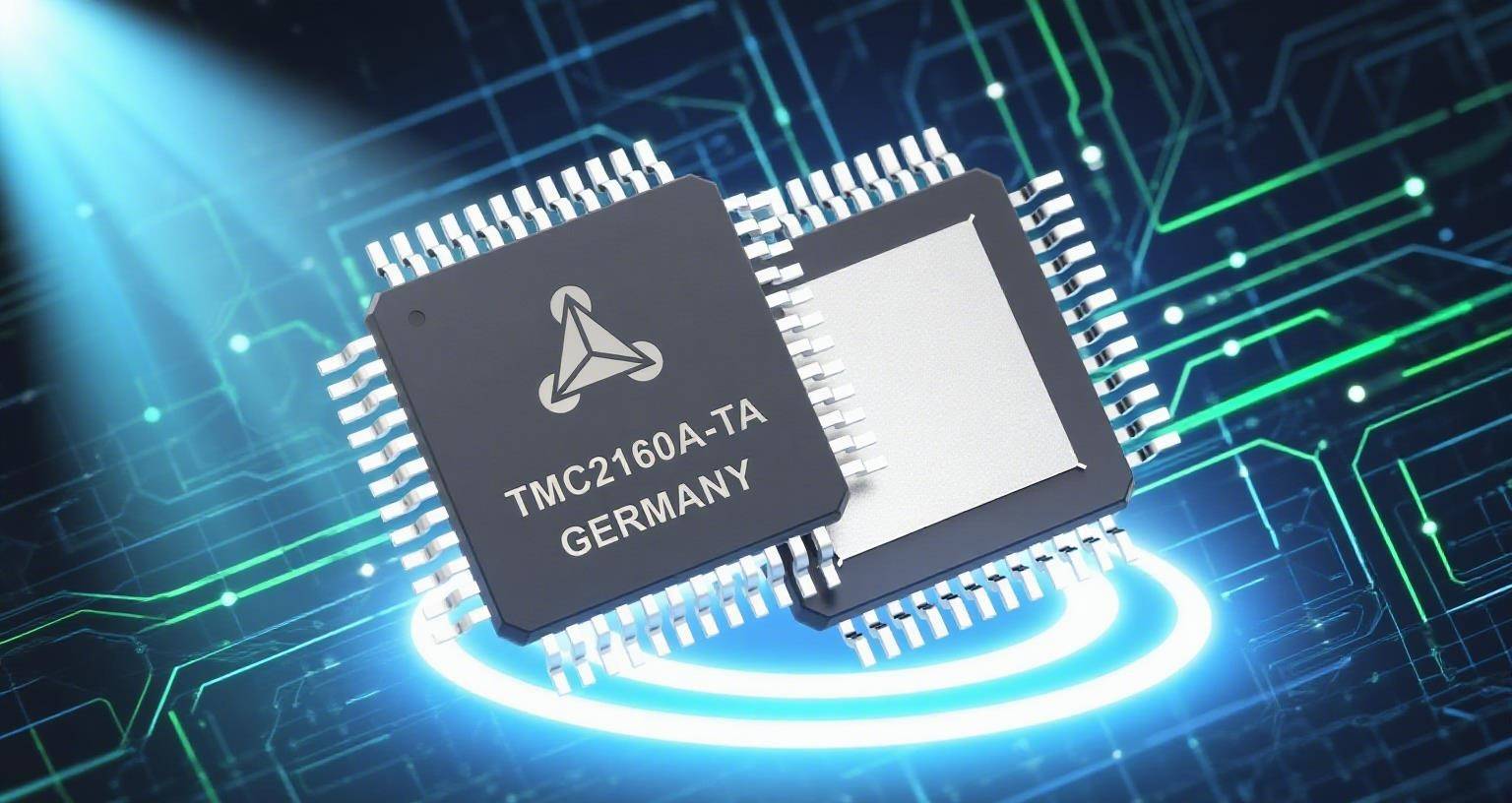
In fields such as modern industrial automation, precision manufacturing, and high-end equipment, stepper motors serve as core actuators for precise positioning and high torque output, and their performance requirements are increasing with scenario complexity. Traditional stepper motor drivers face pain points such as high noise, strong vibration, low energy efficiency, and low integration. Especially in high-power (e.g., NEMA23/NEMA34 motors) and wide-voltage (12–48 V industrial supply) scenarios, the requirements for driver IC stability, quietness, and scalability are even stricter. Trinamic's high-power stepper driver IC.TMC2160With its highly integrated design and excellent performance, it has become an ideal industry solution.

The TMC2160/TMC2160A is ahigh-power stepper motor driver ICwith an SPI interface. It uses a compact TQFP-48 package (7×7 mm), supports a wide voltage range of 8–60 V and coil current up to 20 A (implemented via external MOSFETs), and can drive stepper motors of various specifications from NEMA23 to NEMA34. It features the industry's most advanced stepper motor driver, with a simple step/direction interface, and is also equipped with an SPI interface, allowing users to choose the appropriate control method according to application requirements. By using external transistors, the TMC2160 can achieve high-dynamic, high-torque drive. Based on TRINAMIC's advanced SpreadCycle™ and StealthChop2™, the driver ensures absolutely noiseless operation while combining maximum efficiency and optimal motor torque. High integration, high energy efficiency, and small size make it a cost-effective solution for miniaturized and scalable systems.
| Core Features | Technical Specifications and Details |
| Motor Compatibility | Two-phase bipolar stepper motor, supports external MOSFET expansion, coil current up to 20 A (RMS) |
| Supply Voltage Range | 8–60 V DC (wide-voltage compatibility, compatible with 12 V/24 V/48 V industrial power supplies, short-term peak voltage up to 64 V) |
| Microstep Resolution | Up to 256 microsteps/full step, supports MicroPlyer™ microstep interpolation (STEP/DIR interface automatically increases to 256 microsteps) |
| Control Interface | STEP/DIR (compatible with traditional pulse control), SPI (parameter configuration and diagnostics), Standalone mode |
| Operating Temperature Range | -40°C to 125°C (industrial-grade temperature range, suitable for harsh high- and low-temperature environments) |
| Core Algorithm | StealthChop2™、SpreadCycle™、CoolStep™、StallGuard2™、DcStep™ |
| Special Functions | Resonance Dampening, External Reset, Automatic Tuning (AT) |

TQFP48-EP package (body 7 mm × 7 mm; the exposed pad must be connected to a GND plane to enhance heat dissipation)
1. Technical Highlights and Core Functions:
With multiple proprietary core technologies, the TMC2160 achieves breakthroughs in four dimensions—quietness, smoothness, energy efficiency, and reliability. Its specific technical features and advantages are as follows:
- StealthChop2TMQuiet control:Voltage-mode PWM-based quiet drive technology with automatic tuning (AT) — after power-up, it automatically optimizes PWM parameters (PWM_OFS_AUTO, PWM_GRAD_AUTO) through two steps: “AT#1 (standby current calibration)” and “AT#2 (medium-speed load adaptation)”; no manual configuration is required to achieve low-speed (<300 RPM) near-silent operation (noise below the threshold perceivable by the human ear). Compared with the first-generation StealthChop, response speed is increased by 30%, and lower standby current is supported (as low as 225 mA, calculated in conjunction with the sense resistor), making it suitable for noise-sensitive scenarios such as medical equipment (e.g., ventilators) and office equipment (e.g., high-end printers).
- SpreadCycleTMAnti-jitter technology:High-precision chopping algorithm; this technology enables stepper motors to maintain smooth and stable operation at high speed without vibration. SpreadCycleTMBy optimizing the motor control algorithm and drive strategy, it reduces motor vibration and noise during high-speed operation. It improves system operating smoothness and precision and reduces noise pollution. It effectively suppresses jitter and resonance during motor operation, ensuring smooth operation across the full speed range and improving control precision.
- MicroPlyerTMMicrostep interpolator:When low-resolution pulses (such as 16 microsteps) are input through the STEP/DIR interface, the chip automatically interpolates internally to 256 microsteps, generating smooth current waveforms through an optimized sine wave lookup table (1024 entries). Motion accuracy can be upgraded without replacing the external controller. It is compatible with retrofitting legacy equipment and reduces system upgrade costs, making it especially suitable for factory automation scenarios where the existing PLC is retained while motor control accuracy is improved.
- StallGuard2TMStall detection:This technology enables stall detection for stepper motors without additional sensors. By monitoring changes in motor current and voltage, StallGuardTMcan infer the load magnitude, thereby providing a basis for subsequent control strategies. It simplifies the system structure, reduces cost, and improves system reliability and flexibility.
- CoolStepTMAdaptive current control:This technology relies on StallGuardTMload value to dynamically adjust the motor current supply. When the load is small, CoolStepTMreduces the motor current supply, thereby reducing motor heating and energy consumption. When the load increases, the current supply automatically increases to ensure normal motor operation. It can save up to 75% energy, reducing equipment operating power consumption and heat, and is suitable for long-running industrial assembly lines, packaging machinery, and other equipment.
- DcStepTMStep-Loss Prevention Mode:Allows the motor to automatically reduce speed to increase torque when approaching the load limit, preventing step loss; if the load continues to increase until stall, StallGuard2™ protection is triggered and the motor is stopped. The dynamic speed range can reach up to 10×. By optimizing motion speed under high-load conditions, this feature further improves overall system efficiency while expanding the motor's operating envelope. It is suitable for heavy-load scenarios such as heavy material transport and valve control, eliminating the need for a higher-spec motor and reducing costs.
- Resonance Dampening:The TPFD parameter (0–15) configures the passive fast-decay time, inserting a fast-decay phase in the motor's medium-speed resonance range (typically 200–500 RPM) to cancel mechanical resonance, avoid torque fluctuations, and suppress medium-speed resonance. It is suitable for low-precision motors (such as low-cost NEMA23), eliminating the need for additional mechanical damping structures and improving system stability.
II. Comprehensive Protection and Diagnostics:
In addition to performance enhancements, the TMC2160 motor driver IC integrates comprehensive protection functions, including short-circuit detection, open-circuit detection, overcurrent protection, overtemperature protection, undervoltage protection, and selection of passive braking and freewheeling modes. It also provides fault feedback: the DIAG0/DIAG1 pins can be configured as fault outputs (such as stall and overtemperature) and support open-drain/push-pull modes, making it easy for the host controller to quickly locate faults. These functions safeguard safe system operation by detecting and preventing various fault conditions, thereby improving safety and equipment fault recovery. They not only enhance system reliability but also extend equipment service life and reduce maintenance costs.
III. Applications
With its high integration and high performance, the TMC2160 is suitable for many scenarios requiring high power, quiet operation, and precise motion:
| Application Areas | Typical Device Examples | Core Adaptation Advantages |
| Industrial Automation | Heavy-duty robotic arms, packaging machinery, textile machinery | 20A high-power drive, CoolStep™ energy saving, DcStep™ anti-step-loss |
| High-end Equipment | High-speed 3D printers, liquid handling equipment, semiconductor auxiliary equipment | SpreadCycle™ high-speed smooth operation, resonance damping, 256 microstep precision |
| Medical Equipment | Ventilators, dental treatment instruments, sample transport systems | StealthChop2™ quiet operation, StallGuard2™ load detection |
| Security and Finance | Heavy-duty security PTZ heads, ATM cash recycling modules | Wide voltage compatibility (12–48 V), stall protection, low heat generation |
| General Industrial | Pump and valve control, material conveyor belts, precision sorting equipment | Standalone operation mode, comprehensive protection, long-term operational reliability |
IV. Development Support and Ecosystem
In terms of development support and ecosystem, Trinamic provides a complete development support ecosystem for the TMC2160. The TMC2160-EVAL-KIT evaluation kit includes an MCU board, a bridge board, and a driver board, enabling engineers to quickly evaluate the product. The accompanying graphical IDE supports real-time data monitoring, data logging, and graphical display, greatly simplifying the development process. The operating modes support two core modes—SPI mode (fine-grained parameter configuration) and standalone operation mode (SPI_MODE=0, with microstep resolution and operating current hard-configured via the CFG0–CFG6 pins, without requiring an MCU), suitable for minimalist scenarios without a controller. In addition, chip distributors such as us also provide engineers with detailed datasheets, application notes, reference designs, and professional technical support, ensuring customers can fully leverage the performance potential of the TMC2160 and shorten time to market.
V. Customer Value and Competitive Advantages
The TMC2160 brings multiple benefits to customers: high integration reduces the number of external components and PCB area, lowering system complexity and overall cost; advanced patented algorithms ensure a quieter, smoother, and more precise motion control experience; built-in protection functions and diagnostic capabilities improve system reliability; energy-saving technology significantly reduces power consumption, aligning with green design principles; easy-to-use features and comprehensive development tool support greatly shorten the product development cycle.
It is worth mentioning thatthe TMC2160 is fully compatible with the TMC5160, the latter provides an additional motion controller, making stepper motor control simpler and more uniform. This compatible design gives customers greater design flexibility and scalability.
VI. Conclusion
The TMC2160 stepper driver chip represents the advanced level of current high-power stepper motor control technology. Through "algorithm innovation + flexible hardware expansion," it breaks the traditional driver dilemma that "high power and quiet operation cannot be achieved simultaneously." Whether for the high-torque requirements of heavy industrial equipment or the low-noise requirements of medical instruments, the TMC2160 can provide precisely tailored solutions.
For detailed parameter tuning of the TMC2160, PCB layout examples, or sample requests, please contact Shenzhen Zhilian Microelectronics Co., Ltd. (Email: sales@chiplinkstech.com) to obtain dedicated technical support and customized solution services. We look forward to working with you.
Appendix: Main Specifications Table
| Axes | 1 |
| Motor Supply | 8…60V |
| Microsteps | 1…256 |
| SPI | Yes |
| Step/Dir | Yes |
| microstep table | Yes |
| MicroPlyer™ (Microstep Interpolator) | Yes |
| CoolStep™ (Current-Saving Control) | Yes |
| passive braking | Yes |
| Short detection (short-circuit detection) | Yes |
| SpreadCycle™ (high-precision chopper algorithm) | Yes |
| Stall detection | Yes |
| StallGuard2™ (sensorless stall detection and mechanical load measurement) | Yes |
| StealthChop2™ (quiet chopper mode) | Yes |
| Package | eTQFP48 (7x7) |
| Product status | Mass production |