
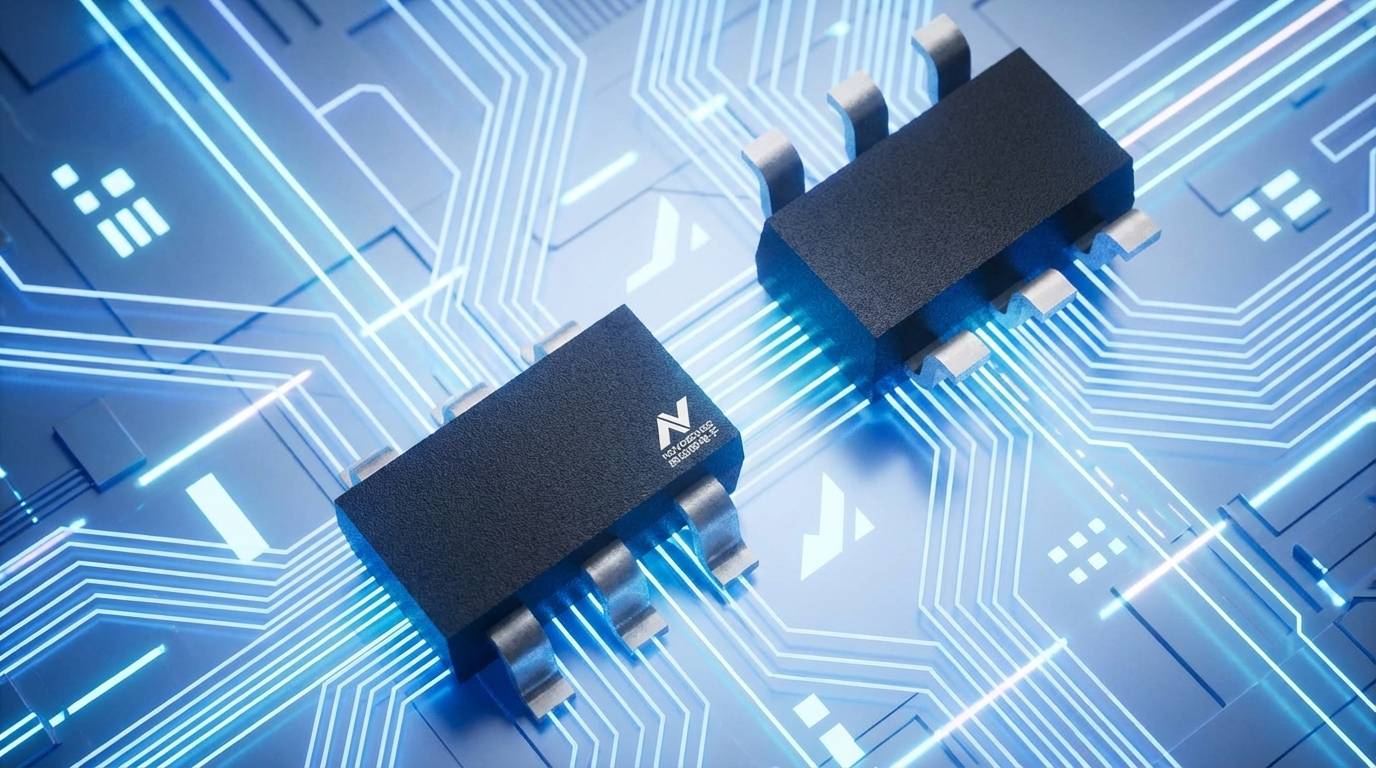
In the intelligent era of the Internet of Everything, temperature is no longer just a simple physical quantity but a key indicator of system health, operating efficiency, and user experience. From high-speed cloud computing centers to portable smart devices, overheating can cause sharp performance degradation, shortened lifespan, or even safety incidents. Traditional thermistor solutions, due to inherent limitations such as nonlinearity and the need for complex calibration, can hardly meet the growing demand of modern electronic systems for more precise, digital, and integrated temperature monitoring. The NST5851 launched by NOVOSENSE Microelectronics is a low-power, high-precision digital temperature sensor and an ideal replacement for negative temperature coefficient (NTC) and positive temperature coefficient (PTC) thermistors.

1. Upgraded Thinking, Unchanged Confidence
Traditional temperature measurement is like solving a puzzle: an NTC provides a variable resistance value, and the MCU must use precious computing power and memory to look up a huge "resistance-temperature" table to guess the approximate temperature. The process is cumbersome, and accuracy is also susceptible to interference from external resistors.
NST5851 delivers an integrated experience. It integrates the entire temperature measurement system into a single chip in a SOT23-6 package (2.9 mm × 1.6 mm). Through an on-chip bandgap sensing element, a 12-bit ΔΣ analog-to-digital converter (ADC), and a signal processing core, it directly outputs digital temperature data, so temperature can be obtained without complex calculations or table lookups.

Block Diagram
This is not merely a change in interface form, but an upgrade in system design thinking: integrating a complete system into a tiny body saves external calibration circuits, amplifier circuits, filter circuits, etc., removes extra burden, and makes PCB layout cleaner. Inside modern electronic devices where space is at a premium, every square millimeter saved is invaluable. At the same time, digital signals are far more robust than analog signals, greatly enhancing immunity to interference.
The NST5851 has been upgraded in design, but its confidence in accuracy remains unchanged: as a highly linearized product, its on-chip 12-bit ADC provides resolution down to 0.0625°C (user-selectable); it provides typical accuracy of ±0.2°C without calibration or external component signal conditioning—delivering typical high accuracy of ±0.2°C over the core range of -20°C to 85°C, with a maximum accuracy deviation of only ±1°C over the full operating temperature range (-40°C to 125°C), for precise sensing.

Package
II. Low Power Consumption for “Long Battery Life”
For power-sensitive applications (such as battery-powered IoT devices), any unnecessary power consumption is draining the product’s life. The NST5851 understands this well; from the moment it was created, “low power” was written into its DNA.
The NST5851 has a typical operating current of only 27 μA, with quiescent current as low as 0.2 μA. It also provides a low-power shutdown mode that can reduce current consumption to below 0.1 μA: when 1 is written to the SD bit of the configuration register, shutdown mode is enabled. In shutdown mode, a One-shot command can be sent to wake the chip to complete a single temperature measurement; after measurement, it automatically shuts down, with no need for continuous power supply, eliminating invalid power consumption. For IoT sensor nodes that run on coin cell batteries for months or even years (such as environmental monitors in smart agriculture), this feature is crucial.
Combined with the NST5851’s wide supply voltage range of 1.62 V to 5.5 V, it can be easily embedded in various designs from 1.8 V low-power MCU systems to 5 V traditional interfaces, without additional level-shifting circuitry, providing great flexibility for product battery life and power supply design.
Parameter Table
| Accuracy within -20°C to 85°C | ±0.2°C (typical); ±0.5°C (maximum) |
| Accuracy within -40°C to 125°C | ±0.5°C (typical); ±1°C (maximum) |
| Resolution (user-selectable) | 0.5℃/0.25℃/0.125℃/0.0625℃ |
| Temperature drift | 0.05°C (1000-hour stress test @150°C) |
| Supply voltage range | 1.62 V to 5.5 V |
| Operating current | 27μA (typical) |
| Quiescent current | 0.2μA (typical) |
| Digital interface | SMBus,I²C |
| Operating temperature range | -40℃~125℃ |
| Package | SOT23-6 |
III. "Networked" temperature-sensing ecosystem
Another strength of the NST5851 is its "networking capability." It supports the I²C bus protocol; on a single two-wire bus (clock SCL and data SDA), up to 9 independent NST5851 sensors can be connected, each with a unique address, and it can operate at up to 2 MHz in I²C high-speed mode.
This makes it possible to build a distributed multipoint temperature measurement network:
Global visibility: The host controller can easily poll the sensors and instantly obtain a complete temperature picture of all key hot spots in the system, rather than a blind-men-feeling-an-elephant approach.
Dynamic strategy: For example, when a rise in processor temperature is detected while the enclosure is dissipating heat well, the system can intelligently increase fan speed first instead of simply applying crude frequency reduction.
Balancing cost and efficiency: There is no need to configure an independent signal chain and ADC channel for each temperature measurement point, greatly saving overall system cost and complexity. This is highly cost-effective for scenarios such as energy storage systems that need to monitor the temperature of multiple battery cells and multipoint thermal monitoring on server motherboards.
It is also compatible with the SMBus interface. Its built-in SMBus alarm function can proactively notify the host when the temperature exceeds the limit, enabling preventive thermal management and improving system reliability.
IV. Application Scenarios
With its outstanding overall performance, the NST5851 can become the preferred choice for temperature monitoring in multiple fields:
Computing and Communications Infrastructure
In servers, switches, routers, and base stations, it accurately monitors the temperatures of core heat sources such as CPUs, FPGAs, and power amplifiers, and works with cooling systems to enable dynamic adjustment, ensuring stable operation and optimal energy efficiency under extreme loads.
Smart IoT and Consumer Electronics
As a core component of smart home thermostats and environmental sensors, it provides reliable ambient temperature data. In laptops and smartphones, it monitors internal temperatures to prevent localized overheating from affecting user experience and device safety.
Industrial Control and Power Management
In inverters, servo drives, and industrial PLCs, it monitors the temperature of power devices and the ambient temperature inside the enclosure in real time, enabling overheat protection and predictive maintenance. It is also an ideal choice for temperature monitoring and over-temperature shutdown protection in switching power supply modules, chargers, and other equipment.
Emerging Hot-Spot Applications
Laser equipment: In laser engravers, for example, the NST5851 can accurately monitor the temperature of the laser, galvanometer driver, and mainboard, ensuring that optical components operate at optimal temperature, avoiding thermal lensing effects on machining accuracy, and improving long-term equipment stability through active temperature control.
Energy Storage Systems: In battery management systems (BMS), multiple NST5851 sensors deployed at different points enable precise mapping of the cell temperature field, providing critical data for thermal balancing control and safety warnings.
Automotive Electronics: Temperature monitoring in in-vehicle infotainment systems, battery packs, domain controllers, and other locations meets automotive-grade reliability requirements.
V. Conclusion
With its impeccable accuracy, highly competitive power consumption, and system-friendly design, the NOVOSENSE NST5851 gives engineers a key to reliable thermal management. A single chip addresses multiple pain points of conventional solutions, moving temperature monitoring from “complex calibration, single-point monitoring, and high power consumption” to “calibration-free, multi-node, and low power consumption,” helping products gain stable and reliable advantages in fierce market competition.
By choosing the NST5851, you gain not only a chip with excellent performance but also NOVOSENSE’s deep technical expertise in precision signal chains and its reliable quality commitment. To learn more about the NST5851 or request samples, contact NOVOSENSE’s official authorized distributor on Electronics Street: sales@chiplinkstech.com; WeChat Official Account: Zhilian Micro - Motor Control Chips, which provides product selection services and technical support. We look forward to working with you.

Sample Request Attached

WeChat Official Account