
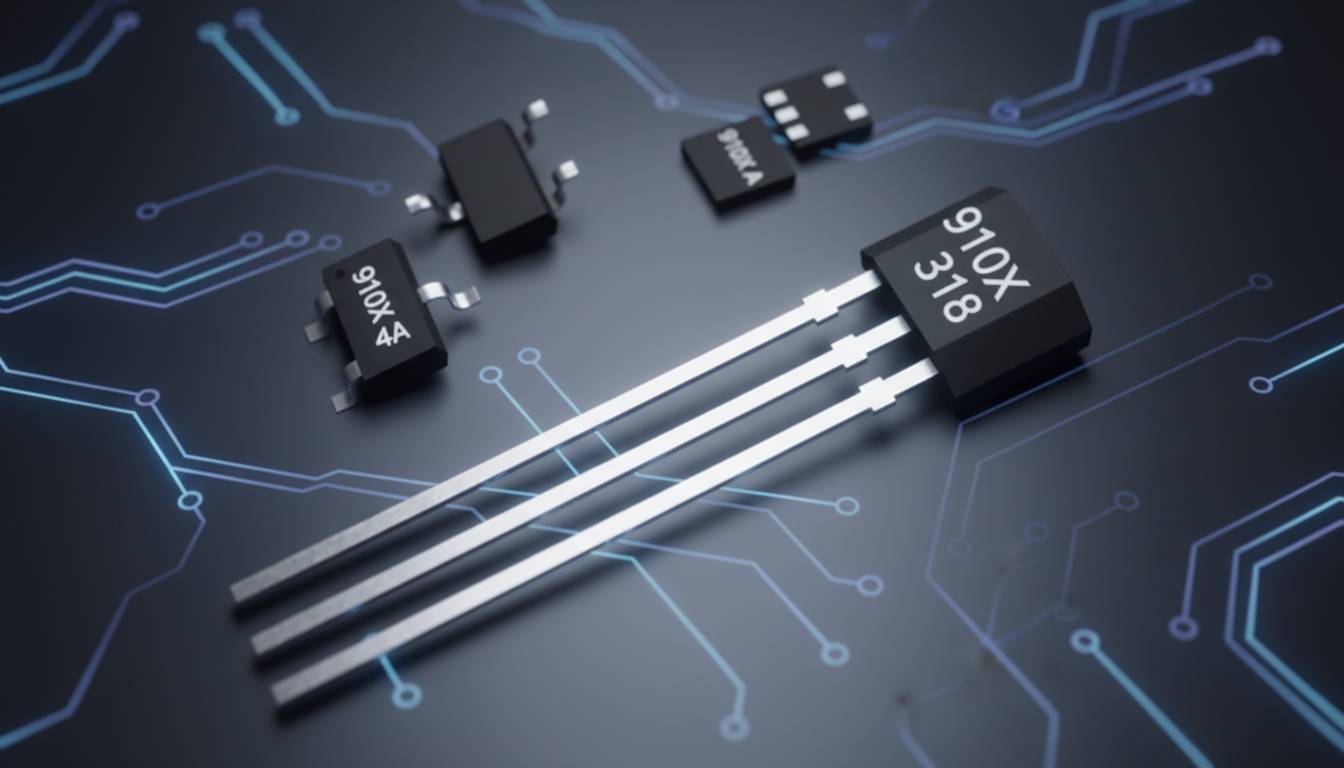
In the wave of intelligent upgrades, whether it is a robot's dexterous arm, a car's precise throttle control, or the operation of a 3D printer, behind each lies a “keen eye” that converts physical displacement into reliable electrical signals. Faced with increasingly stringent requirements for electronic devices, traditional contact-measurement position sensors often fall short. Therefore, for smart products requiring high precision and high reliability, linear Hall sensors that use the Hall effect principle to detect displacement by measuring magnetic field changes are undoubtedly an ideal solution. The MT9105 series linear Hall sensors from MagnTek (now part of NOVOSENSE), the highest-sensitivity models in the MT910X series, inject “core” power into high-precision linear position detection with excellent performance and high reliability.

1. Product Overview
The MT9105 series devices are low-noise, high-precision linear Hall-effect ICs based on a BCD process. Their core function is to linearly convert the magnetic flux density (Gauss) perpendicular to the package surface into an analog voltage output, enabling high-precision position detection without complex digital protocols. Compared with traditional contact-type position sensors, they offer non-contact measurement, fast response, long service life, and proportional response to magnetic flux density. These devices can be widely used for precise position sensing in various applications. They support a wide operating voltage of 3.0 V to 5.5 V; with no magnetic field, the output voltage is half of VCC, and they support a linear magnetic field range of ±440 Gs (5 V)/±430 Gs (3.3 V), perfectly matching position-sensing scenarios with medium-to-low magnetic field strength. Their output signal (voltage) is proportional to magnetic field strength (ratiometric output), allowing them to very accurately reflect small changes in the magnetic field. The MT9105 series is available in ultra-small packages such as SOT-23, all RoHS compliant, making it highly suitable for space-constrained modern electronic devices.
| Parameter Category | Technical Specifications |
| Operating Voltage | 3.0V~5.5V DC |
| Sensitivity | 5mV/Gs@Vcc=5V
3.15mV/Gs@Vcc=3.3V |
| Operating Power Consumption | Quiescent current: 6.7 mA (typical, VCC = 5 V, B = 0), 6.0 mA (typical, VCC = 3.3 V, B = 0) |
| Output Characteristics | Output resistance: 2–4 Ω (IOUT ≤ ±1.5 mA);
Maximum load capacitance: 10 nF; Supports sink current (-1.5 mA)/source current (1.5 mA) |
| Response Performance | Bandwidth: 30 kHz (typical);
Response time (TRESP): 15 μs (TA = 25°C); Rise time (TR): 12 μs; Propagation delay (TPD): 5.5 μs |
| Linearity and Noise | Linearity: -1.5% to 1.5%; zero-drift voltage (VNULL): 2.475 to 2.525 V (5 V), 1.630 to 1.670 V (3.3 V); noise: 1.9 mG/√Hz (typical) |
| Magnetic Field Range | ±440Gs |
| Environmental Adaptability | Operating temperature: -40°C to 150°C
ESD protection: HBM ±3000 V, CDM ±1000 V (AEC-Q100 standard) |
| Package and Thermal Dissipation | Small SOT-23 (3 × 3 mm, thermal resistance 301°C/W)
Flat TO-92 (through-hole, thermal resistance 230°C/W) |

Functional Block Diagram
II. Why Choose the MT9105? Four Core Advantages Establish Its Leading Position
The MT9105 is not an ordinary sensor; it combines high accuracy, high reliability, small size, and ease of use, making it a powerful assistant for engineers tackling complex application scenarios.
1.Exceptional Precision, Detecting the Slightest Variations
The MT9105 offers sensitivity as high as 5.0 mV/Gs (the higher the sensitivity, the stronger the ability to detect tiny magnetic field changes) and a wide linear measurement range of ±440 Gs. With linearity of -1.5% to 1.5%, it ensures a strictly proportional relationship between magnetic field and voltage, accurately captures small magnetic field variations, and is suitable for precision measurements such as cylinder piston displacement and valve opening.
It integrates a high-precision temperature compensation circuit (across the full temperature range, sensitivity temperature drift ±10%). This means that within the MT9105's wide operating temperature range of -40°C to 150°C, it can automatically compensate for the effects of temperature changes, maintaining excellent linearity and stability of the output signal and greatly reducing the difficulty and cost of system calibration. Therefore, choosing the MT9105 eliminates the need to worry about complex software temperature compensation algorithms; it can consistently maintain accurate performance in different environments (such as the 125°C high temperature of an automotive engine compartment or the low temperatures of around -10°C to -19°C in northern winters), fundamentally improving the system's long-term reliability.
2.High Reliability, Withstanding Harsh Challenges
The MT9105 is designed to industrial/automotive-grade standards and can handle complex environmental challenges.
Its operating voltage range is as wide as 3.0 V to 5.5 V, making it compatible with lithium batteries (3.7 V) and MCU systems (3.3 V/5 V), and it can easily adapt to fluctuations in different power supply systems. Its ESD protection reaches HBM ±3000 V and CDM ±1000 V, complying with the automotive electronics AEC-Q100-002/011 standards to prevent electrostatic damage during assembly or use. Its wide operating temperature range of -40°C to 150°C enables the MT9105 to handle high temperatures such as those in automotive engine compartments, severe cold in northern winters, and drastic temperature swings at industrial sites, demonstrating excellent environmental adaptability and long-term reliability and effectively improving the quality and lifespan of end products.
3.Compact Form Factor, Enabling Compact Designs
In modern electronic products pursuing ultimate compactness, every millimeter of PCB space is critical, and traditional potentiometers or large sensors can no longer meet the requirements of compact layouts. The MT9105 is offered in a standard miniature SOT-23 package measuring only 3×3 mm, a 40% reduction in volume compared with the traditional TO-92. Despite its small size, it integrates complete functions such as a Hall element, signal amplification, temperature compensation, and voltage regulation circuitry on a compact footprint. Its high integration provides great flexibility for high-density circuit board layouts, helping products achieve miniaturized and lightweight designs.

Pin Configuration Diagram
4.Simple and cost-effective, accelerating time to market
The MT9105 uses a direct analog voltage output, and the output signal is linearly proportional to magnetic field strength. Designers do not need to parse digital protocols such as I2C/SPI; the MCU's ADC pin can directly read the output voltage. Through a simple conversion of “voltage → magnetic field → position” (for example, when the relationship between magnet displacement and magnetic field is known), position information can be obtained, shortening the development cycle. At the same time, the MT9105's minimalist peripheral circuit design requires only two capacitors (100 nF + 4.7 nF) for power supply and output filtering, with no additional signal conditioning chip. The BOM cost is as low as under RMB 0.5, delivering high performance and cost-effectiveness.
III. Practical Application Scenarios: Where the MT9105 Excels
Consumer electronics: such as Z-axis leveling in 3D printers. Installed beside the print head, it detects the distance between the nozzle and the print platform (through magnetic field changes from the platform magnet) and outputs a linear voltage signal to achieve automatic leveling (accuracy ±0.05 mm). Its high-precision temperature compensation and wide operating temperature range adapt well to the high-temperature internal environment during 3D printer operation, ensuring measurement accuracy.
Automotive: such as accelerator pedal position sensors, electronic throttles, and transmission gear position detection. It withstands high temperatures and vibration in the engine compartment, adapts to harsh and complex environments without losing detection accuracy, and ensures driving safety and comfort.
Industrial control: such as precise positioning via cylinder piston position feedback, precise valve opening control, and linear motor displacement measurement, improving automation accuracy.
Smart home: such as washing machine drum balance detection, dishwasher spray arm positioning, robot vacuum travel detection, and smart door lock latch position feedback, providing high-precision and reliable operation.
IV. Conclusion: Let Excellent Design Return to Simplicity
The value of the MT9105 linear Hall-effect sensor lies in its highly integrated and optimized approach, which perfectly combines high precision, high reliability, and ease of use. It requires no digital protocol parsing and no multi-chip combination; a single IC can achieve linear magnetic field-to-position conversion. It is an excellent choice for “non-contact high-precision detection” that can effectively help engineers solve engineering challenges and make design simple and efficient again.
For more information or to request samples, please contact us—Shenzhen Zhilian Microelectronics Co., Ltd. (Email: sales@chiplinkstech.com, Tel: 0755-82557621). We are an officially authorized chip distribution agent for NOVOSENSE and look forward to working with you to inject powerful “chip” momentum into excellent designs.

Appendix: Sample Request

WeChat Official Account