
In modern electronic systems, the I²C bus has become one of the most common device management buses due to its simplicity and flexible master-slave communication mechanism. However, as system complexity increases in scenarios such as industrial automation, servers, and communications equipment, challenges including excessive loading and signal integrity caused by multi-device interconnection, long routing, and hot-swap requirements have caused headaches for engineers.

I. Why I²C Bus Buffers Are Needed
The I²C bus (Inter-Integrated Circuit bus) uses an open-drain structure. With only two lines, SDA (serial data line) and SCL (serial clock line), it can connect multiple devices and transmit signals via pull-up resistors. Although the design is simple, it has inherent limitations: the bus capacitive load cannot be too large.
According to the standard I²C specification, the maximum allowed load capacitance is usually 400 pF. However, in actual engineering design, every PCB trace, every device pin, and every connecting cable introduces parasitic capacitance. When too many devices are connected to the bus or the transmission distance is too long, the total bus capacitance can easily exceed the 400 pF upper limit. This slows the signal rising edge, preventing it from crossing the logic threshold within the specified timing, ultimately causing waveform distortion, communication bit errors, device disconnection, and other failures.
In addition, hot-swap requirements bring hardware and communication risks. In applications requiring high reliability, such as servers and telecommunications equipment, function boards often need to be inserted and removed for maintenance while the system is powered. The instant a board is plugged in live, it is equivalent to instantly connecting a huge capacitance to the bus, generating a very large inrush current. At best, this causes data corruption; at worst, it can burn out chip pins.
The value of an I²C bus buffer lies in solving the above problems: without changing the communication protocol, it physically divides the bus into multiple segments, providing functions such as capacitance isolation, signal regeneration, and level translation. It also provides critical protection for hot-swap applications and can improve the I²C bus drive capability and communication stability, allowing more devices at greater distances to be connected to the same bus.
II. NCA9511: Hot-Swappable I²C Bus Buffer
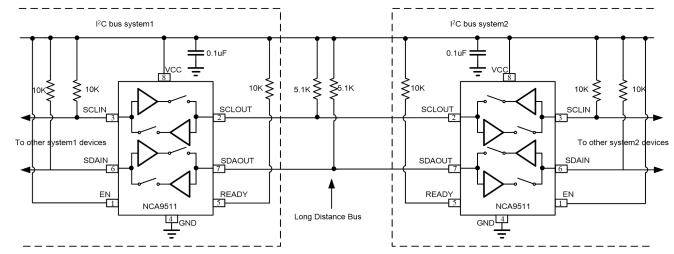
The NCA9511 is a highly integrated hot-swappable I²C bus buffer from NOVOSENSE, designed specifically to solve live backplane card insertion issues. Through its built-in control circuitry, the chip connects the backplane-side and card-side I²C buses only when a STOP condition or bus idle state is present on the backplane side and there is no bus contention on the card side; after connection, it provides bidirectional buffering to electrically isolate the bus capacitance between the backplane and card sides. The chip supports EN pin shutdown control to reduce power consumption and outputs bus connection status through an open-drain READY pin, making it widely suitable for servers, telecom equipment, industrial automation, and other scenarios.
Key Features
- Bidirectional data transmission: Fully supports bidirectional transmission of I²C bus signals without additional protocol adaptation;
- Wide operating voltage: Supply voltage range of 2.7 V to 5.5 V, compatible with common power rails such as 3.3 V MCU systems and 5 V conventional sensors;
- Wide temperature range: -40°C to 105°C ambient operating temperature, suitable for outdoor scenarios;
- Protocol support: Compatible with standard-mode (100 kHz) and fast-mode (400 kHz) I²C devices;
- Power-loss protection: When VCC drops, all I²C pins automatically become high-impedance and do not interfere with the bus;
- Shutdown mode: When the bus is idle, the EN pin can be driven low to enter shutdown mode, reducing power consumption to 0.1 µA and lowering system power consumption;
- Multiple package options: SOP-8 and MSOP-8 RoHS-compliant packages are available to meet different size design requirements.

Functional Block Diagram
III. Key Features Explained
1. 1V Precharge Protection:All SDA and SCL pins of the NCA9511 have built-in 1V precharge circuits. At the instant a board is inserted, the chip precharges the pins to 1V through internal 100 kΩ resistors before the bus is connected, bringing the pin voltage close to the bus idle voltage before contact. This greatly reduces voltage transients caused by charging parasitic capacitance during hot swapping, prevents instantaneous current surges from damaging the main line, and protects the I/O pins.
2. Smart Connection Control:To prevent the backplane-side I²C line (input) from being connected directly to the card-side I²C line (output), the control circuit continuously monitors the bus status and sets admission conditions: only when a STOP condition is detected on the backplane side or the bus enters an idle state, and both SDAOUT and SCLOUT are high, with no contention on the card side, does the NCA9511 close its internal switch to connect the backplane side and the card side. This avoids data conflicts caused by forced connection when the bus is busy.
3. Bidirectional Buffer Isolation:The NCA9511 has a built-in bidirectional buffer. Once a connection is established, it can provide bidirectional buffering. It not only enables bidirectional transparent transmission of I²C signals between the backplane side and the board side, but also keeps the backplane and board capacitances separated throughout the entire process. Even if the card-side capacitance is as high as 1000 pF, the backplane side still sees only the small capacitance of the buffer pins. This fundamentally alleviates the excess capacitance problem caused by mounting multiple devices, ensures main bus signal quality, and improves the load-driving capability and transmission stability of the I²C bus.
At the same time, the buffer uses a level-shifting design (typical offset 130 mV) to prevent bus lock-up and fully supports core I²C protocols such as clock stretching, arbitration, and synchronization.
4. Rise Time Accelerator (RTA):All I²C pins of the NCA9511 have built-in rise time accelerators. During a positive bus transition, a 5 mA current source is turned on to accelerate the bus level pull-up process. This feature allows the use of larger pull-up resistors while still meeting the rise-edge timing requirements of I²C fast mode.
5. Status Indication:The NAC9511 includes an open-drain READY output pin. When READY is high, it indicates that SDAIN and SCLIN have successfully connected to SDAOUT and SCLOUT; when low, it indicates that the two sides are disconnected. This allows the system to clearly monitor the bus connection status.
IV. Typical Application Scenarios
The NCA9511 can be widely used in applications requiring high reliability and hot-swap support:
- Servers: used in motherboards and hot-swappable hard disk backplanes;
- Industrial automation equipment: pluggable I/O modules and fieldbus gateways, enabling modular design and on-site maintenance;
- Telecommunications switching equipment: in core routers, base stations, and similar equipment, hot-swapping boards is common. The NCA9511 supports live insertion and removal maintenance of boards;
- Enterprise switches: help ensure continuous operation of network equipment;
- Multi-voltage-domain systems: when the host MCU operates at 1.8 V while sensors require a 5 V supply, the NCA9511 does not perform level translation directly, but it can work with a level translator chip to provide hot-swap protection while achieving voltage matching.
V. NOVOSENSE NCA9xxx Series: Complete I²C Interface Solution
The NCA9511 is an important member of NOVOSENSE's NCA9xxx I²C interface product family. The series also includes the I/O expander NCA9555B, multiplexer NCA9548, dual bidirectional buffer NCA9617A, and level translator NCA9306, providing engineers with a one-stop I²C bus design solution.
1、NCA9555B:A 24-pin CMOS device that provides 16-bit general-purpose parallel I²C-bus digital input/output GPIO expansion. It offers a simple solution for additional I/O requirements in applications such as ACPI power switches, sensors, push buttons, LEDs, and fans.
Product features:
- Operating supply voltage range: 1.65 V to 5.5 V;
- I²C-to-parallel port expander;
- Polarity inversion register;
- Open-drain active-low interrupt output;
- Compatible with most MCUs;
- 16 I/O pins, defaulting to 16 inputs;
- Low standby current: 0.2uA;
- ESD protection performance: 2000V (HBM); 1000V (CDM), exceeding JESD22 standards;
- 3 address pins, supporting 8 different addresses;
- 0 to 400kHz clock frequency;
- Latch-up performance exceeds 100mA;
- Operating temperature: -40℃ to 125℃;
- Package: TSSOP24, RoHS compliant.
2、NCA9548:An eight-channel bidirectional translating switch controlled via the I²C bus; SCL/SDA upstream data is distributed to eight pairs of downstream data or channels. Any single SCN/SDN channel or combination of channels can be selected, depending on the contents of the programmable control register.
Product Features:
- 8-to-1 bidirectional switch;
- Compatible with the I²C bus and SMBus;
- Active-low reset input;
- 3 address terminals, allowing up to 8 devices on the I²C bus;
- Channel selection via the I2C bus, in any combination;
- Allows voltage-level translation between 1.8 V, 2.5 V, 3.3 V, and 5 V buses;
- Operating supply voltage range of 1.65 V to 5.5 V;
- 5.5 V tolerant input;
- 0 to 400 kHz clock frequency;
- Latch-up performance exceeds 100 mA, compliant with JESD78 Class II;
- ESD protection: 2000 V (HBM); 1000 V (CDM);
- Operating temperature: -40°C to 105°C;
- Package: TSSOP-24, RoHS compliant.
3、NCA9617A:A BiCMOS dual bidirectional buffer designed specifically for I²C bus and SMBus systems, providing bidirectional voltage-level translation between low voltage and higher voltage in mixed applications (up-translation mode and down-translation mode). During level translation, the device extends I²C and similar bus systems without compromising system performance.
Product features:
- Dual-channel bidirectional I²C buffer;
- Supports Standard mode, Fast mode (400 kHz), and Fast mode+ (1 MHz);
- Voltage-level translation for I²C operation from 0.8 V to 5.5 V and 2.5 V to 5.5 V;
- Open-drain I²C I/O;
- Supports clock stretching and multi-master arbitration on the device;
- Latch-up performance exceeds 100 mA, compliant with JESD78 Class II;
- ESD protection: 5500 V (HBM); 1500 V (CDM);
- Operating temperature: -40 °C to 105 °C;
- Package: MSOP-8, RoHS compliant.
4、NCA9306:A 2-bit bidirectional I²C and SMBus voltage-level translator with an enable (EN) input that can perform bidirectional voltage translation between 1.2 V and 5 V without requiring a direction pin. It also features low on-state resistance (RON), enabling connections with minimal propagation delay. In addition to voltage translation, the NCA9306 device can be used to isolate a 400 kHz bus from a 100 kHz bus by controlling the EN pin during Fast-mode communication to disconnect the slower bus.
Product Features:
- 2-bit bidirectional translator for SDA and SCL lines in I²C applications;
- Compatible with I²C and System Management Bus (SMBus);
- Can perform level translation between the following voltages: 1.2 V VREF1 and 1.8 V, 2.5 V, 3.3 V, or 5 V VREF2; 1.8 V VREF1 and 2.5 V, 3.3 V, or 5 V VREF2; 2.5 V VREF1 and 3.3 V or 5 V VREF2; 3.3 V VREF1 and 5 V VREF2
- Provides bidirectional voltage translation without a direction pin;
- Open-drain I²C I/O ports (SCL1, SDA1, SCL2, and SDA2);
- Latch-up performance exceeds 100 mA and complies with JESD78 Class II;
- ESD protection: 2000 V (HBM); 1000 V (CDM);
- Operating temperature: -40°C to 105°C;
- Packages: VSSOP-8 and TSSOP-8, both RoHS compliant.
Wang Shengyang, CEO of NOVOSENSE, said: "The NCA9xxx series of I²C interface products meet industrial-grade temperature requirements, are compatible with the interface levels of most MCUs on the market, and fully meet the functional and performance requirements for the I²C bus in system development. The entire series, from design and manufacturing to packaging, has achieved full domestic localization, ensuring supply security and reliability."
6. Conclusion
With the development trends of industrial connectivity and intelligence, hot-swap protection and signal integrity in I²C bus applications are unavoidable challenges. NOVOSENSE's NCA9511 provides reliable protection for applications such as servers, telecommunications equipment, and industrial automation through three core mechanisms: 1 V precharge protection, intelligent connection control, and bidirectional buffer isolation. If you are designing an I²C system that needs to support hot swapping, the NCA9511 is worth including in your selection considerations.For more information about the NCA95xxx series I²C interface solutions or to request samples, please contact: sales@chiplinkstech.com (email); 0755-82557621 (phone); WeChat Official Account: Zhilian Micro - Motor Control Chips, which offers part selection services and technical support.

Sample request attached

WeChat Official Account