
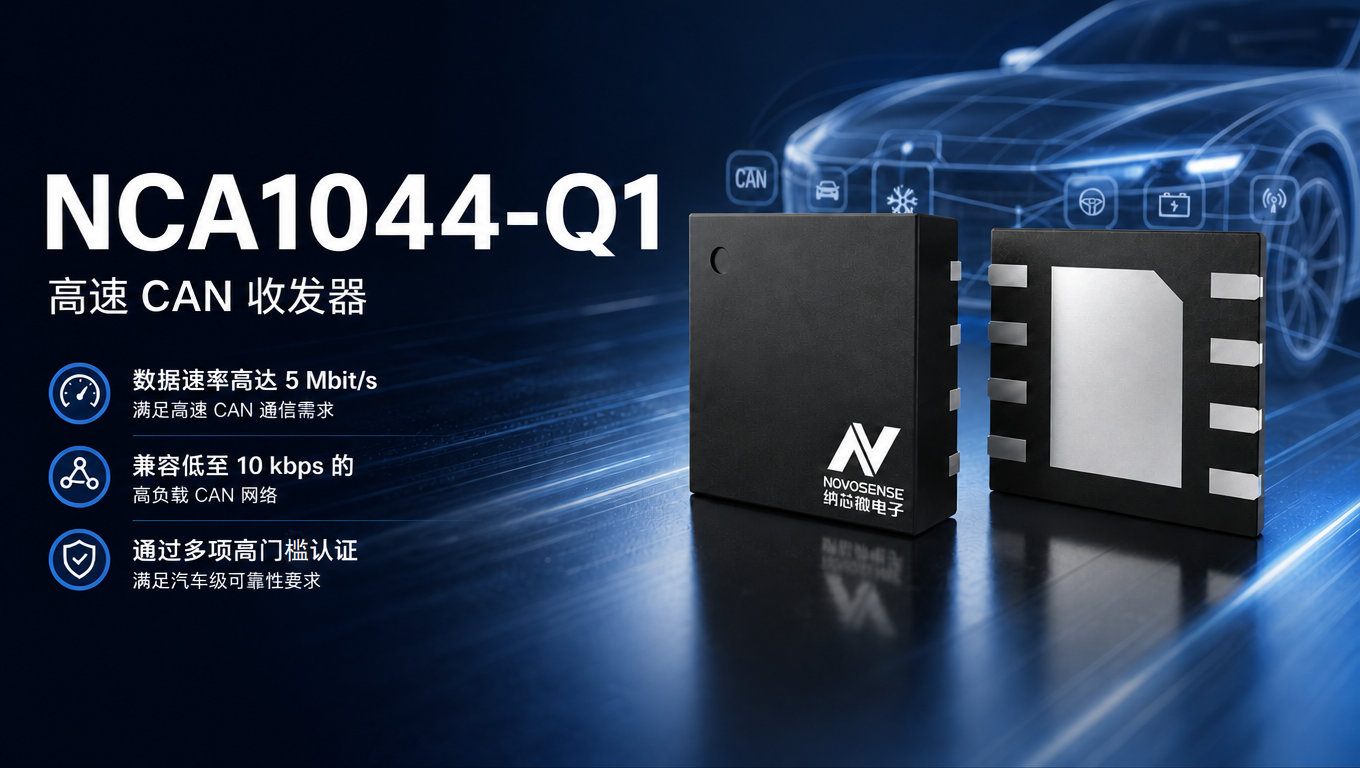
In the iterative evolution of automotive E/E architectures, CAN FD (CAN with flexible data rate) is widely used in in-vehicle gateways, body control, driver assistance, and other modules. Compared with traditional CAN, CAN FD retains the advantages of high reliability and low cost while raising data rates to a higher level, but it also places stricter physical-layer requirements on transceiver signal integrity, fault tolerance, EMC performance, and sleep power consumption. NCA1044-Q1 is an AEC-Q100 Grade 1 automotive high-speed CAN transceiver launched by NOVOSENSE. It performs signal conversion between the CAN protocol controller and the two-wire CAN bus and is the first domestically produced CAN FD transceiver chip to pass VeLIO certification, targeting automotive gateway, body control, ADAS, infotainment, and other scenarios.
1. High Speed, Automotive-Grade, and Easy to Use
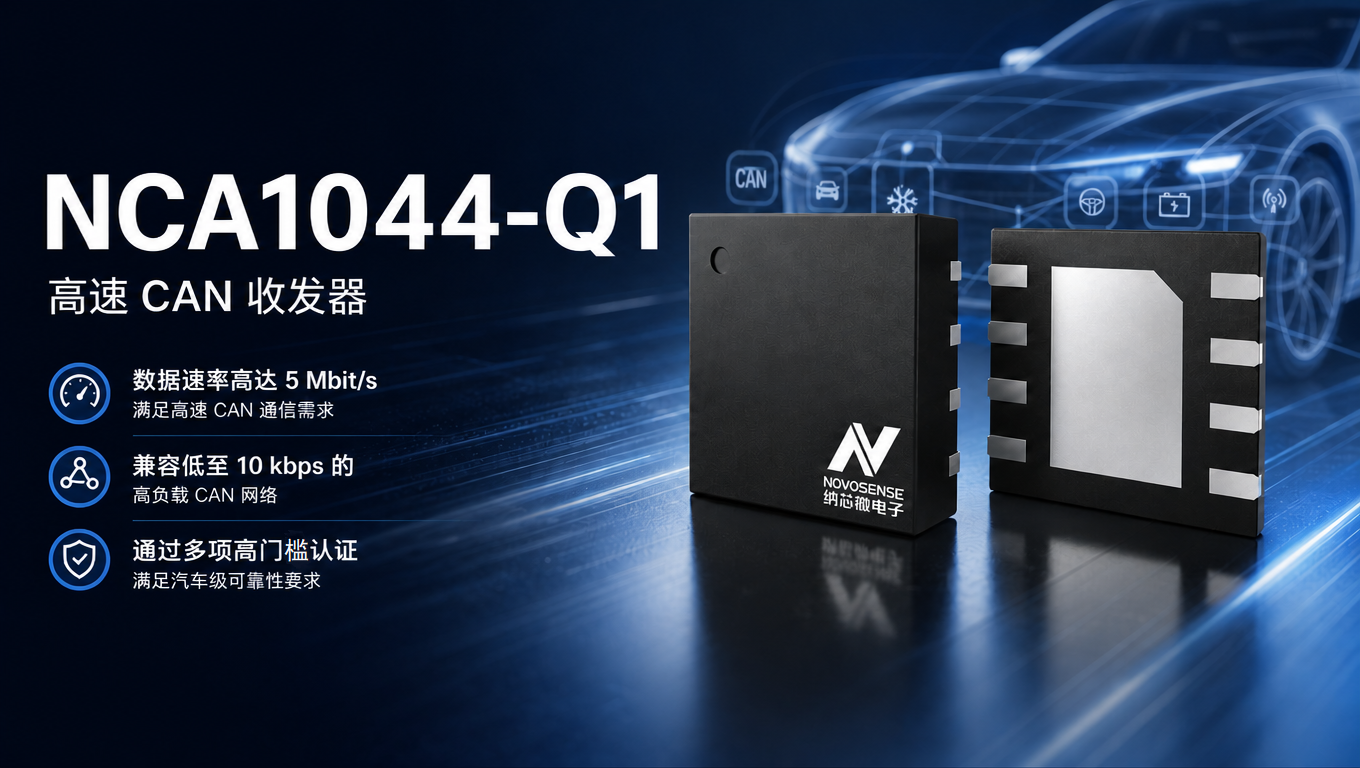
The NCA1044-Q1 CAN FD fast phase supports data rates up to 5 Mbps while remaining compatible with heavily loaded CAN networks down to 10 kbps. The device is AEC-Q100 Grade 1 certified, operates over -40°C to 125°C, and meets RoHS and REACH requirements, making it suitable for harsh automotive environments.
To accommodate the diverse I/O voltage requirements of automotive MCUs, NCA1044-Q1 is offered in two sub-models:
- NCA1044‑Q1:With an independent VIO pin, the logic I/O supply supports 1.7 V to 5.5 V, enabling direct connection to 1.8 V, 3.3 V, and 5 V controllers and eliminating the need for external level shifters;
- NCA1044N‑Q1:VIO is connected directly to VCC internally, making it better suited to designs using 5 V-supplied MCUs.
The two sub-models are pin-compatible, facilitating hardware selection and version replacement.
| Standards compliance | ISO 11898-2:2024,SAE J2284-1~5 |
| Data rate | 5 Mbps; compatible with networks as low as 10 kbps |
| Bus latency | Typical 130 ns, max. 255 ns |
| I/O level | VIO 1.7 V to 5.5 V, supports 1.8 V/3.3 V/5 V MCUs |
| Supply Voltage | VCC 4.5V~5.5V |
| Bus Pin Fault Tolerance | -58V~58V |
| Bus Common-Mode Range | -12V~12V |
| Operating Temperature | -40℃~125℃ |
| Package | SOP8;DFN8 |
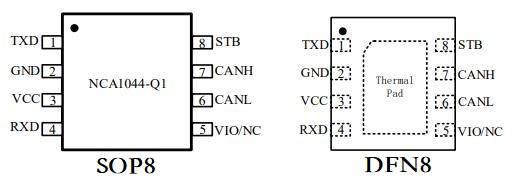
The package is offered in two options: SOP‑8 (4.9 mm × 3.9 mm) and DFN‑8 (3 mm × 3 mm, with thermal pad). The DFN‑8 package has lower thermal resistance and is suitable for space-constrained ECU boards with limited heat dissipation; the SOP‑8 is compatible with conventional PCB layout practices.
II. High-Speed Communication and Signal Integrity
The NCA1044-Q1 is optimized for high-speed CAN FD communication. The internal enhanced CAN signal design processes the driver waveform to reduce signal ringing on the network, making reliable 5 Mbps CAN FD communication possible in larger topologies. The device's loop delay is kept within the specified limit, providing timing margin for CAN FD rate switching and reducing communication anomalies caused by physical-layer timing issues.
In addition, the NCA1044-Q1 supports up to 110 CAN nodes and can maintain stable communication in high-load networks. For automotive networks requiring long cables, multiple nodes, and complex topologies, the NCA1044-Q1 provides a solid physical-layer foundation.
III. Multiple Fault Protection Mechanisms
In automotive networks, transceivers often face conditions such as short circuits, overvoltage, ground offset, electrostatic discharge, and transient interference. The NCA1044-Q1 integrates multiple fail-safe mechanisms to address these conditions:
- Bus fault protection: -58 V to 58 V, improving the bus's survivability under abnormal voltages.
- Short-circuit protection: When CANH/CANL are shorted to GND or the power supply, the current-limiting circuit protects the device; a persistent short circuit triggers overtemperature protection and then shuts down the transmitter.
- Overtemperature protection (OTP): When the junction temperature exceeds the threshold, the output driver is turned off to prevent device damage.
- TXD dominant timeout (TXD DTO): If the MCU abnormally holds the TXD pin low continuously, the chip automatically disables the transmit path after the timeout, preventing a single-point fault from clamping the bus to the dominant state and causing network-wide communication interruption. Its typical timeout is 2.8 ms.
- Undervoltage detection: Enters protection mode when VCC or VIO is undervoltage, preventing bus abnormalities.
- Ideal passive behavior when unpowered: When the device is unpowered, it presents extremely low leakage to the CAN bus, avoiding any impact on other normally operating nodes.
- Internal pull-ups: The TXD and STB pins have built-in pull-ups, allowing them to maintain a defined logic state when floating and avoiding false triggering caused by floating pins.
In terms of EMC, the NCA1044-Q1 provides ESD protection ratings such as HBM, CDM, and MM, and offers IEC 61000-4-2 system-level ESD and ISO 7637-2 automotive transient conducted immunity; specific ratings vary by part number.
IV. Certification and System Compatibility
The NCA1044-Q1 has passed several stringent performance tests.
The NCA1044-Q1 is the first domestically produced CAN FD transceiver chip to pass VeLIO certification; versions with the “H” suffix in the series meet the VeLIO test conditions (with VCC from 4.75 V to 5.25 V). This certification, led by Toyota, focuses on transceiver delay, dV/dt, threshold-voltage frequency response, S-parameters, and other items that are highly sensitive to timing and signal integrity. It imposes extremely high requirements on the chip's physical-layer consistency and serves as a high-bar benchmark for automotive LAN interoperability and system compatibility.
At the same time, the NCA1044-Q1 has also completed the IBEE/FTZ-Zwickau EMC test (an authoritative European electromagnetic compatibility certification). Based on the IEC 62228-3 standard, this test covers core items such as RF emissions, RF immunity, transient immunity, and ESD immunity. It is an important benchmark for automotive network EMC capability and an EMC threshold widely recognized by mainstream European OEMs; passing it facilitates system-level certification reference for complete vehicles.
In terms of physical-layer design, the NCA1044-Q1 meets the requirements of the general international standard (ISO 11898-2:2024) and the North American automotive industry-specific standards (SAE J2284-1 to 5), supporting reliable communication in various automotive CAN/CAN FD networks worldwide. Currently, the NCA1044-Q1 has achieved mass-production shipments with dozens of leading global OEMs and Tier 1 customers.
V. Low-Power Standby and Remote Wakeup
The NCA1044-Q1 supports two main operating modes, Normal and Standby, selected via the STB pin. In Standby mode, the transmitter and normal receiver are turned off, and only a low-power differential receiver monitors the bus, significantly reducing quiescent current. For example, the NCA1044-Q1 has a typical standby current as low as 0.72 μA; the NCA1044N-Q1 has a typical value of 13.5 μA under corresponding conditions.
The device supports remote wakeup over the CAN bus. When a valid “dominant-recessive-dominant” wakeup pattern appears on the bus and the timing and filtering conditions are met, RXD outputs a wakeup request. The wakeup logic includes filtering and timeout mechanisms, effectively preventing false wakeups caused by noise or bus clamping. After wakeup, the RXD output has a 50 μs startup delay.
VI. Conclusion
In practical projects, the NCA1044-Q1 can be used in automotive gateways, body control modules (BCM), ADAS units, and in-vehicle infotainment systems. It is also suitable for industrial equipment that uses the CAN physical layer, such as CANopen and DeviceNet, providing an automotive-grade physical-layer device option for hardware designs that need to upgrade to CAN FD networks.
With high-speed communication, automotive-grade reliability, flexible I/O levels, comprehensive fault protection, ultra-low standby power consumption, and bus wakeup capability, supported by validation in demanding programs such as VeLIO and IBEE/FTZ-Zwickau, the NCA1044-Q1 can meet the stringent temperature, electromagnetic interference, and fault tolerance requirements of automotive electronics, and can also serve the development of industrial control, construction machinery, and other equipment with high requirements for device stability.
For more information about the NCA1044-Q1 or to request samples, please contact: sales@chiplinkstech.com; Mr. Chen, 13924675549.
Appendix: Selection Table:
| Part Number | VIO Pin | Compatible MCU | VeLIO Status | Package |
| NCA1044-Q1SPR | Yes, 1.7 V to 5.5 V | 1.8V / 3.3V / 5V | Non-VeLIO | SOP8 |
| NCA1044-Q1DNR | Yes, 1.7 V to 5.5 V | 1.8V / 3.3V / 5V | Non-VeLIO | DFN8 |
| NCA1044N-Q1SPR | None (NC), internally connected to VCC | 5V | Non-VeLIO | SOP8 |
| NCA1044N-Q1DNR | None (NC), internally connected to VCC | 5V | Non-VeLIO | DFN8 |
| NCA1044-Q1SPRH | Yes, 1.7V~5.5V | 1.8V / 3.3V / 5V | Can pass VeLIO testing | SOP8 |
| NCA1044-Q1DNRH | Yes, 1.7V~5.5V | 1.8V / 3.3V / 5V | Can pass VeLIO testing | DFN8 |
| NCA1044N-Q1SPRH | None (NC), internally connected to VCC | 5V | Can pass VeLIO testing | SOP8 |
| NCA1044N-Q1DNRH | None (NC), internally connected to VCC | 5V | Can pass VeLIO testing | DFN8 |

Sample request attached

WeChat Official Account