
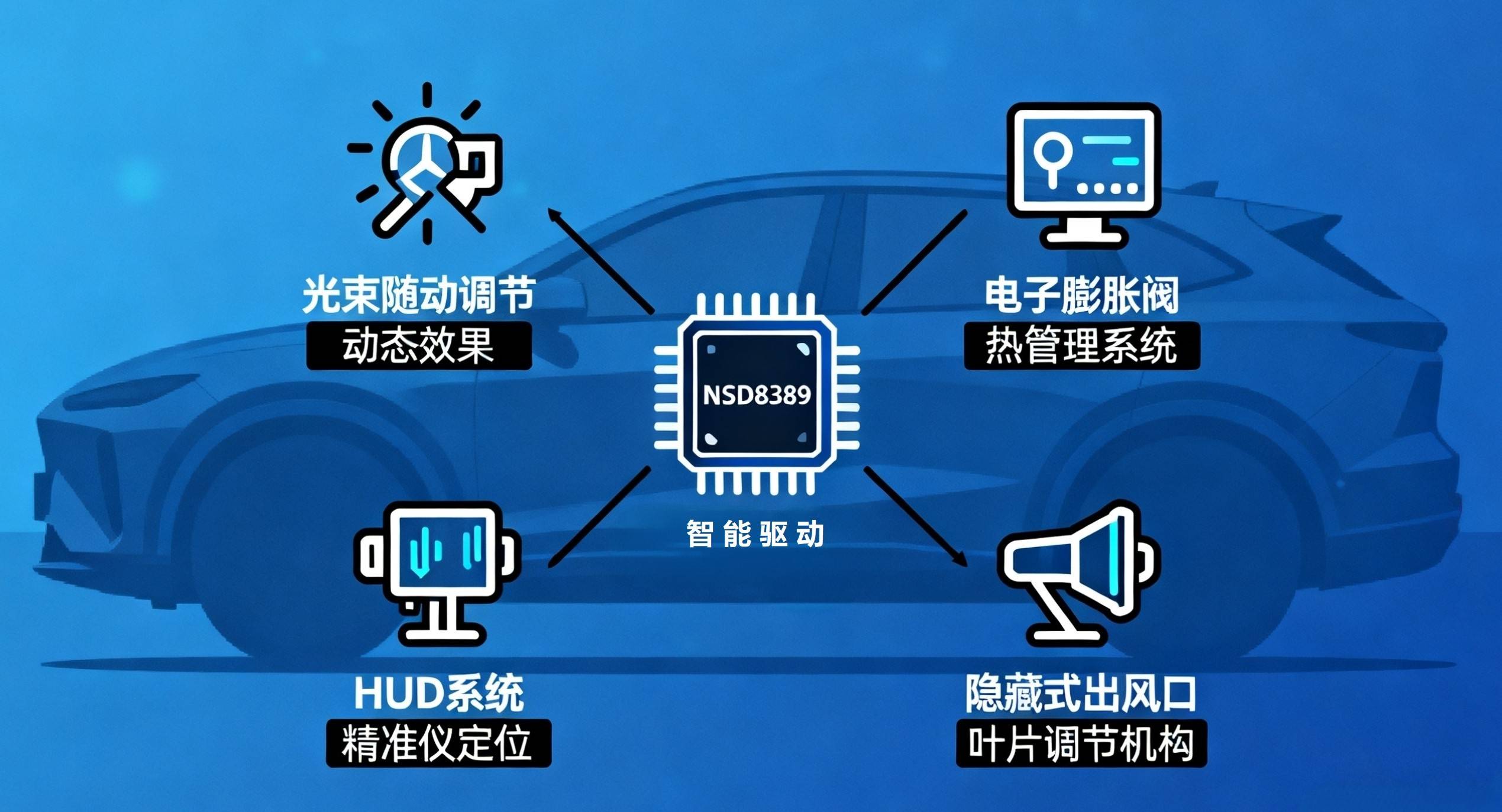
With the deep evolution of automotive electrification and intelligence, stepper motors are increasingly used in vehicles—precisely automatically adjusted air vents, adaptive smart headlights, electronic valves in thermal management systems, and more all depend on their stable operation, while high-performance driver ICs are the core of their precise operation. To further meet the stringent application requirements of the automotive industry, NOVOSENSE Microelectronics has launched the second-generation automotive-grade high-performance stepper motor driver NSD8389-Q1. With three core advantages—automotive-grade reliability, high-precision smooth control, and end-to-end safety protection—it provides the market with a highly integrated drive solution and makes intelligent control easier.

1. Product Overview
The NSD8389-Q1 is an automotive-grade highly integrated bipolar stepper motor driver. It features eight programmable decay modes, PWM spread-spectrum frequency dithering, slew-rate adjustment, dead-time configuration, sensorless stall detection, phase counting, an integrated Serial Peripheral Interface (SPI), and overtemperature warning and shutdown. When the EN input is low or VS or VDDIO falls below the POR threshold, the device enters a low-quiescent-current sleep mode. Its core advantages are automotive-grade environmental adaptability, high-precision smooth control, and end-to-end safety protection. With excellent performance and stability, it is designed specifically for automotive stepper motor drive applications such as electronic expansion valves, headlamp stepper motors, HUD adjustment motors, and hidden air vents.
| Electrical Performance | Operating voltage: 4.5 V–36 V (40 V maximum withstand voltage) |
| Drive current: 1.5 A full-scale peak current | |
| On-resistance (HS+LS): 900 mΩ | |
| Control and Precision | Programmable microstepping modes, up to 1/256 microstepping |
| 8 programmable decay modes, PWM spread-spectrum frequency dithering, slew-rate adjustment, and dead-time configuration | |
| Supports STEP/DIR I/O control and hold mode; 16-bit SPI communication supports daisy-chain mode | |
| Protection and Diagnostics | Integrated back-EMF detection enables locked-rotor and stall detection |
| Supports bus undervoltage lockout (VSUV), overcurrent protection (OCP), thermal warnings (OTW/UTW), and overtemperature protection (OTSD); supports open-circuit diagnostics and protection for output loads | |
| Automotive-grade specifications | AEC-Q100 certified |
| Operating temperature: Tj = -40°C to 150°C | |
| Available in HTSSOP24 and VQFN24 packages |

Functional block diagram
II. Core Technical Features
1. Strong Electrical Performance
The NSD8389-Q1 has a wide operating voltage range of 4.5 V to 36 V and a peak withstand voltage of 40 V, making it easy to handle various fluctuations in automotive power systems; VDDIO supports 3 V to 5.5 V and is compatible with 3.3 V and 5 V systems. The chip provides a full-scale drive current of up to 1.5 A, with a typical on-resistance of only 900 mΩ (sum of high-side and low-side MOSFETs), achieving a perfect combination of small size, low internal resistance, and high current. It also features a low-power design: in sleep mode, the VS-side current is ≤10 μA and the VDDIO-side current is ≤10 μA, reducing overall vehicle power consumption.
2. High-Precision Smooth Control
NSD8389-Q1 supports microstepping capability of up to 256 microsteps, dividing a single full motor step (1.8°) into tiny step increments of 0.007°. Imagine a conventional stepper motor as climbing stairs, where each step produces noticeable jerk; in contrast, a motor driven by NSD8389-Q1 is like walking on a gentle slope—smooth and natural. This precise control capability makes motor operation extremely smooth, significantly reduces vibration, and lowers noise, which is crucial for improving automotive ride comfort.
The chip also provides 8 programmable decay modes and supports PWM spread spectrum, slew-rate configuration, and dead-time configuration, enabling engineers to flexibly optimize motor operating performance. Its A version supports BLANK and OPL time configuration, further enhancing application flexibility.
3. Sensorless Stall Detection
NOVOSENSE stepper motors use the back-EMF method for stall detection. The chip monitors the back electromotive force generated during motor operation through an internal ADC to determine whether a stall has occurred, consistent with the stall detection principle of the previous-generation NSD8381-Q1: under normal conditions, the motor generates back EMF during operation. The back-EMF voltage and the voltage due to winding current together make up the motor winding voltage; therefore, when the winding current is zero, the winding voltage can be used to detect the back EMF. Because back-EMF voltage is proportional to motor angular velocity, when the motor stalls, the speed is zero, the angular velocity is zero, and the back EMF is also zero. Thus, stall is determined by detecting the change in back EMF when the current is zero. NSD8389-Q1 supports configurable sampling delay (CV_DELAY: 0–6400 μs), detection gain (CV_GAIN: 1x/2x/5x/10x), and consecutive detection count (CV_STALL_NUM: 1–7), enhancing detection flexibility and accuracy.
NSD8389-Q1 eliminates the need to install additional hardware such as Hall sensors in the mechanical structure, improving system reliability and reducing cost and design complexity.
4. Comprehensive Protection + Automotive-Grade Certification
The chip integrates comprehensive protection functions such as undervoltage lockout (UVLO), overcurrent protection (OCP), and overtemperature protection (OTP), ensuring system safety under various abnormal conditions. It also provides open-load diagnostics and protection for output loads; each channel is equipped with overcurrent detection and open-load detection, comprehensively safeguarding system safety and reliability.
The chip is AEC-Q100 automotive qualified and has an operating junction temperature range of -40°C to 150°C, enabling it to withstand various harsh automotive environments.
3. Flexible System Adaptation
1. Interfaces and Control
The NSD8389-Q1 offers two control interface options: a simple STEP (pulse)/DIR (direction) interface for basic control requirements, and a 16-bit SPI interface for fine configuration of all parameters such as microstepping, decay mode, and current. It also supports daisy-chain mode, allowing a single MCU to control multiple drivers, saving MCU pins and simplifying wiring design in multi-motor systems. This interface flexibility enables the NSD8389-Q1 to meet application requirements at different levels, from simple air flap control to complex safety systems, giving engineers ample design freedom.
2. Package and Version Options
The NSD8389-Q1 is available in two package types, HTSSOP24 and VQFN24, to meet the space and thermal requirements of different application scenarios. The HTSSOP24 package (7.80 mm × 4.40 mm) has a 0.5 mm pin pitch, facilitating manual soldering and repair, and is suitable for small-batch trial production or scenarios requiring later maintenance. The VQFN24 package (4 mm × 4 mm × 0.85 mm) has an ultra-small footprint and is suitable for space-constrained scenarios such as HUD projectors and hidden air vents; its surface-mount process is compatible with automotive electronics mass-production SMT lines. In addition, depending on the default state of DRV-DIS and the different BLANK and OPL timing configurations, the NSD8389-Q1 is divided into A and non-A versions, providing users with more flexible choice.

Package Diagram

Selection Guide
IV. Broad Application Scenarios and Market Prospects
With its outstanding performance, NSD8389-Q1 has broad application prospects in the automotive electronics field.
1. Automotive Electronics Application Scenarios
For example, in headlamp position control, it can enable advanced functions such as adaptive high beam and adaptive front lighting; in HUD head-up display systems, NSD8389-Q1 can be used as an adjustment actuator for the projector to ensure the clarity and stability of displayed information; it can also be used for valve control in thermal management systems and precise adjustment of hidden air vents, comprehensively enhancing vehicle intelligence and the driving experience.
2. Market Prospects
With the continuous growth of the stepper motor drive system market, the launch of NSD8389-Q1 is timely.
According to market research report forecasts, from 2025 to 2030, the market size of China's stepper motor drive systems will exceed RMB 10 billion, with the compound annual growth rate maintaining steady growth, and demand for high-precision stepper motors in the new energy vehicle sector will occupy a dominant position in the market. As China is an important global stepper motor market, NSD8389-Q1 has broad market prospects.
V. Conclusion
The launch of the NSD8389-Q1 represents a further step forward for domestically produced automotive-grade stepper motor driver chips. This tiny chip carries not only current and signals, but also a relentless pursuit of safe, comfortable, and intelligent driving experiences. It may never be directly seen by end users, but its value will be best proven in every smooth and reliable operation.
As the trend toward automotive intelligence accelerates, this type of highly integrated, highly reliable chip will become a core component of the new generation of automotive electronic systems, bringing drivers and passengers a safer, more comfortable, and more intelligent driving experience. In the future, NOVOSENSE will continue to deepen its presence in automotive electronics, and through continuous innovation and technological breakthroughs, provide strong technical support for the intelligent transformation of the automotive industry. For more information about the NSD8389-Q1 or to request samples, please contact the official authorized distributor—Email: sales@chiplinkstech.com; WeChat Official Account: Zhilianwei - Motor Control Chips.

Sample Request Attached

WeChat Official Account