
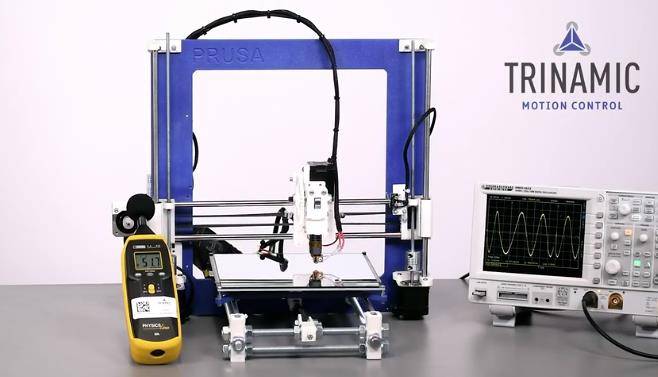
Stepper motors are widely used; they can be employed wherever an object needs to move. At the same time, within cost and size constraints and a given load capacity, they can achieve high torque at low speed or standstill without a relatively large and bulky gearbox. Their perfect microstepping also enables fairly precise control over one revolution, making them particularly suitable for positioning tasks such as 3D printers.

However, requiring so many steps per revolution can easily cause the motor to vibrate and generate noise. Sometimes the vibration is very obvious and visible to the naked eye, especially at low speed and during frequency resonance. Do not underestimate these vibrations: they are transferred directly to the 3D printer structure and directly affect print quality. So how can this problem be solved?

In application cases using Trinamic driver chips, this problem can be solved perfectly. The best solution is to set the stepper motor to the smallest microstep of 256 microsteps and precisely control the current through the driver chip. What does precise current control mean? It is actually also an energy-saving approach: during slow-speed and acceleration phases of the motor, current is flexibly controlled, because motor motion does not require constant current; otherwise, at low speed, a large current would create certain resistance to the motor's motion. When the motor is running slowly, supplying a smaller current keeps it very quiet.

Trinamic's TMC2208 driver chip is used in 3D printing precisely to minimize vibration and noise. Unlike other choppers, stealthChop2 can reduce 3D printer noise by 15 dB or even more without configuration. Testing yields many clear data points; in fact, the TMC2208 has already been successfully used in many 3D printers.
For high-performance 3D printers requiring different currents and higher voltages, Trinamic has never stopped innovating. For example, the TMC2209 supports higher current and also accommodates lower operating voltages; the TMC2130 integrates stallGuard2 technology and is an even better driver. Thanks to Trinamic's professional team and field application engineers.