
Anyone who has worked on multi-axis stepper systems has probably had this experience: one or two axes are manageable, but beyond four axes the pressure surges. Each additional axis means the MCU must take on another portion of STEP pulse acceleration/deceleration calculation and timing coordination. The more axes, the more likely issues such as interrupt latency, pulse loss/missed steps, and uneven motion are to break out. Some people switch to a higher-performance MCU, but the new platform's low-level drivers must be re-adapted, peripheral mappings may all change, and the firmware is basically equivalent to a rewrite, making time cost and engineering risk difficult to control.
In fact, there is no need to tough out the bottleneck of main-controller computing power. An efficient optimization approach is to push motion planning down from the main controller to the drive side, letting each drive chip autonomously complete trajectory calculation and pulse output—this is the core value of the integrated drive-and-control stepper drive solution.
As a new-generation integrated drive-and-control stepper drive solution from Trinamic (now ADI), the TMC5262 centers on full-speed-range silent technology, a fully integrated medium-power stage, and intelligent motion control, providing a high-performance optimization path for multi-axis precision motion systems with high requirements for operating quality and development efficiency.

I. Two Architectural Routes, Filling a Gap
In Trinamic's (now ADI) stepper drive product matrix, chips can be divided by architecture into two major categories: pure driver chips and integrated drive-and-control chips (cDriver). The former focuses on power output and chopper algorithms; motion planning relies on an external MCU via STEP/DIR or SPI commands, with representative models such as TMC2209 and TMC2240. The latter has a built-in ramp motion controller; the MCU only needs to issue a target position or speed, and the chip can autonomously complete trajectory calculation and pulse generation, typically such as TMC5130 and TMC5160.
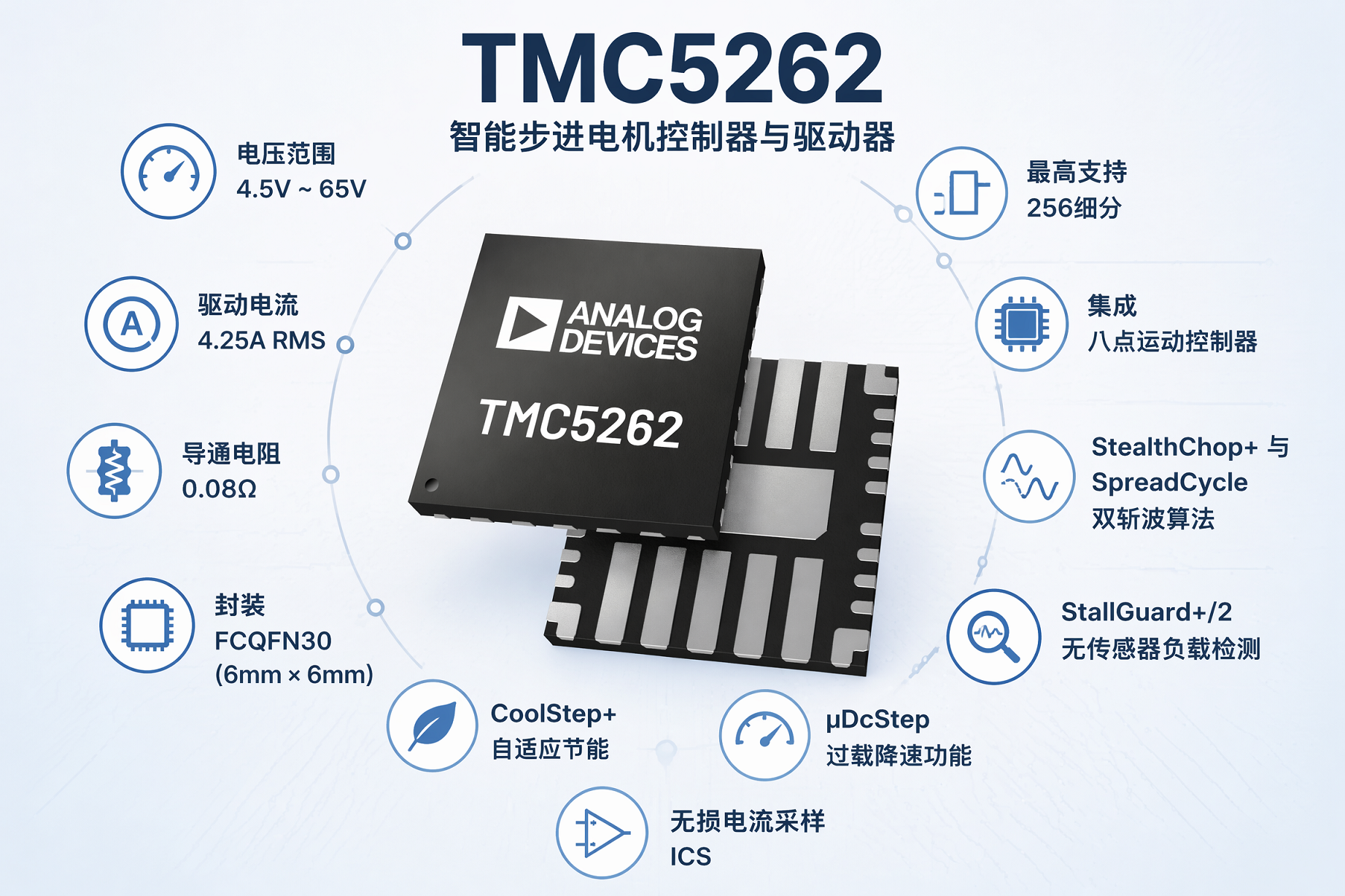
As a new-generation integrated drive-and-control stepper drive solution, the TMC5262 fills the positioning gap of previous-generation products—TMC5130 has high integration but limited drive capability (1.4A RMS), while TMC5160 has greater power but requires external MOSFETs. The TMC5262, by contrast, integrates two 65V/4.25A RMS (6A peak) fully integrated H-bridges, and can drive medium-torque stepper motors without external power transistors. At the same time, its 4.5V~65V wide-voltage input covers various scenarios from low-voltage batteries to high-voltage industrial buses, achieving a precise balance between integration and drive capability.

System block diagram
II. Eight-point ramp generator: core integrated drive-and-control capability
The eight-point ramp generator is the core mechanism through which the TMC5262 achieves integrated drive-and-control capability, and it is also the core added value that distinguishes it from pure driver chips. The term "eight-point" refers to three acceleration segments, one constant-velocity segment, three deceleration segments, and a jerk-suppression transition segment, which together form a complete S-shaped acceleration/deceleration profile.
In actual operation, the MCU only needs to write the target position through the SPI interface, and the chip's internal ramp generator autonomously completes the full motion plan: from startup acceleration and constant-velocity running to deceleration and stop, with no master involvement in pulse generation throughout the process. Between the acceleration and deceleration segments, the chip automatically inserts a jerk-suppressed smooth transition to avoid mechanical shock caused by abrupt acceleration changes. It stops automatically upon reaching the target position, and the target position can be changed online via SPI at any time during operation for real-time response.
In addition to trajectory planning, the TMC5262 also integrates positioning assistance functions. With reference switch (REFL/REFR) inputs and an incremental encoder interface, the chip can complete homing search and position verification at the hardware level. The entire process requires no MCU interrupt intervention, further freeing up host resources.
This mechanism completely frees the main controller from the burden of real-time pulse generation and moves it to the scheduling layer—only the target position needs to be issued, and one chip per axis can independently complete S-shaped acceleration/deceleration control. For systems with six or more axes, this means the MCU interrupt load drops sharply from "once per axis per step" to "once per axis per motion segment," greatly reducing the risk of pulse loss and making multi-axis motion synchronization easier to guarantee.
III. Highly integrated power stage: low-loss, strong drive in a small package
With autonomous trajectory planning capability in place, the next natural question is: how solid is the hardware foundation for driving the motor? As mentioned earlier, the TMC5262's power-stage design has already provided a clear answer; another highlight is how it truly implements "low loss":
Ultra-low on-resistance: the chip integrates power MOSFETs with a typical total high-side and low-side on-resistance of only 0.08Ω, far lower than the 0.9Ω of the TMC5130. Lower on-resistance means less conduction loss and heat generation; even under full-current drive, it can maintain a controllable temperature rise, supporting smaller thermal designs or even passive cooling in the system.
Lossless current sensing (ICS): the TMC5262 integrates lossless current detection technology and can perform current sampling without an external sense resistor. This saves PCB space, reduces BOM cost, and eliminates the power loss caused by the sense resistor; its advantages are particularly prominent in portable or battery-powered devices that are sensitive to energy efficiency.
In terms of packaging, the TMC5262 uses a 6 mm × 6 mm FCQFN30 package, which is further reduced compared with the TMC5130's 7 mm × 7 mm TQFP48 package, providing more design margin for space-constrained compact devices.

Package Pin View
IV. StealthChop+: From Limited-Range Quiet Operation to Low Noise Across the Full Speed Range
Hardware solves the question of 'whether it can drive,' while 'whether it drives smoothly and quietly' depends on the chopper and control algorithm.
The TMC5262 is equipped with Trinamic's new-generation quiet chopper algorithm—StealthChop+—which breaks through the limitation of StealthChop2, which can only cover quiet operation at low/medium speed, extends the quiet range to the high-speed segment, and switches to SpreadCycle dynamic mode only at extremely high speed when maximum torque output is required.
Compared with the quiet capability of StealthChop/StealthChop2, the most essential change in StealthChop+ lies in the control architecture: it upgrades from single-PI open loop to dual closed loops in parallel—a current PI loop and an angle PI loop. The current loop precisely stabilizes the coil waveform, while the angle loop corrects in real time the deviation between the current vector and rotor phase, specifically suppressing resonance that easily occurs in the medium-speed range of stepper motors. At the same time, automatic coil resistance measurement (R_COIL_AUTO) replaces the one-time learning scheme at power-up, continuously compensating for copper resistance temperature drift during operation, so current control remains stable across the full temperature range.
In addition, the chip integrates a Resonance Dampening function that uses an active algorithm to cancel mechanical resonance of the motor-load system within specific speed ranges. This function directly improves layer lines in 3D printers and the machined surface finish of desktop CNC equipment, while balancing quietness and smooth operation.
V. Intelligent Energy Efficiency and Full-Chain Protection Ensure Long-Term Operational Reliability
The TMC5262 is also fully equipped for energy-efficiency optimization and system protection.
CoolStep+ technology dynamically adjusts the operating current based on StallGuard+ feedback: it automatically reduces current at light load and quickly restores output at heavy load. Combined with ICS lossless sensing, it eliminates sense-resistor power consumption and achieves significant energy savings (up to 90%). The chip also supports µDcStep, which automatically reduces speed to gain higher torque and avoid step loss when the motor encounters a sudden overload, and automatically restores speed after the load recovers.
In terms of protection mechanisms, the chip is equipped with a full-chain protection system covering short-circuit protection, 150°C over-temperature shutdown, undervoltage lockout, and open-circuit detection; it also integrates on-chip temperature and voltage ADCs and an RT-OCSI real-time debugging interface, facilitating device debugging and status diagnosis and ensuring long-term stable operation of the system.
VI. Clear Scenario Adaptability and Controllable Upgrade Cost for Existing Systems
Thanks to its high integration and medium-power configuration, the TMC5262 can flexibly support NEMA 17, NEMA 23, and even NEMA 24 stepper motors.
For new projects, when the system has ≥3 axes and the motion profile requires smooth control, the TMC5262 is an excellent choice. Typical scenarios include desktop multi-axis CNC, multi-channel peristaltic pumps, automated sorting lines, multi-axis liquid handling workstations, etc.; one chip per axis enables independent S-curve acceleration/deceleration control.
For existing projects, if devices currently using the TMC5130 encounter issues such as insufficient noise control, current output that cannot meet requirements, or package size crowding PCB space, the TMC5262 is an upgrade path with manageable layout-modification cost—both share the cDriver architecture, and software adaptation effort is lower than switching platforms; if the existing solution runs stably and there is no urgent need to upgrade, the TMC5130 can also continue to be used.
Overall, the TMC5262 combines eight-point ramp motion control and an intelligent algorithm suite with a fully integrated medium-power stage, achieving a balance of performance, integration, and ease of use in a compact package. It fills the power gap of previous-generation integrated driver-controller products and provides a high-performance solution for multi-axis precision motion scenarios that demand operating quality and development efficiency, combining technical advancement with engineering practicality.

Sample request attached

WeChat Official Account