
Motion Trends Report: Electric Actuators Replace Other Motion Options
Today, electric actuators are easier to customize and install than ever before. Value-added services from component suppliers and application-specific actuator product lines eliminate many integration tasks for OEMs and end users. These trends are due in part to what Design World has tracked over the past few years—increasingly pre-integrated motion builds, with the fastest growth in compact motion designs intended to replace manually operated functions.
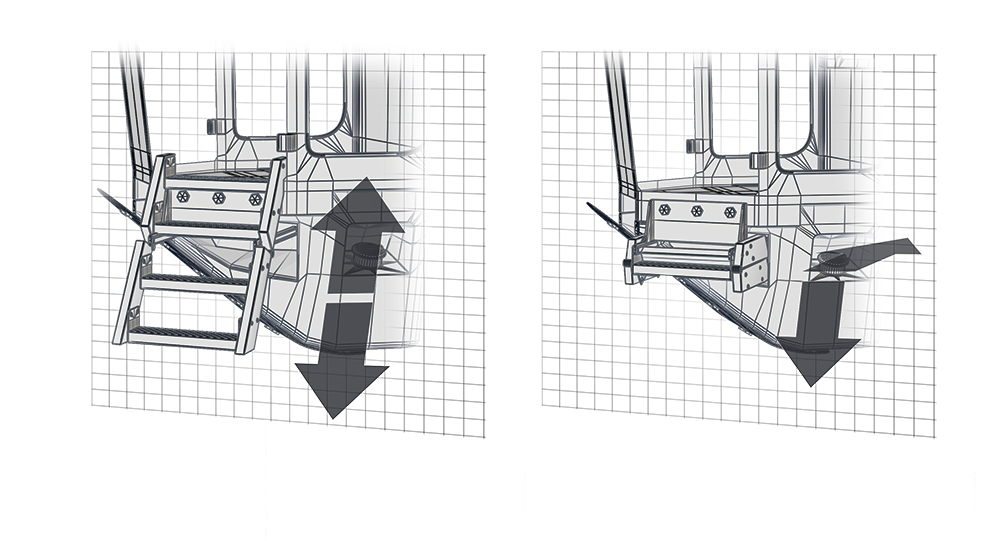
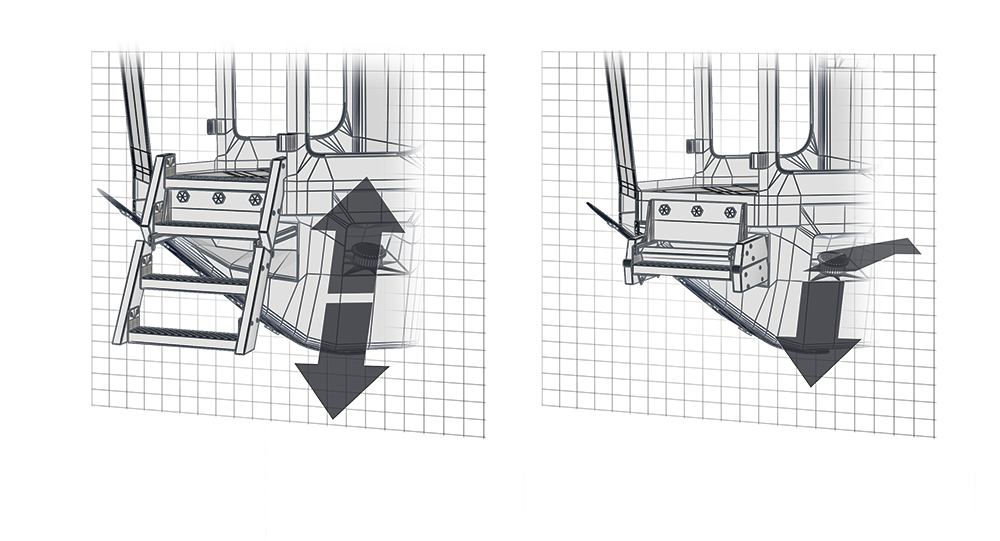
LINAK linear actuators power the retractable ladder for operator cabs on off-highway equipment, making it easier for workers to climb up (or down from the cab).

Jonas Proeger – Trinamic Marketing Director:
One major trend we are seeing is what some people call the Fourth Industrial Revolution. What follows are two important things:
- More and more aspects of human life are becoming automated… from large machines to small everyday tasks.
- The use of software-defined machines is growing exponentially. A perfect example is 3D printers: these machines can make anything for which appropriate software is provided. But it is not just 3D printers... In fact, software-defined machines also mean that new manufacturing plants are now aimed not just at one product... but accept reprogramming and even manufacture each part according to customer requirements—what the industry calls mass customization.
As products and machines become increasingly software-defined (the physics of the machine does not change at all), we believe that underlying functions (such as motor control and ramping) should be performed in proven building blocks that keep working reliably—even when the application software changes. What makes Trinamic products unique is how we divide the work with hardware—our designs handle motor control and software tasks—and our customers use these divisions to implement communication stacks and application code.
Others have seen the same trend,
Dave Humblet – Senior Application Engineer at PBC Linear:
Some recent applications show more OEMs incorporating actuators and other linear-motion designs into their machines. In one case, a linear actuator provides cab movement on a trencher for operator visibility. More specifically, the design uses PBC Linear CCR16 linear shafting and FLN16 standard linear bearings in the customer housing. Advantages here include availability, good load ratings, and rugged design.

The Tolomatic IMA linear servo actuator uses a hollow-core rotor design. Compared with standard actuators, this compact package can reduce the overall actuator length because it does not require a separate motor, motor mount, and gearbox.
Another major trend in electric actuators is their use to replace pneumatic devices.
Peter Zafiro - LinMot USA:
Most actuators in industry are pneumatic; even in non-automated factories, they are used in large numbers. This means there is still plenty of room for electric actuators... These motion components are becoming easier to use. This means we need to remind end customers of the cost of compressed air—even in the U.S., where we have very low electricity prices, you still have to consider noise... and maintenance... and the hassle of recurring repairs.
A factory manager has used our product for 18 months in exactly the same pneumatic application. The electric motor actuators we provide work better than pneumatic cylinders, thereby increasing productivity. When we introduced a high-efficiency compressor, it created a perfectly leak-free air delivery system to run his cylinder machine. Our electric actuator solution consumes only 3% of the electricity used by the pneumatic cylinders. He spends more than $5,000 per year to run the pneumatic cylinders… the ROI on the electrical replacement is less than one year.
Many factories that manufacture production parts have very low profit margins. Providing an additional $5,000 in profit each year—that is huge.
Another benefit of electric actuator technology compared with fluid power products is that it rarely requires maintenance and is programmable—it can fully leverage sensor data and load monitoring… sometimes in real time.
There are still many advanced capabilities in linear actuator mechanisms, some of which are also aimed at traditional fluid power products.
Aaron Dietrich - Tolomatic:
When replacing hydraulic cylinder technology, the growing demand for roller screws stems from requirements for greater force and smaller package size. Not only must the force be achieved, but the screw technology must also provide a very long life in demanding applications and be able to withstand machine vibration and other challenging environments.
Dave Beckstoffer – Product Manager • Portescap:
The ongoing trend in linear actuators is to reduce size while maintaining high force output. Portescap continues to develop new linear actuators that can increase linear force while maintaining the same outer diameter.
In addition, external linear actuator designs can offer additional options using different technologies—including brushed DC motors and gearboxes. Alternative technologies help reduce the diameter of the motor solution.
Stefan Vorndran•Physik Instrumente(PI):
We see that miniature actuators driven by linear motors are better suited for applications with limited space and power and high precision requirements. Linear motors are smaller and more efficient than conventional micro motors, and linear-motor actuators can hold position very stably without continuous power or mechanical brakes.
Regardless of the type of motor and mechanical actuator, pre-designed actuator assemblies are now common. OEM customization is sometimes useful because it may be necessary to move faster than standard products… or the software may need to meet specialized communication requirements.
Choosing among assembled components or integrating them in advance lets OEMs and end users control the time and effort they devote to motion design tasks… including tasks related to matching motors and drives and to application-specific customization. This type of design often results in smart actuators that include cables and connectors, potentiometers, encoders, controllers, relays, and embedded electronics for networking. If component suppliers or their distributors take on some actuator programming, OEMs and end users can get more support.
Dietrich - Tolomatic:
Integrating multiple technologies into a modular motion-control solution helps machine designers create more compact machine designs. For example, Tolomatic's IMA product line is an optimized solution with matched components. It integrates a mechanical actuator and a servo motor into a single actuator module.
With integrated actuator solutions, machine designers have only one mechanical design, independent of the servo-control supplier. This reduces the number of components and eliminates the need to mount the motor to the actuator. In addition, integrated actuator assemblies are optimized for performance, cost, size, and weight.
Patrick Wheeler - Product Manager • Aerotech:
Control technology is moving toward embedded solutions. This means that increasingly, the traditional PC is no longer the starting point. We are also seeing a trend toward more advanced programming languages than traditional IEC languages (such as ladder diagram and structured text). It is not that there is some global move away from IEC… but increased use of high-level programming is an emerging trend. In fact, we increasingly hear that customers are willing to accept new languages to get the job done… although they do want the languages to be familiar and to adhere to modern language structures.
How does increased linear actuator integration help OEMs?
Dan Schmidt | Product Manager • Tolomatic:
By simply replacing the motion module, integrated actuators let OEMs better support customers compared with troubleshooting components in conventional actuator–gearbox–belt systems. This also helps reduce the number of components purchased in machine designs (aligned with purchasing trends and best practices). In the food and beverage industry, the trend toward more compact solutions and open machine designs requires washdown-capable integrated actuators to improve cleaning convenience and machine reliability and to enable open, clean-in-place machine designs.
Sizing software and online purchasing tools continue to change the way linear actuators are designed—just as they have changed consumer buying habits.
For example, Bosch Rexroth's linear motion eTools (Linear Motion Designer, LinSelect and eConfigurators) help users obtain information and then select, purchase, supply, commission, start up, operate and maintain designs. For the latter, the manufacturer's ActiveCockpit data visualization tool allows real-time tracking of plant data.
Young engineers' preference for self-guided research helps drive this online purchasing and specification.Design engineering in emerging markets such as Eastern Europe and Central Asia is also strongly supported by online tools. Of course, critical mass in regional markets still supports traditional sales methods—especially when engineers want to work with knowledgeable supplier representatives who can visit in person.
Travis Gilmer – Product Line Specialist, Industrial Linear Actuators • Thomson Industries:
We recently expanded the Linear MOTIONEERING online sizing and selection tool with a linear actuator platform. Because various product family groups overlap, these products are often difficult to fit to new applications. This can lead to costly and time-consuming misapplication. So we simplified this process by creating a list of about 20 questions that can most accurately identify the right product for a specific application. The result is a more application-centric view of a broad range of feature options than a design engineer might find by searching on their own.
Design engineers can log in to our self-service sizing tool from their PC, phone, or tablet to make real-time adjustments, recalculate based on parameters they define, and download CAD-ready 3D models and 2D projections of the project to help integrate the customized product into their overall application and design. In addition, they can not only save project work and adjustment effort but also order linear actuators directly within the platform.