
For a long time, when selecting encoders, engineers have had to make a difficult trade-off between the high precision of optical encoders and the ruggedness of magnetic encoders. Optical encoders are like precise but delicate instruments—a speck of dust or a trace of oil is enough to make them lose accuracy; magnetic encoders, though rock-solid and durable, often lose their bearings in strong magnetic environments. In fields with high standards such as humanoid robots or collaborative robots, this divided situation has become a roadblock to technology implementation.
Magntek Microelectronics (now part of NOVOSENSE) has a deep understanding of this core contradiction and has launched the MT6901—a high-speed, high-precision angle encoder chip based on eddy current sensing technology. It is not merely a simple replacement for traditional solutions, but a systematic solution that integrates accuracy, reliability, and intelligence.
1. The Design Philosophy of Inductive Encoders
The MT6901 abandons the optical encoder’s dependence on an optical path and avoids the magnetic encoder’s sensitivity to background magnetic fields, choosing a more robust path:
- “Area-based” spatial sensing: Unlike point or line measurement, an inductive encoder uses an excitation coil to emit a high-frequency electromagnetic field toward a specially designed rotor, while a receive coil captures spatial magnetic-field variations modulated by the rotor position. This “face-to-face” interaction inherently provides strong common-mode noise suppression and is “immune” to point-source strong magnetic interference or distributed electromagnetic interference (EMI) in space.
- Fearless in harsh environments: It inherits the “iron body” of magnetic encoders—tolerance to high vibration and resistance to dust, oil, condensation, and even magnetic dust contamination. At the same time, its accuracy and repeatability are close to those of optical encoders, without the need for expensive and complex hermetic or labyrinth seals. This means the product is suitable for all scenarios, from cleanrooms to painting lines, and from outdoor mobile robots to industrial robotic arm joints.
- Structural liberation, design freedom: Another advantage of inductive encoders lies in their high flexibility. Their system consists of a PCB stator and a metal (or electrically conductive material) rotor, and the stator coils can be freely routed. This completely breaks the constraints of traditional magnetic and optical encoders, which are limited by fixed-size sensor ICs. It is particularly suited to modern mechatronic designs that strongly require hollow shafts, large apertures, and irregular structures, opening up entirely new physical implementation possibilities for robot joints, direct-drive motors, surgical instruments, and more.
II. Intelligent Core: Innovative Architecture and Exquisite Details
1. Three-Layer Inductive Technology and Double-Sided Acquisition: Accuracy '+', Interference '-'
The MT6901 adopts an innovative design with a three-layer PCB layout and dual-rotor sensing. It achieves double-sided signal acquisition through electromagnetic induction, fundamentally eliminating the limitation of single-sided sensing in traditional solutions, and forms an 'inner ring nested within an outer ring' sensing scheme, as if equipping position measurement with 'stereoscopic vision':
- Dynamic common-mode error cancellation: Differential processing of the double-sided signals can effectively eliminate common noise caused by temperature drift and power supply fluctuations.
- Resolving wiring interference: Cables in the hollow area are no longer an interference source, and the symmetrical magnetic field design can effectively avoid EMC issues.
- Improving signal quality and accuracy: Dual-channel data acquisition provides a richer and more reliable information source for subsequent digital processing, laying the hardware foundation for high-resolution angle calculation.
2. Fully Integrated Signal Chain: An Elegant Journey from Magnetic Field to Digital Bits
The MT6901 integrates a complete signal processing chain internally:
- Excitation and reception: The built-in oscillator drives the excitation coil to generate a stable high-frequency alternating magnetic field, and the 8-channel receiver front end captures changes in magnetic flux;
- Signal conditioning: The signal voltage generated by the receive coil is demodulated and then converted into a digital signal by a high-performance ADC before being sent to the DSP;
- Intelligent solving: A powerful DSP core performs compensation, calibration, angle calculation (fine/coarse), and vernier calculation to synthesize a high-precision absolute angle value;
- Multiple output interfaces: The calculation results are delivered to the system controller in real time and without error through the interface selected by the user;
- Auxiliary modules: Integrated modules include a low-dropout regulator (LDO), clock oscillator (OSC), reference power supply (REF), electrically erasable programmable read-only memory (EEPROM), and other modules.

Functional block diagram
3. Triple intelligent calibration system: pushing system accuracy to the extreme
Non-idealities in the individual components that make up the sensor introduce errors into the final angle output, and the MT6901 builds a triple-calibration "pyramid" to reduce the impact of non-ideal factors on the final output angle.
Tier 1: Simple customer-side self-calibration
No precision fixture is required. After installing the stator and rotor, continuously rotate several turns (non-uniform speed is acceptable) to automatically compensate for major nonlinear errors such as installation eccentricity and slight tilt. Trigger calibration by pulling the CAL_B pin low or by register operation. The calibration speed must match the coil pole pairs (for example, a 32-pole-pair fine coil plus a 5-pole-pair coarse coil requires a speed of 8–120 RPM or 375–4800 RPM), greatly simplifying on-site installation and commissioning. Typical linearity (INL) after calibration is ±0.1°.
Tier 2: Customer-side constant-speed self-calibration
The system runs at a stable speed with less than 3‰ fluctuation for more than 192 revolutions, and the chip deeply learns and compensates for periodic errors caused by machining and assembly. SPI configuration can adapt to different speed ranges (32–6000 RPM). Typical INL after calibration is ±0.02°, meeting the requirements of high-precision scenarios.
Tier 3: Nonlinear (NLC) calibration
NLC calibration consists of a 128-point lookup table, with each point recorded in the MT6901 EEPROM. By coupling with an ultra-high-precision reference encoder, comparison learning is performed at 128 equally spaced points, and the parameters are generated and written back to the MT6901 for calibration. Typical INL after calibration is <0.01°, suitable for cutting-edge precision control scenarios.
III. Flexible Interaction: Enabling Diverse System Designs
MT6901 provides a rich combination of output interfaces, ensuring seamless connection with both new and old systems:
(1) Incremental output (ABZ): programmable 1–16384 pulses/rev, or 65536 steps/rev; the Z signal width is programmable from 1–128 LSB or 45°–240°, perfectly compatible with traditional servo drives and PLC systems;
(2) Absolute position output:
- 4-wire SPI: outputs 21-bit absolute angle data, supports MODE=1 (CPOL=0, CPHA=1) timing, CRC verification ensures data reliability, and meets high-speed real-time requirements;
- UART: configurable 17-bit/23-bit resolution, baud rate supports 5 Mbps/4.0 Mbps, paired with an RS-485 driver chip to enhance anti-interference performance, enabling direct construction of a servo closed loop;
- Single-wire PWM: 12-bit resolution, frequency programmable from 125 Hz to 2 kHz, simple wiring, suitable for resource-constrained MCUs or redundant monitoring signals;
(3) Motor commutation signals (UVW): programmable support for 1–16 pole-pair brushless DC motors (BLDC), directly outputs ideal Hall commutation logic, simplifying motor drive design.
Core Parameter Table
| Parameter Category | Specification Details |
| Accuracy Specifications | Simple self-calibration INL ±0.1°, constant-speed self-calibration INL ±0.02°, NLC calibration INL <0.01°; hysteresis 0–0.176° programmable |
| Dynamic Performance | Maximum speed 12,000 RPM, system latency typically 10 μs, step response time typically 250 μs |
| Power Supply and Power Consumption | Supply voltage 3.0–5.5 V, operating current typically 33.8 mA; power-on preparation time typically 5 ms |
| Reliability Specifications | ESD protection: HBM ±4 kV, CDM ±1 kV; supports fault diagnosis for excitation coil open-circuit, signal amplitude out-of-range, and other faults |
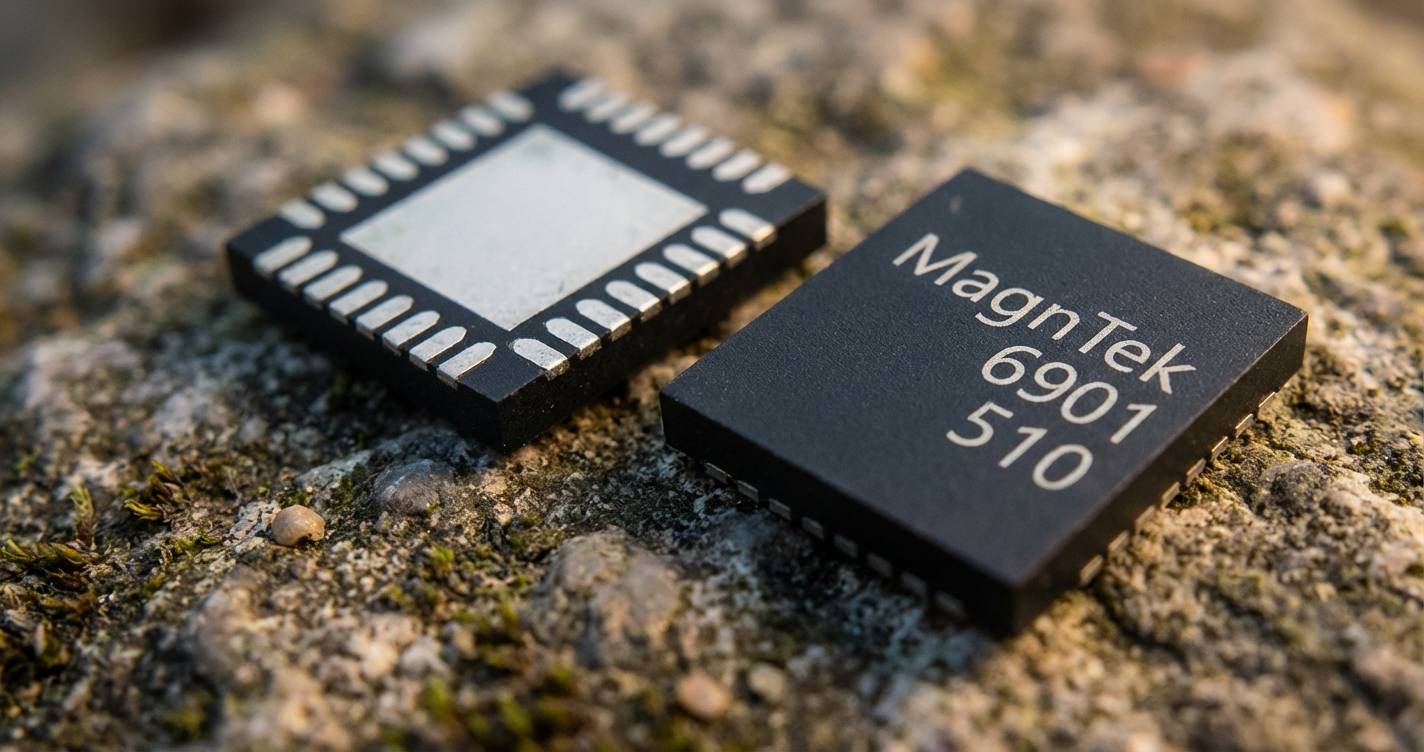
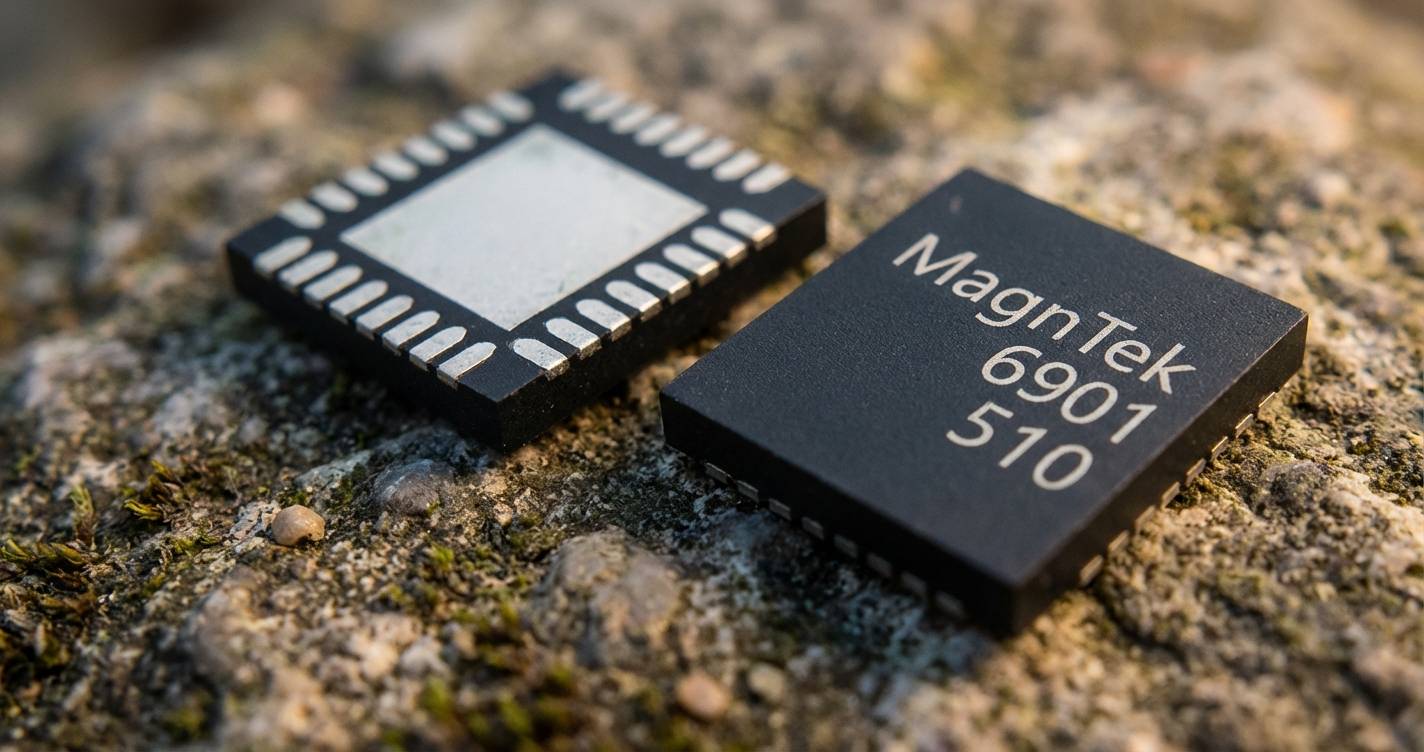
| Package and Operating Temperature | QFN 5×5 package; operates normally from -40°C to 125°C |

Package Appearance Diagram
IV. Application Scenarios
The MT6901 can be a preferred choice for new designs or as a replacement for traditional solutions in the following demanding scenarios:
- Humanoid robot and collaborative robot joints: high vibration resistance ensures stable readings during dynamic motion; the hollow structure facilitates internal routing; immunity to electromagnetic interference from the motor itself; and a high speed of 12,000 RPM supports rapid joint motion.
- High-end servo motors and direct-drive motors: 23-bit absolute accuracy meets precision positioning requirements; multiple ABZ/UVW interfaces simplify system architecture; high environmental robustness extends maintenance intervals; excellent adaptability for closed-loop stepper motor control scenarios.
- Automotive electric power steering (EPS) and steer-by-wire chassis: withstand automotive-grade temperature, vibration, and oil contamination environments; fault diagnosis improves driving safety.
- Industrial automation: high precision, high contamination resistance, and high electromagnetic interference immunity; suitable for harsh environments such as food and beverage machinery (washdown environments) and textile machinery (lint/fly-fluff environments).
- Medical and high-end equipment: can meet both the adaptation to irregular structures of surgical instruments and the high-precision requirements of precision instruments; the magnetic-interference-free design ensures equipment stability.
In addition, MT6901 can be used to design a linear DEMO: two schemes. Scheme 1 has the coil moving and the target plate stationary; Scheme 2 has the coil stationary and the target plate moving. For Scheme 1, the error range of the 3 cm stroke test remains around -0.005 mm to 0.005 mm, while the error range of the 10 cm stroke test remains between -0.01 mm and 0.02 mm.

V. Conclusion
MT6901 inductive encoder chip, with eddy current technology at its core, combines the high precision of optical encoders with the strong robustness of magnetic encoders. With three-layer intelligent calibration, flexible interfaces, and structural freedom, it breaks the traditional selection dilemma.
It not only measures angles precisely but also injects “spatial awareness intelligence” into core motion systems, helping secure precision, withstand environments, and drive into the future. For more information about MT6901 or to request samples, contact the official authorized distributor: sales@chiplinkstech.com (email); WeChat official account: Zhilian Micro - Motor Control Chips, which provides product selection services and technical support.

Sample request attached

WeChat Official Account